Archimedes' inventions: what he built and discovered
Archimedes is the name behind a water screw, a famous shout of "Eureka!" and a ray that set ships on fire. Some of those stories are solid history. Some are much less certain. This guide sorts Archimedes' inventions and discoveries by how sure historians are about each one, using World History Encyclopedia's article on Archimedes, so you know what you can repeat in an essay and what needs a warning.
Who Archimedes was
Archimedes lived from 287 to 212 BCE. He was born in Syracuse, a Greek city on Sicily, and lived there all his life apart from a spell of study in Alexandria in Egypt, where he became friends with the scholars Eratosthenes and Conon of Samos. Back home he worked for King Hiero II as an engineer and problem-solver. World History Encyclopedia calls him the greatest mathematician of the ancient world.
Almost nothing is known about his life beyond that. Much of what we "know" comes from writers who lived long after him, such as Plutarch, Livy and Vitruvius. That is why sorting the stories matters.
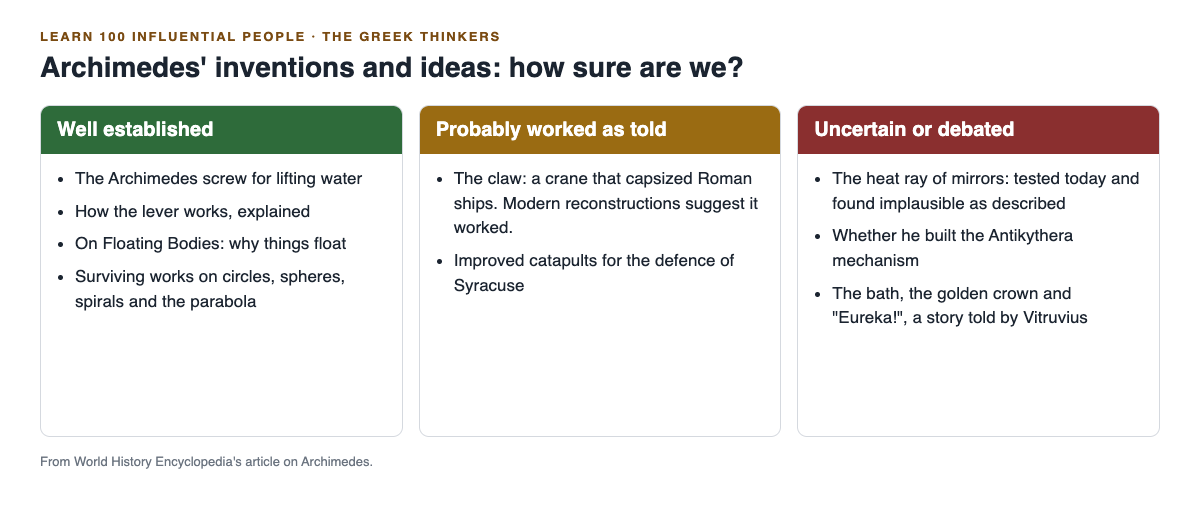
Archimedes' work, sorted by how sure we are.
Archimedes' inventions that are well established
- The Archimedes screw. A cylinder with a twisted blade inside. Put one end in water and turn the crank, and the water climbs up and out. The best-known story says he designed it to empty water from the hold of Hiero's giant ship, the Syracusia. The details of that story vary, but he is well established as the screw's inventor, and the same design is still used today.
- The lever, explained. He is often said to have invented the lever. World History Encyclopedia corrects this: what he did was explain how the lever works, which allowed more precise use of it.
- Floating bodies. In his book On Floating Bodies, which survives, he showed that a floating object displaces its own weight of the fluid it sits in. This is why he is called the father of hydrostatics, the science of fluids at rest.
His mathematical discoveries
Archimedes' fame rests above all on his mathematics, and much of it survives in his own words. His works include On the Sphere and Cylinder, Measurement of a Circle, On Spirals and Quadrature of the Parabola. World History Encyclopedia credits him with working out the value of pi as 3.14 and finding the area of a circle, among other results.
In The Sand-Reckoner he tried to work out how many grains of sand would fill the universe. To do that he needed a way to write very large numbers, and an idea of how big the universe was. The book also preserves the Sun-centred model of the astronomer Aristarchus of Samos.
One of his works has an amazing survival story. The Method was identified only in 1906, by the scholar Johan Heiberg. Its pages had been scraped and reused for a Christian liturgical text around 1229, but the old text could still be read underneath. Imaging work between 1999 and 2008 made it readable as a complete work.
Archimedes' war machines
During the Second Punic War, Syracuse switched sides from Rome to Carthage, and Rome attacked the city in 214 BCE. According to World History Encyclopedia, Archimedes' machines are said to have held off the Romans for two years.
- Improved catapults. He used his understanding of the lever to make existing catapults better.
- The claw of Archimedes. A crane with a hook that swung down on Roman ships, then capsized them or lifted them and dashed them against each other. The Roman historian Livy notes that Rome suffered heavy losses, and modern reconstructions suggest the claw probably worked as the ancient writers described.
When the city finally fell in 212 BCE, a Roman soldier who did not recognize Archimedes killed him, against the orders of the Roman general Marcellus. According to Plutarch, his last words were "Do not disturb my circles", about the diagrams he had drawn.
Uncertain or debated: the heat ray, the mechanism and "Eureka"
The heat ray. Several later writers say Archimedes burned Roman ships from a distance, some with mirrors, but none of them explains how. Some scholars question whether the device existed at all. Tests in modern times found it implausible as described, though it is unclear how accurate the old description was. World History Encyclopedia concludes that he seems to have made some invention that set ships on fire from afar, without saying what it was.
The Antikythera mechanism. This bronze device, found in 1901 off a Greek island, calculated the positions of the Sun, Moon and planets. Some modern scholars name Archimedes as its most likely inventor, because Cicero describes a similar device of his. Others point to the astronomer Hipparchus or someone else. The question is still open.
The bath and the crown. The best-known version comes from the Roman architect Vitruvius. King Hiero suspected a goldsmith of mixing cheaper metal into a gold crown. Archimedes noticed the water rise as he got into his bath, saw how to test the crown, and ran through the street shouting "Eureka!" ("I have found it!"). It is a great story, but notice that Archimedes' own On Floating Bodies never mentions the crown. Treat the details as a story told about him, not as his own account.
A worked way to sort any famous story
The method in this post works for any figure from the past. Take three famous stories about a person and, for each one, ask:
- Who first told it, and when? Archimedes' own book, or a writer born centuries later?
- Does the person's own work mention it? On Floating Bodies sets out the principle but not the crown.
- Has anyone tested it? The claw passed a modern test; the heat ray, as described, did not.
Then place each story in one of the three groups. This is a small exercise in historiography, the study of how history gets written, and the post on what historiography is explains the idea. For another scientist whose famous stories need the same care, see Galileo's discoveries.
Frequently asked questions
What did Archimedes invent?
He is well established as the inventor of the Archimedes screw for lifting water, and he improved catapults and built the claw, a ship-wrecking crane. He explained how the lever works rather than inventing it.
Is the Archimedes screw still used today?
Yes. World History Encyclopedia notes that the same mechanism is still used in a number of applications around the world.
Did Archimedes really have a heat ray?
Nobody knows. Ancient writers never explain how it worked, and modern tests found the mirror version implausible as described, though he may have made some device that set ships on fire.
What is Archimedes' principle?
A floating object displaces its own weight of the fluid it is in. He set it out in On Floating Bodies.
Get started
Archimedes is one of six people in The Greek Thinkers, a Basic course on Learn 100 Influential People, alongside Socrates, Plato, Aristotle, Euclid and Hippocrates. Basic courses cover the best-known names, with no background needed. Each lesson takes about 9 minutes and lists its sources, and the site's debate cards set out where researchers disagree, the same habit this post uses. You sign in with your email and an emailed code.
Comments
No comments yet.
Sign in or make an account to comment.