Are house cats related to tigers? Yes, and here is how
Are house cats related to tigers? Yes. Cats Protection, the UK cat charity, says domestic cats, lions, tigers and leopards all belong to the same animal family, Felidae. They split into different species millions of years ago, but still share many physical features, behaviours and hunting instincts. This guide sets out how the family tree branches, what the often-quoted DNA figure really says, the traits your cat shares with a tiger, and the one big thing it cannot do.
Everything here comes from Cats Protection's guide "How are domestic cats related to lions, tigers and other big cats?", opened for this article.
Are house cats related to tigers? The family tree
The cat family, Felidae, takes in every cat from the tiny black-footed cat to the tiger. Inside it, Cats Protection describes two branches that matter here.
- The Panthera line. The oldest cat lineage, which split from its common ancestor around 10.8 million years ago. Today's big cats evolved from it, and tigers were among the earliest members to evolve. Tigers now live in a wide range of places, from the freezing forests of Siberia to the hot, humid swamps of the Sundarbans.
- The Felis genus. The family kept branching until around 3.4 million years ago, when this group appeared. It includes the European wildcat, the jungle cat and our own domestic cats.
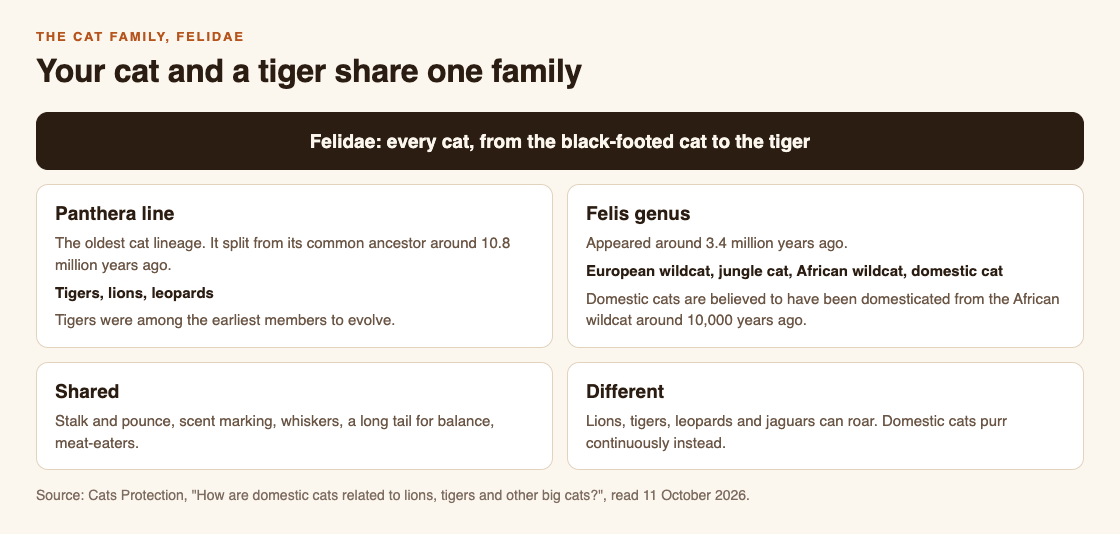
How your cat and a tiger fit into one family, from Cats Protection's guide.
So your cat is not a small tiger. It is a close cousin of wildcats and a distant cousin of tigers, with a shared ancestor far back in time.
Your cat's closest relative
Cats Protection says domestic cats are most closely related to the African wildcat, from which they are believed to have been domesticated around 10,000 years ago. Because the two share such a recent common ancestry, they have many of the same behaviours, including hunting instincts and a preference for being alone.
Domestic cats are also closely related to the European wildcat, which is why the two can interbreed and have kittens.
The 95 percent DNA figure
You may have heard that a cat is "95 percent tiger". Cats Protection says domestic cats and tigers shared a common ancestor more than 10 million years ago and share more than 95 percent of their DNA. It adds a fair caveat: the exact figure varies between studies, but scientists agree the two are genetically very similar.
Read it as "very similar", not as an exact number. The charity says this shared ancestry helps explain why both stalk, pounce, scent mark and groom.
Eight things your cat shares with a tiger
Cats Protection lists eight similarities. Here they are in short.
- Body shape. Sizes differ hugely, since a tiger can weigh up to 300kg and the average house cat around 4 to 5kg. Yet both have strong, supple bodies, a long tail for balance, and sharp teeth and retractable claws built for hunting.
- Meat-eaters. Both are obligate carnivores, meaning they need meat. Without it, the charity says, cats can go short of nutrients such as taurine and vitamin A.
- Scent marking. Both mark territory by spraying urine, rubbing the scent markers on their face against objects, and scratching.
- Living alone. Lions are the only members of the family that regularly live in groups, called prides. Most wild cats are largely solitary, and many house cats prefer their own space too.
- Boxes. Zoo enrichment has shown that tigers love a good cardboard box as much as house cats do. Our guide on why cats love boxes covers the house cat side.
- Whiskers. Whiskers pick up tiny changes in air currents, helping any cat judge narrow spaces, avoid obstacles and find prey in low light.
- Stalk and pounce. Lions, tigers and leopards move low and quietly, then launch a powerful pounce. House cats use the same sequence on a feather wand, a toy mouse or a leaf, often with a wiggle before the pounce.
- Tails. All cats use the tail as a counterbalance when climbing, jumping and turning fast.
The big difference: roar or purr
Not every cat can both purr and roar. Cats Protection says the roar comes down to the voice box, or larynx: lions, tigers, leopards and jaguars have the special anatomy needed to roar, while a house cat's larynx is built for purring.
Big cats do make purr-like sounds. Lions and tigers can make one, but only when breathing out, and it is not the continuous purr of a house cat. Leopards chuff, growl and make purr-like sounds without a true continuous purr. Smaller wild cats, such as cheetahs, bobcats and lynxes, cannot roar but can purr much like a pet cat. Our guide on why cats purr explains what a house cat's purr can mean.
The upright tail is only for house cats
One more difference. The charity says domestic cats are the only cats that regularly walk with their tails held upright as a friendly greeting to people and other cats. Big cats usually carry their tails level or lower as they walk.
Spot the tiger in your own cat: a worked example
Next time your cat plays, watch for three of the shared traits from the list above. It takes five minutes.
- The stalk. Move a feather toy slowly along the floor. Watch your cat drop low and creep forward before it springs, the same sequence a tiger uses.
- The tail. When it jumps onto a shelf or turns sharply, watch the tail swing out to keep balance.
- The greeting. When it walks up to you afterwards, look for the upright tail, the one sign Cats Protection says big cats do not regularly show.
If you see all three, you have watched two sides of your cat at once: the hunter it shares with tigers, and the friendly house cat that is all its own.
Meeting cats on a walk, and Cat Go
Outside, the same traits are easy to see from a polite distance: a cat stalking a leaf, or one walking towards its home with its tail up. Cat Go is a game that plays in your web browser, made for walks like these: "Walk anywhere, photograph a real cat, lure it with food and catch it. Every catch keeps its breed and where you found it."
A catch starts with a photo. Then the game asks "Which breed is it?", and you pick from a list. Its own tip: "Mixed breed is always a safe pick." The kibble and tuna you toss are food inside the game, never real food, and each catch goes into your Catdex.
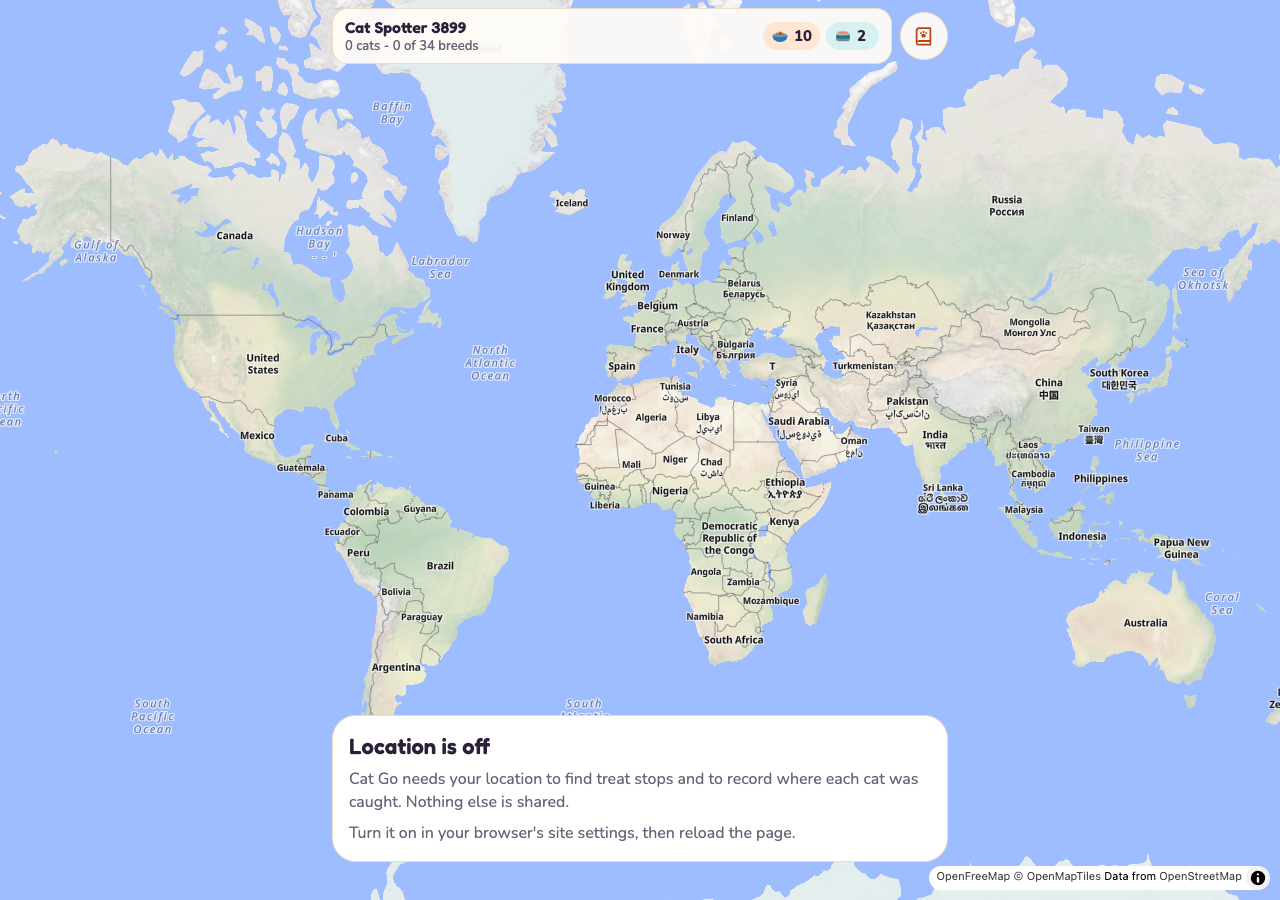
Cat Go's map, where each catch is recorded with the place you found the cat.
Frequently asked questions
Are cats 95 percent tiger?
Cats Protection says house cats and tigers share more than 95 percent of their DNA, though the exact figure varies between studies. Scientists agree the two are genetically very similar.
What is the closest wild relative of a house cat?
The African wildcat. Cats Protection says house cats are believed to have been domesticated from it around 10,000 years ago.
Which cat breed is closest to a lion?
None, according to the charity. Some breeds look a little like lions, such as the large, shaggy Maine Coon or the Norwegian Forest Cat with its thick ruff, but all house cat breeds are one species, Felis catus.
Can house cats roar?
No. Cats Protection says house cats have a larynx adapted for purring and lack the structures needed to roar.
Get started
Next time you meet a cat on a walk, look for the tiger in it, then take a calm photo. Open Cat Go in your browser, allow location and the camera, and start your Catdex with the cats you meet.
Comments
No comments yet.
Sign in or make an account to comment.