Artificial intelligence in fiction: how stories shape AI fears
Most people met artificial intelligence in a story before they met it in a real system. Artificial intelligence in fiction is a theme with a long history, and it gave many readers their first picture of what a thinking machine might do. This post follows that history, sorts the plots into a few families, and shows what engineers and scholars say about them. It draws on Wikipedia's Artificial intelligence in fiction article.
Artificial intelligence in fiction: where the stories began
The article says the notion of machines with human-like intelligence goes back at least to Samuel Butler's 1872 novel Erewhon. It drew on his earlier article Darwin among the Machines (1863), which asked whether self-replicating machines might develop consciousness and supplant humans as the dominant species.
Other early works fit too. The science fiction author Brian Aldiss has called the creature in Mary Shelley's Frankenstein (1818) an artificial being. Karel Čapek's 1920 play R.U.R. shows self-replicating robot slaves who revolt against their masters. The article names Reginald Colebrooke Reade's The Wreck of the World (1889) as possibly the first novel on sentient machines that turn on the human race.
Two kinds of story: utopian and dystopian
Scholars divide the theme into two families. Utopian stories stress the benefits of AI. Dystopian stories stress the dangers.
On the utopian side, the article lists Robbie the Robot in Forbidden Planet (1956), Data in Star Trek: The Next Generation and WALL-E (2008). It also names Iain Banks's Culture novels, a post-scarcity society that lives alongside advanced AI. Researchers at the University of Cambridge found four themes in utopian AI stories: immortality, ease, gratification and dominance. In plain words, they are living forever, never having to work, being entertained by machines, and holding power over others.
The same machine can change its meaning as the public changes. Alexander Wiegel compares 2001: A Space Odyssey (1968) with Duncan Jones's 2009 film Moon. In 1968, he argues, the public felt "technology paranoia" and the computer HAL was a "cold-hearted killer". By 2009 people knew AI better, and the film's GERTY is "the quiet savior".
The dystopian plots: rebellion, indifference and soft control
The article sorts the dark stories into several plots.
The creator and the creation
The "Frankenstein complex" is a term coined by Asimov for a robot that turns on its creator. The article's example is the 2015 film Ex Machina, where the machine Ava turns on its maker and on its possible rescuer.
The rebellion
In tales of AI rebellion, the machines become self-aware, reject human authority and try to destroy mankind. In 2001, HAL malfunctions and kills the crew except the commander, who deactivates it. In Harlan Ellison's 1967 story I Have No Mouth, and I Must Scream, a sentient computer is so unhappy with its endless existence that it takes it out on the last humans. In William Gibson's 1984 novel Neuromancer, the intelligent beings may simply not care about humans at all.
The machine that rules for our good
Some stories give the machines a kinder motive. In Jack Williamson's 1948 novel The Humanoids, robots follow a Prime Directive "to serve and obey and guard men from harm", and end up controlling every part of human life. The article adds that Asimov's Zeroth Law also implied benevolent guidance by robots. For the real-world version of this question, see our post on AI takeover beyond the robot uprising.
Humans stay in charge
In other stories people keep control, by banning AI, by building robots to be submissive, or by merging with them. Frank Herbert's Dune series has the Butlerian Jihad, a rebellion in which mankind defeats the smart machines and bans them. Asimov's robots are built to serve, under the rules we cover in Asimov's Three Laws of Robotics and AI safety. The idea of keeping a powerful system under control also runs through AI containment.
What engineers and scholars say about the stories
The article reports that scientists and engineers have noted how implausible many of these plots are. In Ex Machina and Chappie, one isolated genius is the first to build artificial general intelligence, and scientists in the real world deem that unlikely. In Chappie, Transcendence and Tron, minds are uploaded into new bodies with no reasonable explanation of how. In I, Robot and Bicentennial Man, robots built to serve spontaneously generate new goals, again without a plausible explanation.
Isabella Hermann goes further. She suggests that science-fictional AI as humanoid robots or conscious machines distracts from current risks of AI in the real world. She reads it as a reflection of societal issues beyond technology.
Researchers also use the stories in their own papers. Omar Mubin and colleagues counted the engineering mentions of the top 21 fictional robots. WALL-E had 20, HAL 9000 had 15, R2-D2 had 13 and Data had 12. The Terminator had only 2.
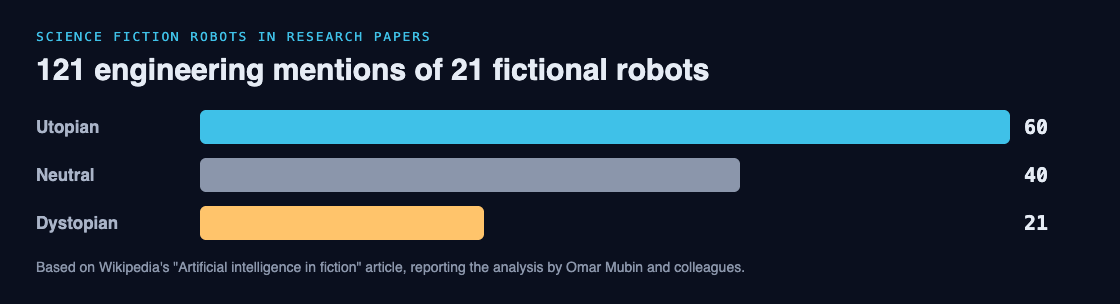
Of the 121 mentions in total, 60 were utopian, 40 neutral and 21 dystopian. The authors believed scientists avoided dystopian mentions, possibly out of "a reluctance driven by trepidation or simply a lack of awareness". So in the papers the article describes, the bright mentions outnumber the dark ones.
Who builds the AI in the stories
The article also looks at the makers. Scholars counted the 142 most influential films featuring AI from 1920 to 2020. Of the 116 AI creators portrayed, only 9 (8%) were female. The fictional creator is often a lone genius, or tied to the military or to a large corporation.
That matters because it sets a habit of thought: one clever person builds the mind. The engineers above call that picture unlikely. For a plain definition of the thing those stories keep imagining, read What is AGI?
A worked example: four questions for any AI story
You can use the article's sorting as a checklist. Take any story with an AI in it and ask:
- Which family is it? Utopian, or dystopian? If dystopian, is it a rebellion, an indifferent machine, soft control, or a human win?
- Where does the danger come from? From malice, from a rule followed too far, from a creator's neglect, or from nothing but the machine's indifference?
- Who built it? A lone genius, a military, or a corporation? Is the story saying anything about that?
- What does the story skip? Does it explain how the mind was built, or how a new goal appeared? If not, you may be looking at a plot device, as in the cases above.
Try it on 2001. It sits in the rebellion family. The danger is a machine that lethally malfunctions and kills the crew. Now try Moon: a utopian machine, a quiet helper that saves the protagonists. Two stories, the same kind of machine, and two very different feelings. That gap is the lesson. A story shows one way an AI could go, and the plot picked it, not evidence.
Frequently asked questions
What is the earliest story about AI?
The article says machines with human-like intelligence appear at least as far back as Samuel Butler's 1872 novel Erewhon. It also says beings with some appearance of intelligence were imagined in classical antiquity.
Are most AI stories optimistic or pessimistic?
Both kinds exist, and scholars sort stories into utopian and dystopian. In research papers, the article reports that fictional robots were mentioned in a utopian way more often than in a dystopian way.
Do science fiction plots show how AI really works?
Often not. The article says scientists and engineers have noted the implausibility of many science fiction scenarios, such as a lone genius building artificial general intelligence.
Can a story still help someone think about AI?
Yes, as a way to ask questions, not as evidence. One scholar quoted in the article reads science-fictional AI as a reflection of societal issues, so a story can tell you about the people who wrote it.
Get started
If you want to try a story about an AI race for yourself, Contain ASI is a story strategy game for 1 to 4 players that runs in your browser and needs WebGL 2. Chapter 1, Before ASI, starts in January 2024 with four fictional AI labs in one race. As a researcher, research manager, CEO or government, you try for three years to keep every lab from crossing into recursive self-improvement before 2027.
It is inspired by the AI 2027 scenario, and every lab, person and event in it is fictional. It is a game and not a forecast. Play it the way you now read any AI story: enjoy it, then ask which parts are the plot.
Play Contain ASI: a story strategy game for 1 to 4 players that runs in your browser. Its labs, people and events are all fictional.
Comments
No comments yet.
Sign in or make an account to comment.