Augustine's Confessions: what it says and why it matters
Augustine's Confessions is often called the first autobiography, but that is not quite right. It is a book about a life that keeps stopping to ask hard questions: about doubt, about the self, about time. This guide covers who Augustine was, the story the book tells, the ideas it is famous for, and why readers still argue about it. Everything here comes from the Stanford Encyclopedia of Philosophy's entry on Augustine.
Who Augustine was
Aurelius Augustinus lived from 13 November 354 to 28 August 430. He was born in Thagaste in Roman Africa, today Souk Ahras in Algeria, to a devout Christian mother, Monnica. He studied rhetoric, the art of persuasive speaking, and rose to a paid post as professor of rhetoric in Milan, then the capital of the western Roman Empire.
After his conversion he went home to Africa, was made a priest at Hippo Regius in 391, and became its bishop around 396. He wrote a great deal, much of it in arguments with rival groups. The entry notes he is often listed as the first medieval philosopher.
The story Augustine's Confessions tells
The Confessions, written around 396 to 400, follows his path to Christianity. The Stanford entry gives the main steps, several of which Augustine reports in the book himself:
- Philosophy at eighteen. Reading Cicero's dialogue Hortensius, now lost, set him on fire for philosophy.
- Nine years as a Manichean. From about 373 he followed Manicheism, a religion with Persian roots that saw the world as a struggle of two powers. His mother strongly opposed it.
- Milan. In 383 he moved to Milan. There Bishop Ambrose and a circle of Christians influenced by Platonist philosophy showed him a Christianity that, to him, made more intellectual sense.
- Crisis and conversion. A period of doubt, which the book presents as something like an illness, ended in the summer of 386. He gave up his career and turned to an ascetic Christian life. The "books of the Platonists" and the letters of Paul helped bring this about.
- Baptism. Ambrose baptised him at Easter 387. His mother died at Ostia on the journey home in 388.
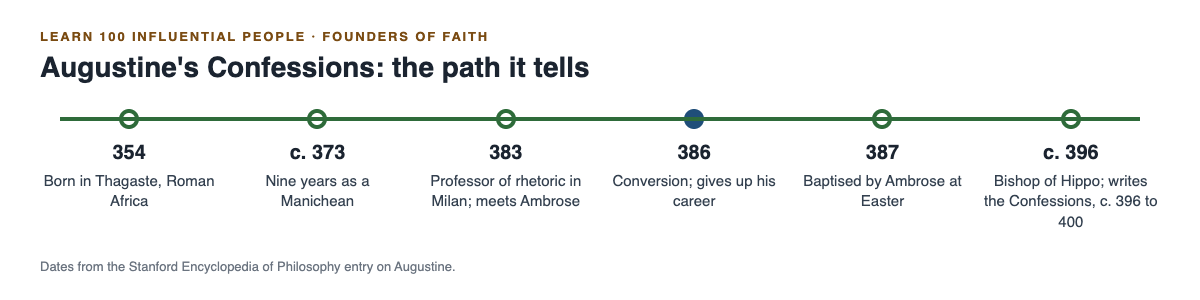
Augustine's path, with the dates the Stanford entry gives.
What kind of book it is
The Stanford entry calls the Confessions "probably his most original work" and, quoting the scholar Mann, "philosophy in autobiography" rather than an autobiography in the modern sense. It shows how one life, Augustine's own, is made sense of by God's providence and grace.
The entry also says the book is "unique in the ancient literary tradition but greatly influenced the modern tradition of autobiography". That is the honest version of the "first autobiography" claim: nothing in ancient writing was quite like it, and much later writing about the self follows it.
The book also does not end with his conversion. Its last three books, 11 to 13, turn to the opening chapters of Genesis; the entry counts them as one of five commentaries on Genesis Augustine wrote. So the Confessions moves from one man's memories of his own past to the beginning of the world itself, and to the question of what time is.
Three ideas the Confessions is known for
1. Doubt. After leaving the Manicheans and before he could accept Christianity, Augustine says he decided to "withhold assent until some certainty lighted up". The entry links this to his later arguments against the ancient sceptics.
2. Looking inward to find God. A Platonist idea runs through the book: you reach the highest truth by turning inward, from bodies to the soul, and then upward. The entry describes God, in Augustine's words, as "more internal to us than our innermost self". Whether the short accounts of such ascents in the book describe mystical experiences is, the entry says, "difficult to determine".
3. Time. In Book 11 Augustine asks what time is. Augustine's example is repeating a poem you know by heart: the words pass from expectation (the future) through attention (the present) into memory (the past). He calls this state "a distention of the soul", a stretching of the mind across past, present and future, and the entry says this is the closest Book 11 comes to a definition of time.
Why it still divides readers
The Confessions already voices a belief Augustine later defended hard: that people depend completely on God's grace to do good. That view, and his ideas on sin, freedom and sexuality, shaped Western culture deeply. The entry is clear that they are contested. They "provoked however fierce criticism in Augustine's lifetime" and have "been vigorously opposed in the twentieth and twenty-first centuries from various (e.g., humanist, liberal, feminist) standpoints".
At the same time, the entry says philosophers "keep however being fascinated" by his ideas on language, knowledge, the will, freedom and the mind, and by a way of doing philosophy it calls "surprisingly undogmatic and marked by a spirit of relentless inquiry". Read the book knowing both views exist.
A worked example: read Book 11 in one sitting
Book 11, on time, is a good place to start. Try this plan:
- Before you start, write one sentence answering "What is time?" in your own words.
- While you read, mark every place Augustine uses memory, attention or expectation.
- After you finish, say a short poem you know by heart, slowly, and notice which words are already in memory and which are still in expectation.
- Last, compare your first sentence with "a distention of the soul". What did Augustine notice that you did not?
If you are writing about the Confessions, remember it is a primary source for what Augustine believed about his own life, written years after the events. Our guide to primary vs secondary sources in history explains why that matters.
Frequently asked questions
When did Augustine write the Confessions?
Around 396 to 400, soon after he became bishop of Hippo, about ten years after his conversion in 386.
Is the Confessions the first autobiography?
Not in the modern sense. The Stanford entry calls it "philosophy in autobiography", unique in ancient writing, and a strong influence on the later tradition of autobiography.
What does Augustine say about time?
In Book 11 he describes time through memory, attention and expectation, and calls this state "a distention of the soul".
Why did Augustine leave Manicheism?
In Milan, Ambrose and Christians influenced by Platonism gave him an understanding of Christianity that he found intellectually more satisfying, and he had already begun to distance himself from the Manicheans.
Get started
Augustine is in Founders of Faith, a Basic course on Learn 100 Influential People, where he shares a lesson with Jesus and Paul. Lessons take about 9 minutes, and 38 cards set out where researchers disagree. Every lesson lists its sources, as the about page says, "so you can read the original work". You sign in with your email and an emailed sign-in code.
Comments
No comments yet.
Sign in or make an account to comment.