Augustus and the Roman Empire: How He Ended the Republic
Augustus and the Roman Empire are almost the same story, because the empire began with him. Born Gaius Octavius in 63 BCE, he was the adopted heir of Julius Caesar, and by his death in 14 CE he had ended the chaos that followed Caesar's death and made himself the sole ruler of Rome without ever calling himself a king. This post sets out how he did it, what he built and what it cost, using two World History Encyclopedia articles: Augustus and Pax Romana.
If you would rather learn this as a short lesson, Learn 100 Influential People puts Augustus in its Empire Builders course next to Cyrus, Alexander, Caesar, Constantine, Qin Shi Huang and Genghis Khan, in lessons of about 9 minutes with questions that check what you remember.
Who was Augustus?
The man history calls Augustus went by several names. The encyclopedia says he was born Gaius Octavius Thurinus on 23 September 63 BCE and was adopted by his great-uncle Julius Caesar in 44 BCE, when he took the name Gaius Julius Caesar. In 27 BCE the Senate gave him the honorific Augustus, "the illustrious one".
Writers use his names as labels for stages of his life: Octavius for 63 to 44 BCE, Octavian for 44 to 27 BCE and Augustus from 27 BCE to his death. The article adds a warning. Between 44 and 27 BCE he never used the name Octavian himself. He carried Caesar's name instead, which led Mark Antony to say, as Cicero recorded it, "You, boy, owe everything to your name."
From Caesar's heir to ruler of Rome
After Caesar's assassination in March 44 BCE, Octavian joined Caesar's friend Mark Antony. With another Caesar supporter, Lepidus, they formed the Second Triumvirate in October 43 BCE. The encyclopedia says their first task was the systematic killing of rivals and supporters of Caesar's killers, and that ancient and modern writers disagree about which of the three was most to blame. In October 42 BCE their forces beat Brutus and Cassius at Philippi, and both assassins killed themselves.
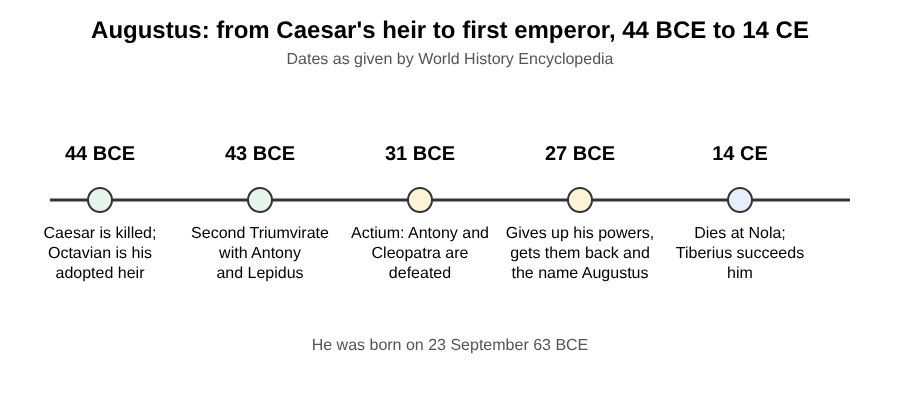
The partnership then fell apart. Lepidus tried to order Octavian out of Sicily, but Octavian offered Lepidus' soldiers more money than Lepidus could pay, and they changed sides. Lepidus kept only the title of Pontifex Maximus. Antony, meanwhile, had joined himself to Cleopatra VII of Egypt. Octavian had Antony's will read to the Senate, and the Senate declared war on Cleopatra. At Actium on 2 September 31 BCE his forces under Marcus Agrippa defeated the two, and by 1 August 30 BCE, after the fall of Alexandria, both were dead. Octavian had Caesar's son by Cleopatra, Caesarion, strangled, saying "two Caesars are one too many", and had Antony's eldest son executed.
How he ended the Republic without saying so
This is the part historians find most interesting. The article says that to avoid Caesar's mistake of seeming to covet power, Octavian presented every move as being for the good of the Roman Republic. In January 27 BCE he gave up his powers, and a grateful Senate gave them back along with the title Augustus. He never used that title for himself in public. He called himself Princeps, "First Citizen".
The encyclopedia's author says he played the game so carefully that his claims to be restoring the Republic "seemed in earnest", even as he gained absolute control. The Pax Romana article spells out the machinery. The Senate granted him and his successors imperium maius, extreme authority over provincial governors, and the powers of a tribune, including the right to call the people's assembly to enact laws and to veto magistrates. He also controlled imperial patronage. The Senate stayed on as an advisory body, he reduced its size, and the popular assemblies became obsolete because, in the article's words, "Augustus was the law".
Augustus and the Roman Empire: what he built
The same article lists the structures that held the new order together:
- A professional army. He commanded 23 legions, paid in money and land, each soldier swearing an oath to the emperor. He also created the Praetorian Guard as his own bodyguard.
- Taxes. He ordered a census of resources across the provinces and among citizens as a framework for assessment, and centralized the treasury on the Capitol.
- Roads and trade. The article credits over fifty thousand miles of new roads and says the seas were cleared of pirates.
- The city. In Rome he provided protection against fire, famine and flood, supervised the grain supply, water and roads, and enlarged the police force.
- Buildings and the arts. His own inscription, the Res Gestae, claims he restored or built 82 temples in one year, and the poet Virgil composed the Aeneid in his reign.
He also tried to steer private life. The Augustus article says his laws made adultery illegal, gave tax breaks to families with more than three children and penalised childless marriages. He is reported to have applied them to his own family, banishing his daughter Julia and a granddaughter for adultery.
The price of the Augustan peace
The encyclopedia calls his era "a golden age in every respect", but the Pax Romana article is blunter about the cost. It says the peace "would come at a steep price". Augustus chose to add territory by conquest, especially to the west and along the Rhine, and the provinces had to swear allegiance to Rome. Slaves and freedmen who worked the land were excluded from any political life.
The article also quotes the Roman historian Tacitus, who recorded the words of the Briton leader Calgacus: "Robbery, butchery, rapine, the liars call Empire; they create desolation and call it peace." The words are about the conquest of Britain, which the article places after Augustus, so they show what the same system meant to those who resisted it, not what happened in his own lifetime.
Restorer of the Republic or first emperor?
The sources in this post lean towards admiration. They call him the first and "by most accounts, greatest" Roman emperor, and the article on his peace says he "stabilized the economy, and brought a sense of peace". Set that beside what the same articles describe: killings by the triumvirate, the strangling of Caesarion, an army sworn to one man, and a Senate that served only as an advisory body.
So there are two fair ways to read him. In one, he rescued Rome from the disorder that followed Caesar's death and kept the forms of the Republic alive. In the other, the forms were a cover for one-man rule. The encyclopedia gives evidence for both, and the choice between them is yours to argue from the facts.
A worked example: read his titles as evidence
You can test the two readings with something the sources give: the names and titles he accepted. Take them in order and ask what each one claims.
- Gaius Julius Caesar. He took Caesar's name in 44 BCE. It claimed Caesar's loyalty and support, which is why Antony sneered at it.
- Augustus (27 BCE). An honorific, "the illustrious one". It sounds like an honour, not an office.
- Princeps. "First Citizen". It was the title he used for himself, and it sounds like a citizen among citizens.
- Imperator. Commander-in-chief. It is the root of "emperor", and it tells you where his power came from.
- Pater Patriae (by 2 BCE). "Father of his country". It is the language of a household head, not a magistrate.
Read the list and sort each title as "Republican" or "monarchical". You will find the soft titles used in public and the hard powers, such as imperium maius, sitting underneath. That mix is the evidence for the argument above.
Frequently asked questions
Was Augustus the first Roman emperor?
The encyclopedia calls him the first and, by most accounts, greatest Roman emperor. He never used the title for himself in public, preferring Princeps.
What is the difference between Octavian and Augustus?
They are the same man. Writers say Octavian for events between 44 and 27 BCE and Augustus for events from 27 BCE, when the Senate gave him that title.
What was the Pax Romana?
It was the long period of relative peace and stability across the empire that began with Augustus. The article ties it to his reforms and warns that it came at a cost.
How did Augustus die?
He died at Nola in 14 CE and was succeeded by Tiberius, whom he had adopted ten years earlier. The article gives two versions of his last words.
Get started
If you want more than a summary, Augustus sits in the Empire Builders course, one of 15 courses made of short lessons. You read, study the diagrams, try a hands-on activity and answer questions. Every lesson lists its sources, and cards set out where researchers disagree, which matters for a ruler whose reputation is still argued over.
You sign in with your email and an emailed sign-in code. It is a web app, so you can open it in a browser.
Start Learn 100 Influential People: short hands-on lessons on the people who shaped history, with every side of the debate and the sources to read next.
100 people who shaped history, from Moses to the web.
Visit influentialpeople.vlvd.net↗

Comments
No comments yet.
Sign in or make an account to comment.