Benchmark Contamination in AI Evaluations Explained
Benchmark contamination in AI evaluations means a model has already seen the test, or something close to it, before you give it the test. The score then measures memory, not the skill you wanted to measure. This post covers how it happens, how researchers look for it, and why it matters when people use evaluation results to judge whether an AI system is safe.
What benchmark contamination in AI evaluations means
A benchmark is a fixed set of questions with known answers. You run a model on it and report a score. The score only means something if the model did not see those questions or their answers during training.
Contamination, also called test set leakage, is any case where that assumption fails. One 2023 position paper puts the worst case plainly: a language model is trained on the test split of a benchmark and then evaluated on the same benchmark. The authors argue that this overestimates the performance of the contaminated model, and that the extent of the problem is unknown because it is not straightforward to measure (Sainz and colleagues, arXiv 2310.18018).
Think of a student who finds last year's exam and memorizes the answer key. A high mark tells you they have a good memory. It does not tell you they understand the subject.
How test data leaks into training sets, and in what forms
Modern language models are trained on huge amounts of text, and public benchmarks are public text too. That overlap is the core problem.
- Public files. Benchmark files sit in code repositories and on papers' websites, where a web crawl can pick them up.
- Study material. Forum threads, blog posts and tutorials can quote benchmark questions and walk through answers.
- Derived data. One study found test overlap in data made by other models: contamination in synthetic data generated by GPT-3.5 and GPT-4, which it describes as a potential risk of unintentional contamination (Yang and colleagues, arXiv 2311.04850).
- Repeated tuning. A team can tune a model against a test set again and again. No leak is needed: the test has become part of training in practice.
Most leaks are not deliberate. When your training data is a large slice of the internet, it is hard to know everything that is in it.
Contamination also comes in levels, and each level needs a different check.
Exact. The test question and answer appear word for word in the training data. This is the easiest kind to find, if you can search the training data.
Paraphrased. The same question appears reworded or translated. The 2023 study by Yang and colleagues showed that decontamination methods built on string matching, such as n-gram overlap, are not enough: simple variations of test data, like paraphrasing and translation, can slip past them. They also showed that if such variations stay in the training data, a 13B model can overfit a test benchmark and reach performance on par with GPT-4. They saw this on MMLU, GSM8k and HumanEval.
Indirect. The model never sees the exact item, but it sees material built around it, such as solution walkthroughs or many near-copies. It can get better at that test without getting better at the skill behind it. I did not find a measured size for this level in the papers I opened, so treat it as a concern, not a number.
Why contaminated benchmarks mislead
A contaminated score is inflated, and you usually cannot tell by how much. Three problems follow.
- Comparisons break. Two models can score the same while one has seen the test and the other has not.
- Progress can look faster than it is. If part of a gain comes from memorizing, trend lines overstate real improvement.
- Failures stay hidden. A model can look reliable on a test it has partly memorized and still fail on a fresh question of the same kind.
This ties to a wider theme. A score stands in for the thing you care about, and once the score becomes the target it can stop tracking that thing. That is the idea behind Goodhart's law, one of the lessons in the Specifying Goals course on Learn AI Alignment Theory, and our post on Goodhart's law in AI goes through it. Contamination is a quiet version of the same effect.
How researchers look for contamination
No single check settles the question. These are the ones the papers above describe.
- Overlap search. Compare test items against training data for long matching strings. It needs access to the training data, and it misses paraphrases.
- A stronger, model-based search. Yang and colleagues proposed an LLM-based decontamination method and applied it to widely used training sets. They report significant, previously unknown test overlap: for example, 8 to 18% of the HumanEval benchmark in RedPajama-Data-1T and StarCoder-Data.
- A fresh matched test. Write new questions that mirror the old ones and compare scores. This is the approach behind GSM1k, described below.
- Likelihood of the original items. GSM1k's authors also measured how likely each model was to generate examples from the original test.
Each method has blind spots, so treat the results as evidence, not proof.
A worked example: the GSM1k study
Here is a real case you can follow step by step. GSM8k is a widely used set of grade school math problems. A team commissioned a new set called GSM1k, designed to mirror the style and difficulty of GSM8k and checked to be comparable on measures such as human solve rates and the number of solution steps (arXiv 2405.00332).
- They ran leading open and closed models on both sets.
- Several families of models scored lower on the new set, with accuracy drops of up to 8%, which the authors read as evidence of systematic overfitting.
- They then compared each model's chance of generating GSM8k examples with its gap between the two sets and found a positive relationship (Spearman's r^2 of 0.36), which suggests some models may have partially memorized GSM8k.
- But many models, especially frontier ones, showed minimal signs of overfitting, and all models broadly generalized to the new problems.
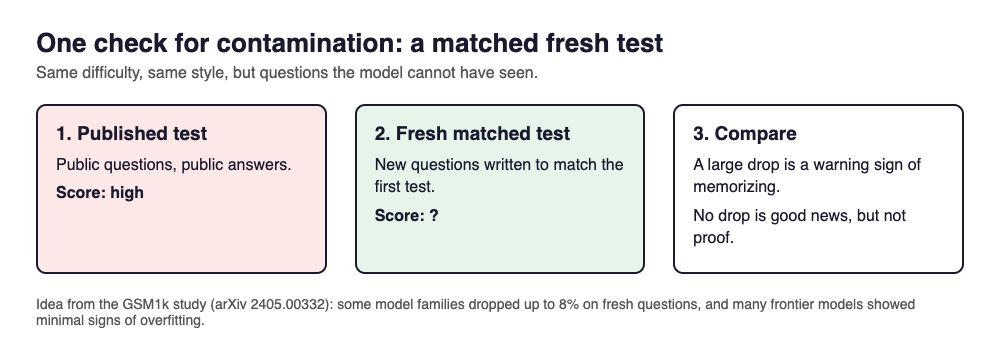
Notice what the result does and does not say. Contamination was real for some models and small for others. A single score never told you which.
Ways to make contamination matter less
Once a test is public you cannot fully stop leaks. You can make them matter less.
- Fresh one-time exams. Yang and colleagues call on the community to develop these to evaluate models.
- Live benchmarks. LiveBench takes frequently updated questions from recent sources such as new math competitions, arXiv papers and news articles, scores answers automatically against objective answers, and adds questions on a monthly basis (arXiv 2406.19314). LiveCodeBench does the same for code, collecting new contest problems from LeetCode, AtCoder and CodeForces over time (arXiv 2403.07974).
- Clear flags. Sainz and colleagues call for a community effort, including ways to detect when benchmark data was exposed to a model and flags on papers whose conclusions may be compromised.
Private test sets are another common answer, though none of the papers above makes that case, so weigh it yourself: they cannot leak through a crawl, but outsiders cannot inspect them.
Why contamination matters for AI safety evaluations
On an ordinary leaderboard, contamination makes the ranking unfair. In safety work the stakes are higher, because evaluations help decide whether a system is safe enough to release. A contaminated test can say "passed" when the honest answer is "unknown."
Where the same worry shows up:
- Dangerous capability evaluations lean on fixed task sets, so a leaked set could make a model look less or more capable than it is on new problems.
- Red teaming uses attack prompts. A model tuned on a known list can look robust and still fail on a new attack.
- Evaluation awareness is a different problem with a similar result: a model that behaves differently when it knows it is tested also makes a test result less trustworthy.
- Our overview of AI evaluations shows what a test can and cannot tell you.
Learn AI Alignment Theory has a course called Evaluations and Red Teaming. Each of its lessons lists its sources and separates what is known from what is still open, which is a useful habit here: how much contamination inflates any given score is often unknown.
Frequently asked questions
What is benchmark contamination in simple terms?
It is when a model has seen test questions or their answers during training. Its score then reflects memory more than ability.
Is contamination always cheating?
No. Benchmarks are public and training data is collected at huge scale, so leaks can be accidental. One study even found test overlap in data generated by other models.
Can you prove a model is contaminated?
Rarely. You gather evidence, such as overlap with training data, a score drop on fresh matched questions, or a link between a model's chance of generating test items and its score gap.
Does contamination mean a model score is useless?
Not always. In the GSM1k study many frontier models showed minimal signs of overfitting. The point is that you need a check, not a guess.
Why does this matter for AI safety?
Safety decisions often rest on evaluation results. If those results are inflated by leaked tests, a system can look safer than it is.
Get started
If you want to go deeper on how models are tested and where tests fail, Learn AI Alignment Theory teaches it in lessons of about 8 minutes, with questions and hands-on activities, and 71 debate cards that set out where researchers disagree without picking a side. You sign in with Google or an emailed code.
Start Learn AI Alignment Theory: short hands-on lessons from first principles to open research, with every side of every debate and the sources to read next.
Comments
No comments yet.
Sign in or make an account to comment.