Bolingbroke Castle: where Henry IV was born and a 1643 siege
Bolingbroke Castle in Lincolnshire is the place where Henry IV was born, and it is also a Civil War ruin: a Royalist garrison held it for about six weeks in 1643 before it surrendered. English Heritage, which looks after it, gives both stories in one short history. This post follows the castle from its builder to its slighting, using only what English Heritage's pages say, and then asks what a defender in Two Towers can take from it.
Who built Bolingbroke Castle, and when
Bolingbroke Castle was one of three castles built by Ranulf de Blondeville, Earl of Chester and Lincoln, in the 1220s, after he came back from the Crusades. The other two stood in Cheshire and in Staffordshire.
It is what English Heritage calls an "enclosure" castle: curtain walls with towers, closing in a courtyard. Inside the courtyard stood timber-framed buildings, among them a great hall and service buildings. Digs in the 1960s found evidence of them. If you want to know what happened in a hall like that, our post on the castle great hall goes through it.
English Heritage's visitor page describes the remains as a 13th-century hexagonal castle. Today you enter through the gatehouse towers into the open central area, and there is water in the moat around the castle.
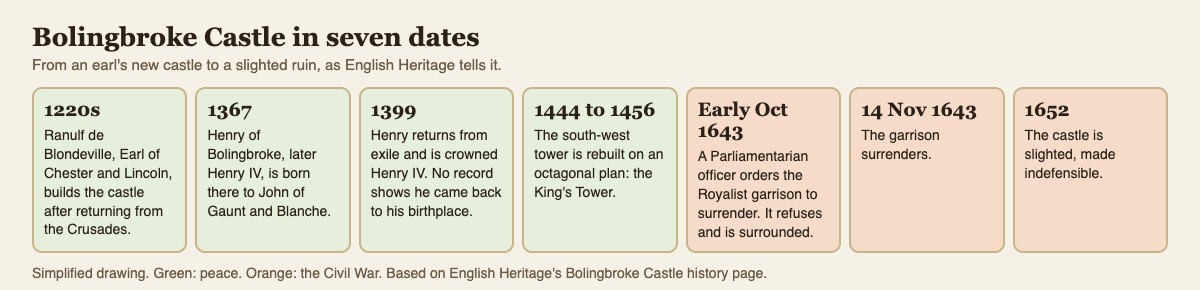
The castle in seven dates, from English Heritage's history page.
Bolingbroke Castle and Henry IV: the birth of 1367
After the earl's death the castle stayed with the Earls of Lincoln. Later it came by marriage to John of Gaunt, Duke of Lancaster. English Heritage calls him an extremely powerful member of the royal court, and he became guardian of Richard II when the boy king took the throne at the age of 10.
John of Gaunt and his first wife, Blanche, lived at the castle in the 1360s. Their son Henry of Bolingbroke was born there in 1367.
The story that follows is short. Henry quarrelled with Richard II and was exiled in 1397. When his father died in 1399, he came back to England, angry that the king had seized the estates he had inherited. Richard was away in Ireland at the time, putting down a rising. Henry was encouraged to claim the throne, Richard was imprisoned, and Henry was crowned Henry IV soon afterwards.
Here is a detail worth keeping. English Heritage says there is no documentary evidence that Henry IV ever returned to his birthplace. The castle gave him his name, but the page does not claim he ever stood in it as king.
From a lord's home to an estate office
In the 15th and 16th centuries the castle's main job was as an administrative centre for the estates of the Duchy of Lancaster. The names of the towers still come from that time: the Auditor's Tower and the Receiver's Tower are named for the clerks who worked there.
The wealth did not vanish. The south-west tower, now called the King's Tower, was rebuilt between 1444 and 1456 on an octagonal plan. English Heritage notes that the castle was by then more than 200 years old, and reads the rebuilding as the owners showing off their wealth and importance.
By the 17th century the picture had changed. Surveys of that century show that only a few of the towers were still in use and that the enclosing walls were extremely dilapidated. That matters for the next part. A castle in this state is not an obvious fortress.
The siege of 1643, step by step
English Heritage's account of the Civil War siege is brief, so you can follow it in four steps.
- A garrison moves in. During the Civil War (1642 to 1648), Bolingbroke became a defensible base for a Royalist garrison.
- A summons. In early October 1643, a Parliamentarian officer, speaking for the Earl of Manchester, ordered it to surrender.
- A refusal, then a ring. The garrison said no, and Parliamentarian forces surrounded the castle.
- A surrender. The garrison held out until 14 November, then gave the castle up.
The page does not say how many soldiers were inside, how the attackers fought, or why the garrison gave in, so we do not guess. Our post on Civil War castle sieges sets Bolingbroke beside other castles, and the post on the castle garrison explains why the size of the garrison mattered.
Slighting: how the castle ended
In 1652 the castle was slighted, which English Heritage defines as made indefensible. The point was to make sure nobody could hold it again. Why this was done to so many castles is the subject of our post on slighting a castle.
Ruin did not stop there. In the early 19th century the last remaining part of the stonework fell down. What you see now is what was left after a siege, a slighting and two more centuries of weather.
What to see at Bolingbroke Castle today
The address is Moat Lane, Old Bolingbroke, Spilsby, Lincolnshire, PE23 4HH. English Heritage's visitor page says there are no facilities at the castle, and that the market town of Spilsby, 3 miles to the west, has shops and places to eat. Opening times and prices change, so check English Heritage's Bolingbroke Castle page before you travel.
Use this short list when you get there.
- The gatehouse towers. This is the way in, so start where an attacker would have started.
- The King's Tower. The south-west tower, rebuilt in the 1440s and 1450s on an octagonal plan.
- The Auditor's Tower. From it you can see the Rout Yard, the field to the south of the castle. It holds earthworks, including a rectangular enclosure. Experts still debate whether it was a fishpond, an animal compound or a 17th-century fort.
- The moat. English Heritage warns that there is water in it. Wheelchair access is available at both entrances from Moat Lane, but the ground is uneven in most places, even where paths are cut in the grass.
What a weak castle teaches a Two Towers defender
Bolingbroke's story has a lesson for a defender. A castle with dilapidated walls still held out for about six weeks, because holding a place is about more than its stone. English Heritage does not say why, so treat this as a way of thinking, not a fact about 1643.
Two Towers is a free medieval tower defense game that plays in your browser. You hold a city gate, and every stage comes stronger, faster or in greater numbers than the last. There is no final stage. Between attacks you can repair the gate or reinforce it with gold, and the game's own tip says: "Spend your gold on Damage between stages, and Reinforce the gate."
Try this plan on your first few stages, as a way to play like a garrison that means to stay put.
- On the title screen, pick the Archer Tower for one side of the gate and the Ballista for the other.
- After every stage, spend gold on Damage first, then Reinforce the gate.
- After a loss, read the line that says "The gate fell mostly to" and an attacker, then buy the answer to that attacker in the game's own tip next time.
- Buy your first hill tower for 150 gold when the gate is steady, and your second for 300.
The aim is the same as the garrison's: not to win the field, just to keep the gate standing one more stage.
Frequently asked questions
Who built Bolingbroke Castle?
Ranulf de Blondeville, Earl of Chester and Lincoln, built it in the 1220s after returning from the Crusades.
Was Henry IV born at Bolingbroke Castle?
Yes. English Heritage says Henry of Bolingbroke, the future Henry IV, was born there in 1367, but there is no documentary evidence that he ever came back as king.
What happened at Bolingbroke Castle in 1643?
A Royalist garrison refused a Parliamentarian summons in early October, was surrounded, and held out until it surrendered on 14 November.
Why is Bolingbroke Castle a ruin?
It was slighted in 1652 to make it indefensible, and the last remaining part of the stonework fell down in the early 19th century.
Get started
If the story makes you want to hold a gate yourself, you can start in a minute. Two Towers is free, with no ads, and it plays on a computer or a phone.
Play Two Towers: it is free and plays in your browser on a computer or a phone.
Comments
No comments yet.
Sign in or make an account to comment.