Book Club Meeting Problems: A List for the Members
Most book clubs run on goodwill and a group chat. That works until the same three issues come up every month and nobody remembers what was said last time. This post is about book club meeting problems: a list for the members, one place where the club's recurring problems are kept, with the fixes you try and what happened each time.
It is not a guide to running a perfect club. It is a way to stop having the same argument about the same thing every third Thursday.
Why book club meetings go wrong (and why one list helps)
Book clubs fail in small, repeated ways. One person talks too long. Half the group did not finish the book. The date shifts again. Each time, someone says "we should fix that," and then the evening ends.
The trouble is memory. A fix suggested in March is gone by June. A fix that already failed gets suggested again, because nobody wrote down that it failed. A group chat buries this stuff under photos of snacks.
A shared list changes that. Each problem gets one line. Each attempted fix gets attached to it, with an outcome. The club can see what was tried before it tries it again. If you have worked on a similar shared list for a team, the idea will be familiar from this post on group project problems.
The most common book club meeting problems
Most clubs run into some mix of three kinds of trouble:
- Discussion: who talks, who does not, and where the conversation drifts.
- Reading: unfinished books, spoilers, and choosing the next title.
- Logistics: dates, attendance, and where to meet.
In Problem Graph these map neatly onto how you organize things. You write each problem as one line, and you can link problems that belong together. "Same two people dominate" and "Quiet members never get a turn" are clearly related. Put a link between them and the map shows the pair.
Discussion problems: dominant voices, silent members, and tangents
Dominant voices
One or two members fill most of the time. They are usually not rude. They simply have a lot to say and the room lets them.
Write it plainly: Two people take most of the talking time. Then add the fixes you might try as solutions. Examples: a talking stick, a round where everyone gives one opinion before open discussion, or a host who calls on people by name.
Silent members
Quiet members often have good things to say but never find a gap. This is the flip side of the first problem, so link the two. When you look at the map, you will see that a fix for one may be the fix for both.
Tangents
The conversation leaves the book in ten minutes and never returns. You might try a short list of questions pinned at the start, or a rule that off-topic chat waits until the end. Mark whichever you try, then record the outcome as worked, partly, or failed.
Reading problems: unfinished books, spoilers, and picking the next title
Unfinished books
Nobody likes arriving to find only four of ten people finished. Possible fixes: pick shorter books for busy months, set a halfway check-in, or agree that unfinished readers can still come and stay spoiler-free.
Each of those is a separate solution on the same problem. That matters. If the halfway check-in fails, it stays on the map as failed. The page puts it this way: "The graph is honest. A solution that failed three times stays on the map as a failed solution, and that is exactly what the next person needs to know."
Spoilers
Someone mentions the ending of chapter 30 when half the room is on chapter 12. The fix is usually a clear rule, such as "discuss only to the agreed page." Write the rule down as a solution and note whether it held.
Picking the next title
Choosing the book can eat twenty minutes of every meeting. You can try rotating who chooses, a vote from a shortlist, or a themed year. Attach each as an idea. Mark the one you are trying this season.
Logistics problems: scheduling, attendance, and venue
Logistics are boring and they sink clubs. The same issues come up: no date works for everyone, people drift away after missing two meetings, and the venue is too loud or too small.
Treat these like any other problem. For a practical example of keeping a recurring group on track, see choir problems: what the section keeps tripping on. The pattern is the same: name the thing, try a fix, note what happened.
A made-up sample entry might look like this:
- Problem: Meeting dates keep moving.
- Solution idea: Fix the second Thursday of every month for the whole year.
- Outcome: Partly. Attendance improved, but December clashed with holidays.
That last line is the useful part. Next December, nobody has to rediscover it.
How to build a shared problem list for the whole club
Problem Graph is a personal journal drawn as a graph, and it also lets you share. Here is a setup that fits a book club, with one person keeping the record and everyone else able to see it.
- Write each problem as one line. One line is enough. It appears on the graph as soon as you press Enter.
- Mark one problem as a main node. Only a main node can be shared. When it is shared, its solutions, outcomes, and requirements go with it. A problem you only link to it stays home.
- Create a private network. Give a few people the invite code, then share the main node into the network. Members see it. Nobody else does. Note that anyone with the invite code can join, so send it only to club members.
- Agree on fixes at the meeting, and record them in your own graph. Members see the shared problem, its solutions and what happened. The pages do not say members can edit a shared node, so pick one person to add the new ideas and mark each outcome after the meeting.
Members need an account with a username and a password to add problems of their own. Browsing the public network needs no account. Problem Graph works in the browser and on your phone, so people can check the list at the meeting itself.

The home page shows the three ways to keep or share a problem.
Note what the app does not describe. It covers sharing, linking, and borrowing. It does not offer chat or comments, and it does not describe members editing a shared problem together. Keep your group chat for talking and use the list for the record.
If you want to see how an empty graph fills in before committing, the app offers a "Load example set" and a "Load example network" button. These are illustrations, not real clubs.
Clubs run by two or three organizers may find the same approach useful as a pair, as described in cofounder problems: one list for two founders to fix together.
Fixes the club has tried and what worked
This section is about how to use the record, not a list of results. Problem Graph's public network was empty when this was written, so there are no club stories to borrow yet. Here is how the process is meant to work.
Suppose your club tries a "one thought each before open talk" round for the dominant voices problem. After two meetings you mark it partly: quiet members spoke, but the round took fifteen minutes. You add a new idea: limit the round to one minute each. Now the graph shows the first fix as partly, and the second as the one you are trying.
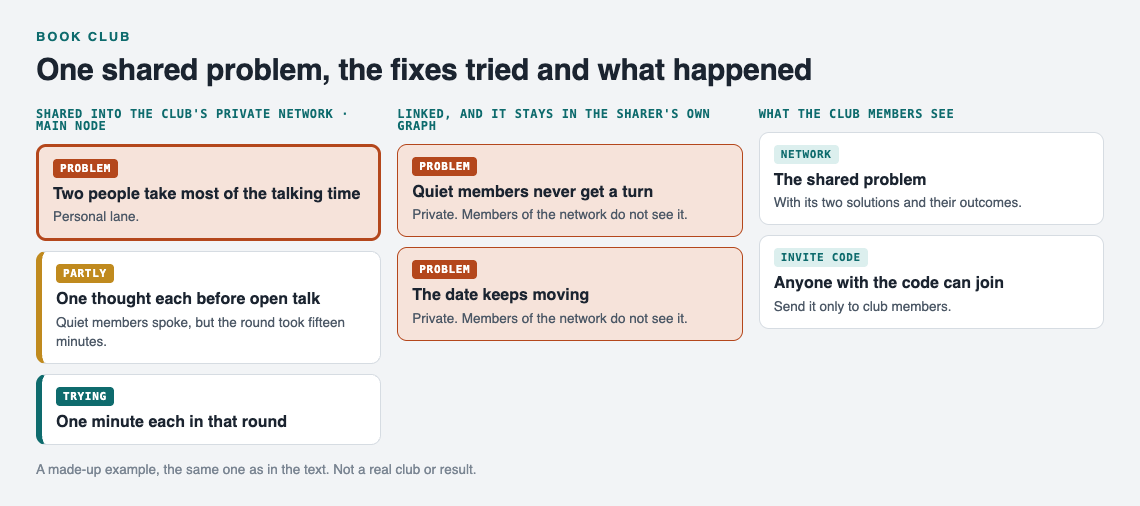
A made-up example: one shared problem, two fixes, and linked problems that stay in the sharer's own graph.
Later, if someone shares a similar problem to the public network, you can see which of their solutions worked and borrow one with a single tap. The borrowed solution keeps a link back to where it came from. You can also ask for AI suggestions, which are proposals based on what worked for others on similar problems. Treat them as ideas to test, not answers.
The habit that matters is recording the outcome. Without it, the list is only a list of complaints. For another take on logging attempts and results, read freelance client problems: log what you tried and what worked.
Frequently asked questions
Can everyone in the club see the list?
If you share a main node into a private network and give members the invite code, they can see it. People outside the network cannot. Private is the default, so nothing is shared until you choose to.
Do members need an account?
To add a problem, recommend a solution, or borrow one, yes: a username and a password. Browsing the public network needs no account.
Should we put the whole club's problems on the list at once?
Start with two or three that annoy people most. Add more as they come up. One line each is enough.
Is this free?
The home page says it is free, with no account needed to look around.
Get started
Try Problem Graph: it is free, and you can look around the public network without an account. Write one problem down in a line and attach the first thing you will try.
Before your next meeting, pick the one problem that cost the club the most time last month. Write it down, add one fix, and agree who will mark the outcome afterward.
Comments
No comments yet.
Sign in or make an account to comment.