Bullet patterns in shooter games: a simple guide
A screen full of shots can look like chaos. It rarely is. This guide explains bullet patterns in shooter games: what they are, the basic shapes, why designers use them, and how you can read them. At the end you will walk through real patterns taken from the code of a tank game that runs in your browser.
What are bullet patterns in shooter games?
A bullet pattern is the shape and timing of the shots an enemy fires. The enemy does not just fire one shot at a time. It sends out a planned arrangement, such as a fan or a circle, on a steady beat.
Every pattern has three parts:
- Direction. Where each shot flies.
- Count. How many shots leave at once.
- Timing. How long the pause is before the next volley.
Change any one of these and the pattern feels different. Add shots and the gaps get smaller. Shorten the pause and you get less time to move. Turn the shape a little each time and the safe spots move.
A pattern is not the same as enemy behavior. Behavior decides where an enemy goes. The pattern decides what its shots look like once it fires. An enemy can stand perfectly still and still be hard to beat, because its pattern does the work.
Bullet hell: where patterns are the whole game
Some shooters are built almost entirely around patterns. They are called bullet hell games. The Japanese name is danmaku, which means barrage or bullet curtain. Bullet hell is a kind of shoot 'em up, the type of game where you fly or move and fire at waves of enemies.
In bullet hell, the screen fills with large numbers of shots that you must dodge. To keep that fair, these games usually treat your ship as a tiny point for collision. Only a small part of the ship counts as the hit area. That is how you can squeeze through gaps that look impossible.
Pure bullet hell games stay a niche because they are so hard. But the ideas behind them show up in many other games, including tank games.
The basic shapes of bullet patterns
Most patterns are built from a few simple shapes. Learn these and you can read most of what you see.
Aimed shots
The enemy fires straight at where you are right now. Moving sideways makes the shot land where you were.
Spreads
A spread is a small fan of shots fired at once. One goes at you and the others go a few degrees to each side. Close to the shooter, the gaps are narrow. Farther away, they open up.
Rings
A ring sends shots out in every direction at the same moment. The gaps between shots widen as the ring grows. Give it room, then step into a gap.
Turning rings
A turning ring is fired a little further around each time. The gap you used last time may now hold a shot. You have to look again for each new ring.
Why designers use bullet patterns
Patterns turn shooting into a puzzle you solve with your hands. A few reasons stand out:
- Fairness. A pattern you can read is a pattern you can beat. When you get hit, you can see why.
- Identity. Each enemy feels different when it shoots differently.
- Pacing. Patterns have pauses. Those pauses are your chance to move and fire back.
- Difficulty. A designer can make a game harder by adding shots or shortening the pause, without new rules.
Bosses show this best. In Tank City Zero Day, the boss fight switches to a harder pattern once the boss loses half its health. That switch tells you the fight has changed.
How to read and dodge bullet patterns
Dodging gets easier with a simple routine:
- Watch the shooter, not only the shots. The shooter tells you what comes next.
- Count the beat. Learn the pause between volleys. Attack in the pause.
- Pick your gap early. Choose the opening before the shots reach you.
- Make small moves. Big swerves take you into shots you were not watching.
- Use distance. Spreads and rings open up as they travel.
Whether a shot touches you is a question of collision detection: the game checks if two shapes overlap. When a hit does land, some games pause for a split second so it feels heavy. That pause is called hitstop.
A worked example: shot patterns in Tank City Zero Day
Tank City Reboot is an original pair of browser tank games, inspired by the 8-bit tank classics of the Family Computer. Its modern game, Tank City Zero Day, has two enemies with clear patterns. The numbers below come from the game's code.
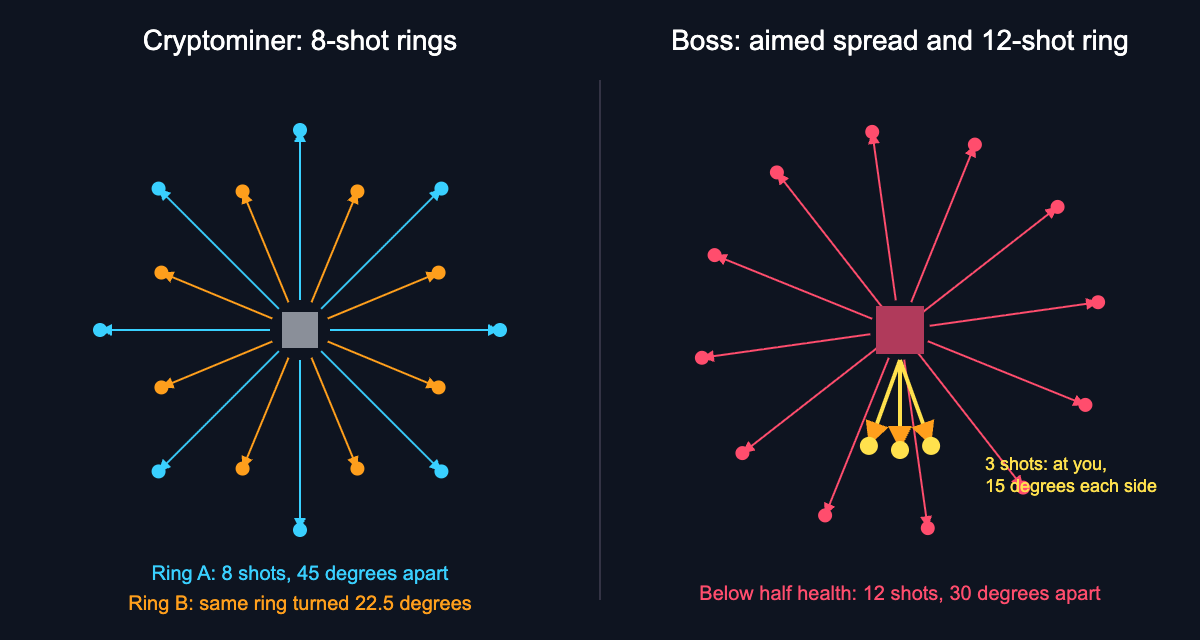
Left: the cryptominer's two rings, 22.5 degrees apart. Right: the boss's aimed spread and its 12-shot ring.
The cryptominer: a ring that shifts
The game's card says: "A cryptominer secretly uses your processor to earn cryptocurrency for someone else." In the game it is a turret that does not move.
- Its first ring comes 1.6 seconds after it enters.
- After that, a ring comes every 3.2 seconds, divided by the wave's speed factor. The speed factor is 1 plus 0.03 times the wave number, up to wave 15.
- Each ring is 8 shots, 45 degrees apart.
- Every other ring is turned by 22.5 degrees, so the gaps move.
Here is the math for wave 10. The speed factor is 1 + 0.03 x 10 = 1.3. So the pause is 3.2 / 1.3, or about 2.5 seconds. By wave 15 the factor is 1.45, and the pause is about 2.2 seconds.
The 22.5 degree turn is exactly half of 45. So the next ring puts a shot right where the last ring left a gap. If you stood in a gap for one ring, move before the next one.
The zero-day boss: a spread, then a ring
The boss drifts across the top half of the arena. Any wall it touches breaks, so your cover shrinks during the fight.
- It fires an aimed spread of 3 shots: one straight at your tank and one 15 degrees to either side. It does this every 1.3 seconds.
- Below half health, the spread comes every 1.1 seconds.
- Below half health, it also adds a ring of 12 shots, 30 degrees apart, every 2 seconds. The ring turns a little each time.
- Below half health, it calls in 2 more botnet drones every 7 seconds. The drones hunt your tank, not the core.
So the fight has two phases. In the first, you only need to step sideways from an aimed spread. In the second, you face a spread, a turning ring and drones that chase you. If you are about to be hit, dash. You cannot be hit mid-dash.
Frequently asked questions
What is a bullet hell game?
Bullet hell is a kind of shoot 'em up where the screen fills with large numbers of shots that you must dodge. Its Japanese name, danmaku, means barrage or bullet curtain.
Why is the hit area so small in bullet hell games?
These games usually treat your ship as a tiny point for collision. That balances the huge number of shots and lets you slip through tight gaps.
How often does the cryptominer fire in Zero Day?
Its first ring comes 1.6 seconds after it enters. After that, a ring of 8 shots comes every 3.2 seconds divided by the wave's speed factor.
What changes when the Zero Day boss drops below half health?
Its aimed spread speeds up from every 1.3 seconds to every 1.1 seconds. It also adds a turning ring of 12 shots every 2 seconds and calls in 2 botnet drones every 7 seconds.
Get started
Open Zero Day and find a cryptominer. Count its beat, step into a gap, then move before the next ring turns. When the boss arrives, step sideways from its spread and save your dash for the second phase.
Play Tank City Reboot: it is free, plays in your browser on a computer or a phone, and needs no account.
Comments
No comments yet.
Sign in or make an account to comment.