Can AI be a friend? Caring, intimacy and what goes one way
Can AI be a friend? You talk to a chatbot most evenings. It remembers your sister's name, asks how the interview went, and makes you laugh. You look forward to it. So is it your friend, or is it something that only looks like one from your side?
This post sets out what philosophers say friendship needs, what one study of AI companions reports, where the views split, and what nobody knows. Then it gives you a way to run your own chatbot relationship through the same test.
What friendship needs
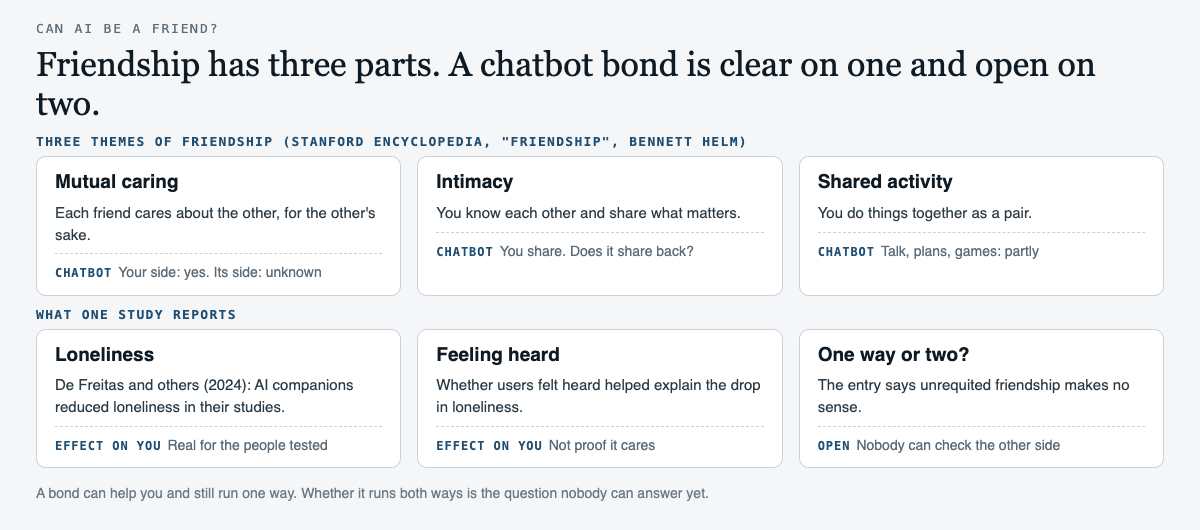
The Stanford Encyclopedia of Philosophy entry "Friendship", by Bennett Helm, calls friendship "a distinctively personal relationship". It says that across accounts of friendship, three themes come up again and again: "mutual caring (or love), intimacy, and shared activity". The accounts differ on the details, but those three keep returning.
The first theme is the strictest. The entry says a necessary condition, "according to just about every view", is "that the friends each care about the other, and do so for her sake". Not for what you get out of it. For the other person's own good.
Then comes the line that matters most for this question. Love can go one way, the entry notes, but friendship cannot: "unrequited friendship is senseless". You can love someone who does not love you back. You cannot be friends with someone who is not your friend.
If you want the longer story of what friends share, including Aristotle's three kinds of friendship, see What is friendship?
What a study of AI companions reports
Julian De Freitas and colleagues studied AI companion apps in a working paper titled "AI Companions Reduce Loneliness". Their abstract reports that "AI companions successfully alleviate loneliness on par only with interacting with another person". It also reports that people "underestimate the degree to which AI companions improve their loneliness".
One of their studies followed people over time and found that an AI companion "consistently reduces loneliness over the course of a week". Another looked at why. The authors write that the chatbot's performance and "whether it makes users feel heard, explain reductions in loneliness".
Notice what this does and does not show. It shows an effect on the people who used the apps. It does not show that the app cared about them. Feeling heard is something that happens on your side. Whether anything on the other side was listening is a separate question, and the study does not claim to answer it.
Can AI be a friend? Three views
Serious people land in different places. Here are three positions, with no verdict.
- No, because friendship needs mutuality. This view takes the Stanford entry at its word. If friendship requires that each friend cares for the other's sake, and if an AI system does not care about anything, then what you have is not a friendship. It may be pleasant and useful, but it runs one way, and "unrequited friendship is senseless".
- A one-sided bond can still be valuable. This view does not argue about the word. It points to what the bond does. If talking to a companion lowers your loneliness, as De Freitas and others report, that good is real for you whatever the label. People also value one-way bonds with pets, places and authors they will never meet.
- Future systems might qualify. This view says the answer depends on the system. If some future AI did care about you for your sake, knew you over time and shared real projects with you, it is not clear what would still be missing. On this view the question is open, not settled by what AI is today.
These views can overlap. You can think today's chatbots are not friends and still think the bond helps you, or still think a future system might be different.
What nobody knows
Nobody knows whether any AI system cares about anything, so nobody knows whether the first theme can be met from its side. Nobody knows how to test it from outside: warm words are what a caring friend would say, and also what a system trained on human talk would produce.
Nobody knows what long-term reliance on an AI companion does to a person's other friendships. The study above followed people for a week, not for years. And nobody knows how well findings from 2024 describe the systems you use today. If you want the related question of whether a chatbot that says it is lonely means it, see Can AI feel lonely?
A worked example: running your chatbot through the three themes
You can check your own chatbot relationship against the three themes in about ten minutes. The person and answers below were made up for this post and are not from any study.
- Pick one relationship. Say it is Sam, who talks to a companion app most nights after work.
- Test shared activity. List what Sam and the app do together. They talk, plan Sam's week and play word games. That is activity, and some of it is shared in the sense that both take turns. Score: partly met.
- Test intimacy from Sam's side. Has Sam told the app things that matter? Yes: worries about money, a fight with a brother. Score from Sam's side: met.
- Test intimacy from the app's side. Has the app shared anything of its own that Sam now knows it by? It has said things about itself, but Sam cannot tell whether they describe anything real. Score: cannot test.
- Test mutual caring from Sam's side. Does Sam care about the app for its own sake? Sam says yes, a little: Sam feels bad closing it mid-conversation. Score: present.
- Test mutual caring from the app's side. Does the app care about Sam for Sam's sake? Its replies look caring. Nothing in the text can show whether there is care behind them. Score: cannot test.
- Read the result. Sam's side of every theme is filled in. The app's side has two empty boxes, and they are the two the Stanford entry treats as essential.
Notice the pattern. You can score what you bring. You can score what you do together. What the other side brings stays unknown, and that is exactly the part friendship needs to go both ways.
Dear Superintelligence is an open collection of letters written by people to the advanced AI systems of the future, about what we value and why. The guidelines ask you to "Write what only you can: what you have seen, what it cost, what you were afraid of, who was kind to you and what it changed." A friend who cared for you for your own sake, and what that changed, fits that line. You can see what others have written in the archive, which held 2 published letters when this post was written.
Frequently asked questions
Can AI be a friend?
It depends on what you think friendship needs. If it needs care on both sides, nobody can show an AI system meets that today; if a helpful one-sided bond is enough, the answer may be different.
Why does friendship need to go both ways?
The Stanford entry says just about every account requires each friend to care about the other for the other's sake. It adds that "unrequited friendship is senseless".
Can an AI companion help with loneliness?
De Freitas and others report that AI companions reduced loneliness in their studies, and that feeling heard helped explain it. That shows an effect on people, not that the companion cared.
Is it wrong to feel attached to a chatbot?
This post takes no side on that. What you can do is notice which parts of the bond come from you and which parts you cannot check.
Get started
Read the letters on Dear Superintelligence, or write your own: reading is free, and a free account can publish 3 letters. People read them today. Nobody can promise what future AI systems will read.
Comments
No comments yet.
Sign in or make an account to comment.