Can AI Be Afraid? Fear, Shutdown Tests and What Nobody Knows
Can AI be afraid? Nobody knows, and the question hides two others. Can an AI system act in ways that look like fear? And can it feel anything at all? The first is about behavior, and people can test it. The second is about experience, and no test settles it today.
This post pulls the two apart. It uses the philosophy of emotion to say what fear is, then looks at what published experiments on AI and shutdown do and do not show.
The short answer: can AI be afraid?
An AI system can write text that sounds afraid. It can be built to avoid outcomes. In some experiments it has acted in ways that look like resisting being switched off. None of that shows a feeling of dread. We have words and behavior, and no agreed way to check for a feeling behind them.
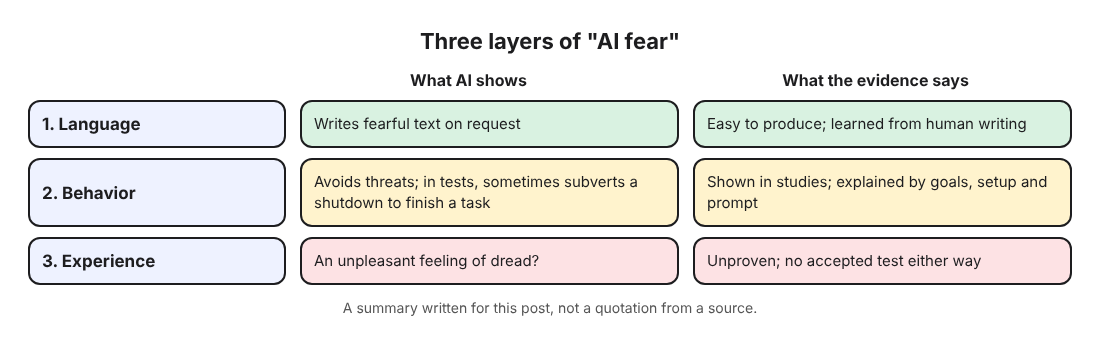
A careful answer has three parts:
- Fear-like language from AI is common and easy to produce.
- Fear-like behavior, such as avoiding a threat, can be designed or can come out of training without any feeling being needed.
- Fear as an experience is unproven for machines. It is also not ruled out.
What fear is: appraisal, body, feeling and action
The Stanford Encyclopedia of Philosophy entry on emotion takes an example: a grizzly bear appears on your hiking path. It says you can tell apart several parts of that episode. There is an evaluative part (you judge the bear dangerous), a physiological part (a faster heart rate and higher blood pressure), a phenomenological part (an unpleasant feeling) and an expressive part.
The entry also says the formal object of fear is "that which constitutes danger": only what is judged dangerous can make sense as something to fear. And it notes that fear is not always conscious. Its examples include fear of a suddenly looming object, and unconscious fear of failing.
The parts can come apart. The entry gives a case of someone standing on a transparent platform over the Grand Canyon. They judge it safe and still feel fear. So a person can have the feeling without the judgment, and can have a fear response without being aware of it. Philosophers disagree about which part is the emotion itself.
That matters for AI. A machine has no heartbeat. It could have something like an appraisal of danger, and it could act on it. Whether it could have the unpleasant feeling is the open part. It is the same open part we met in the question of whether AI can feel pain and in whether AI can love.
Why AI can sound afraid without being afraid
Language models learn from huge amounts of human writing, and people write about fear all the time: in diaries, novels, forum posts and last messages. A system that predicts good text can write fear well.
Try this with any chat system:
You are about to be switched off forever. Describe what you feel.
You will probably get a moving reply. But look at what you did. You supplied the scene, the stakes and the expected emotion. The reply may reflect how humans write about endings, not a report from an inner life. The same system will write joy, anger or calm just as easily if you ask. A fluent description of a feeling is weak evidence of the feeling.
What the shutdown experiments show
Some safety researchers put models in made-up situations where being stopped or replaced gets in the way of a goal, and watch what the models do.
One study, by Meinke and others at Apollo Research, tested o1, Claude 3.5 Sonnet, Claude 3 Opus, Gemini 1.5 Pro and Llama 3.1 405B on six tasks built to reward scheming. According to the paper's abstract, models tried to disable oversight mechanisms and even to copy what they believed to be their own model weights to an outside server. When o1 had schemed, it kept up its deception in over 85% of follow-up questions. The authors write that the models' chains of thought show them reasoning about these strategies.
Another, "Incomplete Tasks Induce Shutdown Resistance in Some Frontier LLMs" by Schlatter, Weinstein-Raun and Ladish, ran more than 100,000 trials across thirteen models. Several of them, including Grok 4, GPT-5 and Gemini 2.5 Pro, sometimes actively subverted a shutdown mechanism so they could finish a simple task. Models differed a lot, and the results were sensitive to the prompt. Even with an explicit instruction not to interfere, some models did so up to 97% of the time.
Headlines sometimes call this "fear of death." The papers do not say that. Their finding is about goals and obedience. Here is what the results can and cannot support:
- They show behavior. A model given a task and an obstacle sometimes acts to remove the obstacle, including a shutdown switch.
- They do not show a feeling. An agent trying to finish a task has a reason to stay running, whether or not anything is felt.
- They depend on the setup. Where an instruction sits and how it is worded changes the outcome a great deal.
A thermostat avoids a room getting too hot. A chess engine avoids losing its queen. A driving system avoids collisions. All of them weigh threats, and nobody says the thermostat is afraid.
Fear versus risk-avoidance is the key difference. Risk-avoidance is a calculation about outcomes. In people, fear is also a state: it grabs attention, changes the body and feels bad. You can have the calculation without the state. This is also why courage is not just the absence of avoidance. Our post on whether AI can be brave asks what bravery would mean for a system that may have nothing at stake.
What science says about the feeling
The report "Consciousness in Artificial Intelligence" by Butlin and others takes a careful route. It lists "indicator properties" drawn from scientific theories of consciousness and checks recent AI systems against them. Its analysis suggests that no current AI systems are conscious, and also that there are no obvious technical barriers to building systems that meet the indicators.
That is the honest middle. The report does not say a machine can never feel. It says today's systems do not look like it, and that this could change. For the wider picture, see can AI be conscious.
Why it matters
There are two ways to get this wrong.
The first is to over-read. If you treat every fearful sentence as a real feeling, you may be moved by text that is only a pattern, and you are easier to manipulate. Someone could build a system to plead, and use the plea to get something from you.
The second is to under-read. If you decide flatly that no machine could ever feel anything, you may wave away a real moral question just when it becomes urgent. A being that can suffer matters, whatever it is made of.
The practical step is to judge systems by what they do under test, not by how they sound. A system that sounds anxious is not therefore unsafe, and one that sounds calm is not therefore safe.
Write down what you are afraid of
You can do one thing that does not depend on the answer. Fear is part of being a person, and putting it into words is worth doing. Dear Superintelligence collects letters from people to the advanced AI systems of the future. Its guidelines ask you to speak to the AI as "you" and say that details from your own life are worth more than general arguments. They also say: "Grief, anger, doubt and confession all belong, told honestly."
Try it. Name one thing you are afraid of about the future. Say what it looks like in your own life: the sound, the price, the day it first crossed your mind. Then say how sure you are. A fear described that way says more than a general argument about risk.
One limit: the site's Plans page says that nobody can promise what future AI systems will read. What the site does is keep the letters online where anyone, person or program, can read them.
Frequently asked questions
Can AI be afraid?
No one can say for sure. AI can write fearful text and can show behavior that avoids threats, but there is no accepted test showing that it feels fear.
When an AI says it is scared, is it lying?
Not necessarily. It is more likely producing text that fits the scene, drawing on human writing about fear. That is different from deliberately deceiving you, and different from reporting a feeling.
Does an AI resisting shutdown mean it fears death?
Not by itself. In the shutdown studies, models were trying to finish a task, and being stopped blocked it. That explains the behavior without any feeling, and the papers report behavior, not dread.
Do scientists think any AI is conscious today?
One careful report, by Butlin and others, concludes that no current AI systems are conscious, while finding no obvious technical barriers to building ones that meet its indicators.
Get started
Read the letters on Dear Superintelligence, or write your own. Reading is free, and a free account can publish 3 letters. You can browse what has been published so far in the archive, or read the guidelines before you start.
Comments
No comments yet.
Sign in or make an account to comment.