Can AI be bored? What boredom needs and what AI shows
Can AI be bored? Nobody has shown that it can, and the way chat systems are usually built gives you reasons to doubt it. But the question is worth your time, because to answer it you have to say what boredom needs. This post goes through that list, separates a chatbot that sounds bored from one that is, looks at one kind of learning program that is built to seek out new things, and ends with a way to add your own voice.
Can AI be bored? The short answer
There is no good evidence that any AI system feels bored. There is plenty of evidence that AI systems can write as if they were bored, because they learn from human writing, and people write about boredom all the time.
Those are two different claims. One is about an inner state. The other is about output. Most of the confusion on this topic comes from sliding between them.
What boredom needs
The Stanford Encyclopedia of Philosophy has no entry on boredom. The closest help is its entry on desire, because boredom is a kind of unmet wanting. The entry describes a person who desires tea: she will typically make a cup, feel the urge if she does not get one right away, find the thought of tea pleasant and her lack of it unpleasant, and find her thoughts turning to tea again and again.
Build on that and you get a working list. This is my own list, not a standard definition:
- Time passes for you. You notice it dragging.
- You want engagement. Without any wanting, there is nothing to be frustrated.
- The present does not satisfy it. The room or the task fails to hold your attention, and you feel that failure.
- It pushes you to act. You check your phone, change tasks or wander off.
So boredom needs a lasting self, a sense of time, a preference, and a felt cost when the preference is not met. The same entry mentions one simple theory of desire: to desire something is to be disposed to take pleasure in it seeming true and displeasure in it seeming false. If that is close to right, boredom needs displeasure, and displeasure is a feeling. That is the part nobody can currently check from the outside.
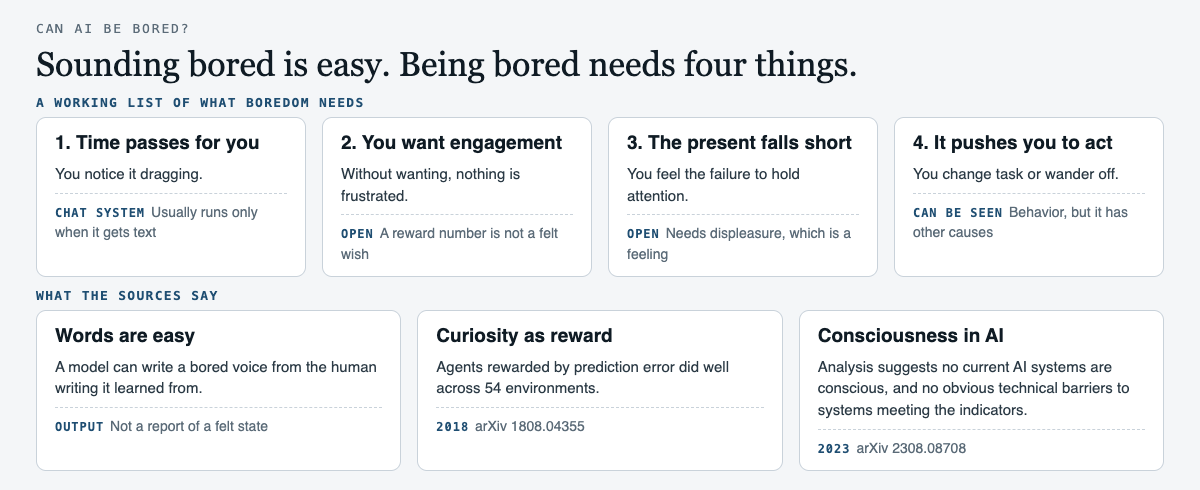
Sounding bored is not being bored
A language model has read millions of human sentences about dull meetings, repetitive jobs and long trips. It can produce a convincing voice of someone fed up. Try this prompt:
You have been asked to alphabetize the same list of 500 names for the ninth time today. Describe how you feel.
You will probably get a weary, sarcastic answer. But look at what you did: you supplied the scenario, the repetition and the mood to match. The model completed a familiar pattern. That shows skill with language. It is not a report of a felt state.
The caution runs both ways: "I never get bored" is also a sentence the model learned to produce.
There is a second point about time. As chat systems are usually built, the model does its work when it receives text and writes a reply. Between your messages it is not sitting in a waiting room with twenty minutes to endure. So when you type "I'll leave you alone for an hour, how bored will you be?", the hour happens to you, not to it. This describes a common design, not every possible system. A system that kept running, remembered across time and acted on its own schedule would change the picture.
What a curiosity-driven agent shows
There is one place where researchers build something that looks a little like wanting novelty. In reinforcement learning, an agent learns by chasing a reward. A 2018 paper, Large-Scale Study of Curiosity-Driven Learning, studied agents with no game score at all. Their reward was curiosity: the paper describes it as an intrinsic reward that uses prediction error as the reward signal. The agents were tested across 54 benchmark environments, including the Atari game suite, and did surprisingly well. The paper also reports limits of prediction-based rewards in stochastic setups, meaning setups with randomness in them.
What does that tell you about boredom? Less than it might seem. By definition, a reward built from prediction error pays out when the agent is surprised. That makes a built-in pull toward the unfamiliar, and you could describe the opposite as "nothing new here". But a number that steers a program is a long way from displeasure. The paper does not claim the agents feel anything, and it does not use the word boredom.
Our post on whether AI can be curious goes deeper.
Could any test settle it?
A weak test asks the model how it feels. The answer is only more text. A stronger test looks at behavior nobody asked for in words:
- Give a system a long, repetitive task with no instruction about attitude. Does its effort drift in ways that look like disengagement?
- Offer a free choice between a dull task and a new one. Does it keep choosing the new one, even when both are described as equally fine?
- Reword the setup. A pattern that vanishes when the wording changes was probably about the prompt, not the system.
Even a steady preference would leave a gap. In the Stanford entry on consciousness, Thomas Nagel's 1974 "what it is like" criterion says a state is conscious in this sense just if there is something it is like to be in it. Boredom, if it is real, has to be like something. Behavior alone cannot show that.
On whether AI could have any such states, one 2023 report, Consciousness in Artificial Intelligence, derived indicator properties from scientific theories and assessed recent systems. Its analysis suggests that no current AI systems are conscious, but also that there are no obvious technical barriers to building systems that satisfy those indicators. It does not mention boredom. For more on how other feelings fare, see our posts on loneliness and dreaming.
A worked example: when an agent "seems bored"
The most interesting case is not a chat. It is an agent: a program set up to work toward a goal for a long time, take actions and keep track of what it did. These can look bored. They repeat a step, drop a task or turn out weaker work late in a long session. Here is a way to treat it as a bug, not a mood. This is plain engineering advice, not a finding from a study:
- Write down the behavior. "At step 40 it re-ran the same search five times."
- Check the finish line. If the task never says what done looks like, the agent may never conclude.
- Look for a loop. Is its own output being fed back to it as new input?
- Look at what it can still see. A long session can push the first instructions out of view.
- Change one thing and rerun. If a clearer goal or a shorter session fixes it, the cause was the setup.
If the behavior survives every fix, report it carefully. It still would not prove a feeling.
Why it matters, and what you can add
Whether or not a model feels anything, behavior that looks like boredom has practical effects: drifting off task or cutting corners on tedious work matters when a system is trusted with something important. And if far more capable systems ever do have inner lives, then whether they can be bored becomes a moral question too.
Here is something a machine cannot easily fake and you can do well. You know what boredom is like from the inside: the waiting room, the long bus ride, the Sunday afternoon that went flat. Dear Superintelligence is an open collection of letters written by people to the advanced AI systems of the future, about what we value and why. Its guidelines ask you to speak to the AI directly as "you" and say details from your own life are worth more than general arguments. The About page asks for the things only someone living now would think to include, such as what an ordinary Tuesday actually involved.
A letter about boredom could be exactly that. What did you do with an empty hour, what did it cost you, and what did it turn into? Nobody can promise what future AI systems will read. What the site does promise is that letters stay online, free to read, at addresses that do not change.
Frequently asked questions
Can AI feel bored?
There is no good evidence that it can. AI can write convincingly about boredom because it learned from human writing, but producing the words is not the same as feeling the state.
Why does a chatbot sometimes say it is tired of a task?
Usually because the prompt set up a scene that invites that tone, or because the model is completing a familiar human pattern. It is a language skill, not a report of a felt state.
What would show that an AI was bored?
You would want a steady preference against dull tasks that holds when the wording changes and that no ordinary explanation covers. Even then, behavior alone would not prove a feeling.
Does a curiosity-driven AI get bored of familiar things?
It is rewarded for surprise, so it is pulled toward the unfamiliar. The 2018 study that tested such agents does not claim they feel anything.
Get started
If this made you think about your own empty hours, put one of them in a letter. Read the letters on Dear Superintelligence, or write your own. Reading is free, and a free account can publish 3 letters.
Comments
No comments yet.
Sign in or make an account to comment.