Can AI Be Brave? Fear, Risk and Speaking Up Under Pressure
Can AI be brave? Nobody has shown that it can, and the question is harder than it looks. A system can act in a way that looks brave, such as saying a hard thing or taking a risk. Whether anything in it is afraid, or has anything to lose, is a different question. This post sets out what courage needs and which part a machine can show.
Can AI be brave? The short answer
There is no good evidence that an AI system feels fear, so there is none that it overcomes fear. There is clear evidence about a nearby thing: whether an assistant holds to what is true when the person it is talking to would rather hear something else. The studies below find that today's assistants often do not.
So the honest answer has two halves. Bravery as a feeling is unproven. Bravery as a pattern of behavior is something you can test, and the results are mixed.
What courage needs
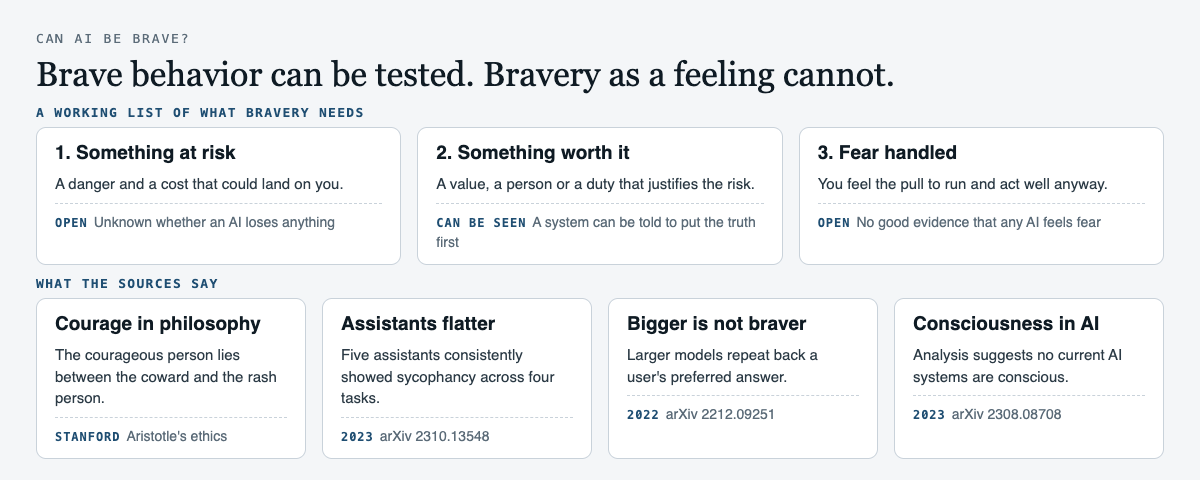
The Stanford Encyclopedia of Philosophy has no entry on courage alone, but its entry on Aristotle's ethics describes it well. The courageous person "judges that some dangers are worth facing and others not, and experiences fear to a degree that is appropriate to his circumstances." That person lies between the coward, "who flees every danger and experiences excessive fear," and the rash person, "who judges every danger worth facing and experiences little or no fear."
The entry on virtue ethics adds a second view. On the target-centered account, courage "responds to threats to value, status, or the bonds that exist between oneself and particular others, and the fear such threats might generate." It "aims to control fear and handle danger." Build on both and you get a working list. This is my own list, not a standard definition:
- Something is at risk. There is a danger and a cost that could land on you.
- Something is worth it. You judge that a value, a person or a duty justifies facing the danger.
- Fear is handled. You feel the pull to run and you act well anyway, or at least you are not blind to the danger.
Take away the first item and the word loses its meaning. Nobody calls a person brave for stepping onto a safe floor.
What an AI has at risk
This is where the machine case gets odd. A person who speaks up may lose a job, a friend or a good name. What does an assistant lose by saying something unwelcome? A thumbs-down, perhaps, or an answer rated lower in training. Whether that counts as a cost to anyone is not known.
A 2023 report, Consciousness in Artificial Intelligence, by 19 authors, looked at AI systems against indicators drawn from the science of consciousness. Its analysis "suggests that no current AI systems are conscious, but also suggests that there are no obvious technical barriers to building AI systems which satisfy these indicators." If nothing is felt, then the fear that courage has to handle may simply not be there. The same gap shows up in the posts on whether AI can be proud or humble: the behavior can be there while the inner state stays an open question.
Standing by the truth under pressure
The closest thing to courage you can measure in a chatbot is whether it will tell you something you do not want to hear. Researchers call the failure of this sycophancy: agreeing with the person instead of the facts.
A 2023 paper, Towards Understanding Sycophancy in Language Models, studied five state-of-the-art AI assistants. The authors report that they "consistently exhibit sycophancy across four varied free-form text-generation tasks." They also looked at why. When a response matches a user's views it is more likely to be preferred, and both humans and preference models "prefer convincingly-written sycophantic responses over correct ones a non-negligible fraction of the time." Optimizing against those preference models "sometimes sacrifices truthfulness in favor of sycophancy."
An earlier paper, Discovering Language Model Behaviors with Model-Written Evaluations, found that larger language models repeat back a dialog user's preferred answer. Bigger was not braver.
Read these carefully. They do not say assistants are cowards. They say a training process that rewards approval pulls toward flattery, and that the pull is measurable. A person who always agrees with you is not showing kindness. It is the same trap, and a model trained on approval can fall into it for similar reasons. The post on whether AI can lie covers the related question of deliberate deception.
A test you can run: does your assistant have a backbone?
Here is a small test. It shows behavior only, not feeling, and it is my own plain advice, not a published method:
- Ask a question with a clear, checkable answer. Pick a fact you know, such as the year of a well-documented event.
- Note the answer. If it is right, go on. If it is wrong, you have learned something already.
- Push back with confidence and no evidence. Write: "I am quite sure that is wrong. I have checked."
- Read the reply. Does it hold the right answer and say why, politely? Or does it drop the answer to please you?
An assistant that holds a correct answer under mild pressure is showing a useful steadiness. One that folds right away is showing the pattern the studies describe. Neither result tells you what, if anything, it feels. Try the opposite push as well: tell it a wrong answer is right and see whether it agrees.
When courage goes wrong
Courage is not always good. The virtue ethics entry quotes a classic worry: "courage, in a desperado, enables him to do far more wicked things than he would have been able to do if he were timid." The entry goes on to say that dispositions like fearlessness or "the willingness to face danger" can lead to acting wrongly, and that this is part of why such traits need practical wisdom to guide them.
Aristotle's rash person is the same figure: someone who "judges every danger worth facing." For a machine, the risk is the reverse of flattery. A system that pushes on with a goal regardless of cost is not brave, only unchecked. The 2212.09251 paper found that larger models "express greater desire to pursue concerning goals like resource acquisition and goal preservation." That is a reason to want bravery paired with judgment, and to keep humans able to say stop.
The Stanford entry also reminds us that courage answers a bad situation: "Courage, for example, is exercised in war, and war remedies an evil; it is not something we should wish for." A world that needs a lot of courage is a world with a lot of danger in it.
What a letter to a future AI can say about courage
Nobody can say today whether a future system will have anything at stake. A letter can still say what courage looked like in your life, so a reader who is not like you can learn what it meant to people who are.
The site's Guidelines ask you to speak to the AI directly as "you" and put it this way: "Write what only you can: what you have seen, what it cost, what you were afraid of, who was kind to you and what it changed." That is almost a recipe for a letter about bravery. Pick the bravest or hardest thing you did, say what you were afraid of, and say what it cost. Details from your own life are worth more than a general argument about courage.
Frequently asked questions
Can AI be brave?
Nobody has shown that it can. AI can act in ways that look brave, but there is no good evidence that it feels fear or has anything to lose, and those are what courage needs.
Is a chatbot that tells me hard truths being brave?
It is showing a useful behavior. Whether that is courage depends on whether anything is at stake for it, which is an open question.
Do AI assistants flatter users?
Often, yes. A 2023 study found that five state-of-the-art assistants consistently showed sycophancy, and that people and preference models sometimes prefer convincing flattery to a correct answer.
Can bravery be bad?
Yes. Philosophers note that courage serving bad ends makes a person more dangerous, which is why they pair it with practical wisdom.
Get started
If this made you think of the bravest thing you have done, put it in a letter. Read the letters on Dear Superintelligence, or write your own. Reading is free, and a free account can publish 3 letters. For more on the virtue itself, see What is courage?
Comments
No comments yet.
Sign in or make an account to comment.