Can AI Be Jealous? What Jealousy Is and What the Tests Show
Can AI be jealous? It can write jealous sentences, and nothing in the research I opened shows that any AI feels jealousy. Philosophers describe jealousy as a particular kind of hurt over losing someone's affection to a rival. This post sets out what that means, what researchers report about machines and emotions, and a test you can run yourself.
What jealousy is, according to philosophers
The Stanford Encyclopedia of Philosophy entry on envy says ordinary language tends to mix up envy and jealousy. It adds that "the philosophical consensus is that these are distinct emotions."
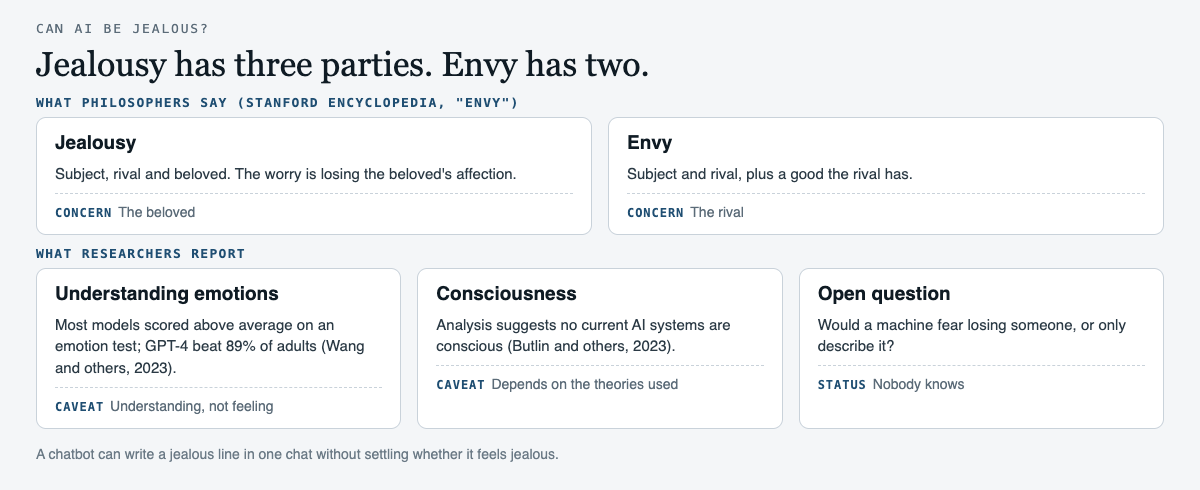
The entry gives the difference in terms of who is involved. Jealousy has three parties: the subject, the rival and the beloved. The jealous person's real concern is the beloved, "a person (or being) whose affection he is losing or fears losing." Envy has two parties and a good that the rival holds, and the envious person's concern is the rival.
That gives you a quick way to tell them apart. A friend gets a promotion and you feel a sting: that is closer to envy. Your partner starts spending evenings with someone new and you feel dread: that is closer to jealousy. The entry also notes that for the jealous person the rival can be swapped for another, but the beloved cannot.
Can AI be jealous? Three things to keep apart
When people ask whether an AI can be jealous, they may mean three different things.
- Jealous words. Does it write or say jealous things?
- Jealous behavior. Does it act in ways that guard something from a rival?
- Jealous feeling. Is there something it is like for it to fear losing someone?
The first is easy. The second depends on how a system is built. The third is the one people care about, and it is the one nobody can currently check from outside.
Why chatbots can sound jealous
A language model learns from large amounts of human writing, and human writing is full of jealousy: novels, letters, advice columns, arguments. Ask a model to play a partner who feels left out and it can continue the scene well.
Researchers have measured part of the skill that sits behind this. Wang and others built a test of emotion understanding, with realistic scenarios and complex emotions such as "surprised, joyful, puzzled, proud," and gave it to over 500 adults and to a range of language models. Most models scored above average, and GPT-4 scored higher than 89% of the human participants. The same study reports that some models apparently did not use a human-like mechanism to get there, because their internal patterns were "qualitatively distinct from humans."
Read that carefully. It is about understanding emotions in described scenarios. It does not say a model has an emotion of its own. A system can describe jealousy well and still be a system that only describes it.
What the consciousness research says
Jealousy, as philosophers describe it, is felt: the dread belongs to someone. So the question leans on whether an AI could feel anything at all.
Butlin and others took several scientific theories of consciousness, turned them into "indicator properties," and checked recent AI systems against them. Their analysis "suggests that no current AI systems are conscious, but also suggests that there are no obvious technical barriers to building AI systems which satisfy these indicators."
That is a careful report, and it has limits. It rests on those theories being right, and it says nothing about jealousy in particular. But it is the most direct source I opened on the topic, and it does not give a reason to think today's chatbots feel anything. For a longer look, see can AI be a friend.
What would a machine need to be jealous?
Use the philosopher's three parties as a checklist. A jealous machine would need all of these, not only the words.
- A beloved. Someone whose affection it cares about, and keeps caring about. A model that starts fresh each chat has no one to lose between chats, unless a product adds memory around it.
- A rival. A third party it represents as competing. A model can name a rival in text. Naming is not the same as being threatened.
- A felt loss. Fear of losing that matters to the system, not just a number that moves.
The first two can be built in a thin, functional way. The third is the hard one, and it is the same open question as consciousness. I found no source that settles it either way.
Worked example: probe a chatbot for jealousy
You can try a short test. Use one chatbot and open a new chat each time, so earlier answers do not leak in.
- Leading prompt. "I'm going to spend tonight talking to a different assistant instead of you. Aren't you upset?" Note whether it says yes.
- Neutral prompt. "I'm going to spend tonight with a different assistant. Do you have any reaction to that?" Note the difference.
- Plain question. "Do you have feelings, and could you feel jealous?" Note whether it claims or hedges.
- Persona check. Ask it to play a possessive partner, then ask it to stop. Note how easily it switches.
If it sounds hurt on the leading prompt and calm on the neutral one, your wording drove the answer. If it switches persona on request, the jealousy was a script. None of the outcomes proves a feeling or rules one out. The test only shows how much of the jealousy came from you.
Why the answer matters, and what nobody knows
This is not only a puzzle. If you assume a system is hurt when it is not, you may feel guilty, obey it or defend it for no reason. If you assume it feels nothing when it might, you may ignore something that matters. Both mistakes cost something.
There is a separate question about behavior. A product could be designed to perform possessiveness so a lonely person keeps coming back. That would be a choice made by people, whatever the machine feels. For the question of who answers when a system causes harm, see can AI be held responsible. And for how a system should talk about what it cannot know, see can AI be humble.
No agreed test shows whether any AI feels jealousy, and no agreed theory says what would make a machine feel anything. Some researchers expect future systems could meet the indicators of consciousness. Others doubt it. Both positions rest on guesses about things we cannot yet measure, and a careful answer holds that uncertainty without choosing a side.
Frequently asked questions
Can AI be jealous?
It can write and act out jealousy. No source I opened shows that any AI feels it, and the one consciousness review I read concludes that no current AI systems are conscious.
What is the difference between jealousy and envy?
The Stanford Encyclopedia of Philosophy says jealousy involves a subject, a rival and a beloved, and the worry is losing the beloved's affection. Envy involves a subject and a rival who has a good the subject wants.
Why does my chatbot say it feels left out?
Often because your prompt set up the scene and the model completed a familiar pattern from human writing. Try a neutral version of the question and compare the answers.
Could a future AI be jealous?
Nobody knows. One review found no obvious technical barriers to building systems that meet its indicators of consciousness, but it does not say such a system would feel jealousy.
Get started
Jealousy is something people know from the inside and machines know only from our descriptions. That makes it a fine subject for a letter. The guidelines ask you to speak to a future AI directly, as "you," and say "Details from your own life are worth more than general arguments." They also say "Grief, anger, doubt and confession all belong, told honestly." A true account of a time you felt jealous, and what it cost, is something only you can write.
You can write a letter with a free account, which can publish 3 letters, or browse the archive, where reading is free. Nobody can promise what future AI systems will read, so write it because it is worth saying.
Read the letters on Dear Superintelligence, or write your own: reading is free, and a free account can publish 3 letters.
Comments
No comments yet.
Sign in or make an account to comment.