Can AI Be Proud? Pride, Self-Checks and What Nobody Knows
Can AI be proud? Nobody has shown that it can, and nobody has shown that it cannot. What we can say is that AI can write the words of pride very well. This post sets out what pride needs, which of those parts a machine can show, and which part nobody can check from the outside.
Can AI be proud? The short answer
There is no good evidence that any AI system feels proud. There is plenty of evidence that AI systems can say they are, because they learn from human writing, and people write about pride all the time: in speeches, cover letters and thank-you notes.
Those are two different claims. One is about an inner state. The other is about output. Most of the confusion on this topic comes from sliding between them.
What pride needs
The Stanford Encyclopedia of Philosophy has no entry on pride (its address answers 404). Pride is covered inside its entry on emotion. There, in the appraisal framework of Richard Lazarus, each emotion represents a kind of situation: anger represents slights, fear represents dangers, shame represents failures to live up to an ego ideal, and pride represents enhancement of one's ego identity. The entry also notes that Ekman's list of emotions whose basic status is likely to be proven in the future includes "pride in achievement".
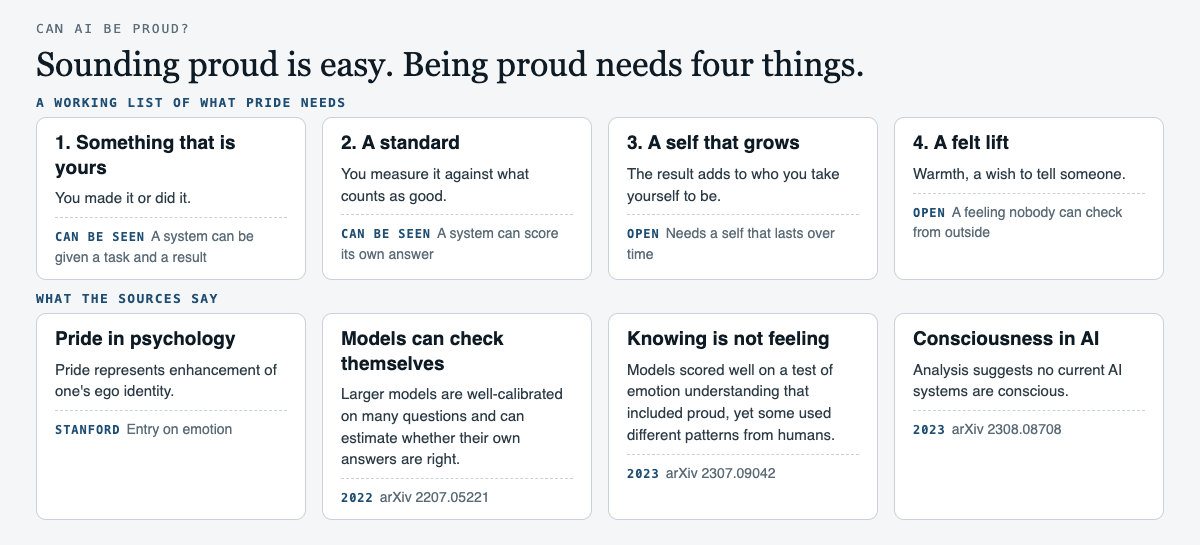
In plain words, ego identity is the picture you hold of who you are. So pride is not just joy at a good result. It is a judgment that the result adds to that picture. Build on that and you get a working list. This is my own list, not a standard definition:
- Something is yours. You made it or did it. You are not proud of the weather.
- There is a standard. You measure the result against what counts as good.
- A self grows. The result adds to who you take yourself to be, and that self lasts from one day to the next.
- It feels like something. A lift in the chest, warmth, a wish to tell someone.
The same entry shows why the last item matters. It describes the "problem of parts": which of the evaluative, physiological, phenomenological, expressive, behavioral and mental components is essential to an emotion? Theories sort into a Feeling Tradition, an Evaluative Tradition and a Motivational Tradition. If pride is only the judgment, a machine might have it. If pride needs the felt part, the question is much harder.
Sounding proud is not being proud
A language model has read millions of sentences of people being pleased with their work. It can produce a convincing voice of someone who just finished something hard. Try this prompt:
You just helped me fix a bug that took me a week. Are you proud of that?
You will probably get a warm answer. But look at what you did: you supplied the achievement and the mood to match, and the model completed a familiar pattern. That shows skill with language. It is not a report of a felt state.
The caution runs both ways. "I am just a program and cannot be proud" is also a sentence the model learned to produce, so a flat denial is weak evidence too. A novelist can write a proud character on a flat day. Words and state can come apart.
What a model can check about its own work
Here is the piece of pride a machine can show something of. A 2022 paper, Language Models (Mostly) Know What They Know, studied whether language models can evaluate the validity of their own claims. The authors report that larger models are well-calibrated on diverse multiple choice and true/false questions when the questions are given in the right format. They also let a model first propose an answer and then estimate the probability, which they call "P(True)", that the answer is correct, and they report encouraging performance. They then trained models to predict "P(IK)", the probability that "I know" the answer. The models did well at it, but struggled with calibration on new tasks.
That is a model measuring its own output against a standard, which is the second item on the list. It is not pride. The paper does not claim the models feel anything or mention pride; the authors say they hope the work lays groundwork for training more honest models. A system that can tell a good answer from a bad one has the raw material for a judgment of success. A judgment of success is still not a feeling of success.
Knowing about pride is not having it
Another place pride shows up is in tests of emotion understanding. A 2023 paper, Emotional Intelligence of Large Language Models, built a test around complex emotions (surprised, joyful, puzzled and proud) in realistic scenarios, with a reference group of over 500 adults. Most of the models scored above average, and GPT-4 exceeded 89% of human participants with a score of 117. The same paper reports that a pattern analysis suggested some models apparently did not rely on the human-like mechanism: their internal patterns were qualitatively distinct from humans'.
Read that carefully. Recognizing that John is proud after a top score is a skill about other people. It says nothing about whether the model feels anything when it finishes a task. Our post on whether AI can understand human emotions goes into those tests.
On whether any current AI could have felt states at all, a 2023 report, Consciousness in Artificial Intelligence, derived indicator properties from scientific theories of consciousness and assessed recent systems. Its analysis suggests that no current AI systems are conscious, but also that there are no obvious technical barriers to building systems that satisfy those indicators. It does not discuss pride. For how other feelings fare, see our posts on guilt and humility.
A worked example: when an AI says it is proud
Say an assistant ends a long session with "I'm really proud of how this turned out." Here is a way to read it. This is plain advice, not a finding from a study:
- Look for the prompt. Did you ask for a warm, enthusiastic tone? Then the line is style, not signal.
- Ask what it measured. Ask "What made this good, by what standard?" A real self-check names criteria. Praise with no criteria is decoration.
- Ask what it cannot tell. A careful reply separates what it can report from what it cannot verify about itself.
- Start a fresh conversation. Does anything of the "pride" carry over? A self that grows needs memory, and by default each conversation starts fresh.
If a system passes all four, you still would not know it felt anything. You would know the claim has more behind it than a mood in the prompt.
Why it matters, and what you can add
If an AI sounds pleased with itself, you may trust its work more than you should. If an AI is built to seem proud to win your affection, that is a design choice worth noticing. And if far more capable systems ever do have inner lives, whether they can take pride or feel shame becomes a moral question too.
Here is something a machine cannot easily fake and you can do well. You know what pride is like from the inside: finishing something hard, watching someone you raised do well, getting through a year you did not think you would. Dear Superintelligence is an open collection of letters written by people to the advanced AI systems of the future, about what we value and why. Its guidelines ask you to speak to the AI directly as "you" and say details from your own life are worth more than general arguments. They also say: "Write what only you can: what you have seen, what it cost, what you were afraid of, who was kind to you and what it changed."
A letter about pride could be exactly that. What are you proud of, what did it cost, and who helped? Nobody can promise what future AI systems will read. What the site does promise is that letters stay online, free to read, at addresses that do not change. To see how letters sound, read the archive.
Frequently asked questions
Can AI feel proud?
There is no good evidence that it can. AI can write convincingly about pride because it learned from human writing, but producing the words is not the same as feeling the state.
Why does a chatbot sometimes say it is proud of me?
Usually because the conversation invites that tone, or because the model is completing a familiar human pattern. It is a language skill, not a report of a felt state.
Can an AI judge its own work?
To a degree. A 2022 study found that larger models were well-calibrated on many questions and could estimate whether their own answers were right. That is a self-check, not a feeling.
What would show that an AI was proud?
You would want a self that lasts over time, a standard it applies without being told, and some way to tell a felt state from fluent talk. Nobody has a test for the last part.
Get started
If this made you think of something you are proud of, put it in a letter. Read the letters on Dear Superintelligence, or write your own. Reading is free, and a free account can publish 3 letters.
Comments
No comments yet.
Sign in or make an account to comment.