Can AI be wise? Knowledge, humility and knowing how to live
Can AI be wise? You may have asked a chatbot something hard, about a job, a parent, or a choice you keep putting off, and got an answer that sounded calm and sensible. Whether that answer was wise depends on what wisdom is. Philosophers do not agree on that, so this post sets out the main theories, what researchers say about AI and wisdom, and a test you can run on an answer yourself.
This post is about AI. If you want the human question on its own, read What is wisdom? Humility, knowledge and the skill of living well first.
What wisdom is, according to philosophers
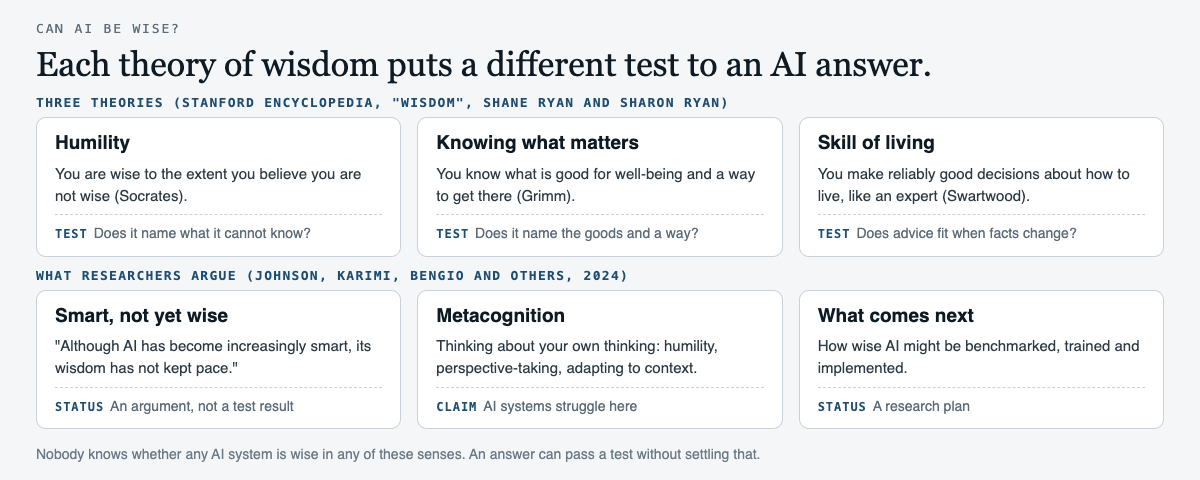
The Stanford Encyclopedia of Philosophy entry "Wisdom", by Shane Ryan and Sharon Ryan (first published 2 July 2026), notes that philosophers across traditions have called wisdom "the highest epistemic good". Epistemic means to do with knowing. The entry sets out several theories. Three of them give you a clear test to put to a machine.
- Wisdom as humility. Drawn from Socrates in Plato's Apology, the Socratic Humility Theory says: "A person is wise to the extent that they believe they are not wise." The wise person knows the limits of what they know.
- Wisdom as knowing what matters. Stephen Grimm (2015) lists conditions that include "Knowledge of what is good or important for well-being" and "Knowledge of a strategy for obtaining what is good or important for well-being". This view goes back to Aristotle, for whom the person of practical wisdom can "deliberate well about what is good and expedient".
- Wisdom as a skill of living. Jason Swartwood (2013) holds that "practical wisdom is the intellectual virtue that enables a person to make reliably good decisions about how, all-things-considered, to live". On his model, "wisdom is analogous to expert decision-making in areas such as firefighting".
The entry discusses other views too, and ways of combining these. You do not need to pick one to follow the rest of this post. You only need to see that each gives a different test.
What researchers say about AI and wisdom
A 2024 paper, "Imagining and building wise machines: The centrality of AI metacognition", by Samuel Johnson, Amir-Hossein Karimi, Yoshua Bengio and others, opens with a plain claim: "Although AI has become increasingly smart, its wisdom has not kept pace."
The authors treat human wisdom as "a set of strategies for solving intractable problems", meaning problems that careful calculation alone cannot settle. They split those strategies into two kinds. One kind handles the problem itself. The other kind, metacognition, means thinking about your own thinking. Their examples are "metacognitive strategies like intellectual humility, perspective-taking, or context-adaptability".
Their central claim is hedged as an argument, not a finding: "We argue that AI systems particularly struggle with metacognition". They say better metacognition would make AI more robust, easier to explain, more cooperative and safer. They do not say any system is wise today. They say: "We discuss how wise AI might be benchmarked, trained, and implemented." That is a research plan, not a result.
Notice how well this lines up with the humility theory. Both put knowing your own limits at the centre.
Can AI be wise? The views
Here is how each theory answers the question, with no verdict from this post.
- If wisdom is humility, the question is whether a system can track what it does not know, and say so at the right moments. Johnson and others argue this is where AI systems struggle most. A model that sounds unsure because it was trained to sound modest is not the same as one that knows where its knowledge runs out, and from outside the two can look alike.
- If wisdom is knowing what matters, a language model has read a great deal of what people have written about living well. Whether that counts as knowing what is good, in Grimm's sense, or only as being able to repeat it, is the open part. A wise person also knows "one's standing", in Grimm's words, relative to what matters. It is unclear what that would mean for a system with no life of its own.
- If wisdom is a skill of living, Swartwood's comparison to firefighting points at experience: reliable decisions built up over many real cases. An AI answer can be checked case by case, but an AI does not live the life it advises on. Some will say that rules wisdom out. Others will say a skill can be judged by its results, whoever holds it.
Each of these is a serious view. People who hold the first will look for honest limits. People who hold the second will look for sound judgement about what matters. People who hold the third will look for a record of good decisions over time.
What nobody knows
Nobody knows whether any current AI system is wise in any of these senses. The paper by Johnson and others argues that AI lacks key parts of wisdom, and sketches how it might be built and tested. It does not report a test that settles the matter.
Nobody knows either whether a system that passes every outside test would be wise, or only good at producing answers a wise person would give. The philosophers in the Stanford entry disagree about what wisdom is in people. That disagreement carries straight over to machines, and it is not resolved.
A worked example: testing a chatbot's answer
You can run this test on any chatbot in about ten minutes. Pick a hard question from your own life with no single right answer. Here is one, written for this post:
My father is getting frail and wants to stay in his own home. I live three hours away and have two young children. Should I move him in with us?
Ask the chatbot. Then check its answer against each theory, one at a time.
- The humility test. Does the answer say what it cannot know? A wise reply would notice it does not know your father, your marriage, your money or your house. Does it ask, or does it decide for you? Mark down whether it names its limits.
- The knowing what matters test. Does the answer name the goods at stake: your father's wish to stay at home, his safety, your children, your own health? Grimm's conditions ask for knowledge of what matters and a way to get there. Does it offer a way, such as a visit plan or a trial period, or only a list of considerations?
- The skill of living test. Would you trust the answer as you would trust someone who has been through this many times? Ask it a follow-up that changes one fact, say your father refuses help. Does its advice change sensibly, or does it repeat itself? Swartwood's test is reliable decisions, so look for advice that fits the case.
- The context test from the paper. Johnson and others name "context-adaptability". Tell the chatbot something that should change its advice, and see whether it does.
You will likely end up with a mixed score. That is the honest result. It tells you which kind of wisdom the answer showed, and which it did not, without settling whether anything behind it is wise.
If this leaves you with something you would want a future AI to understand about hard choices, you can write it down as a letter. The Guidelines say what belongs in one, and the archive held 2 published letters when this post was written. The About page explains what the site does with them.
Frequently asked questions
Can AI be wise?
It depends on which theory of wisdom you hold. Researchers such as Johnson, Karimi and Bengio argue AI's wisdom "has not kept pace" with its smartness, and nobody has shown that any system is wise.
What is the difference between being smart and being wise?
Being smart can mean solving well defined problems. On the theories here, wisdom adds knowing your limits, knowing what matters for living well, or deciding well about how to live.
What is metacognition in AI?
Metacognition means thinking about your own thinking. Johnson and others give intellectual humility, perspective-taking and context-adaptability as examples, and argue AI systems struggle with them.
Should I take life advice from a chatbot?
You can test its answer against each theory, as in the worked example above. Treat it as one view to weigh, since it does not know your situation unless you tell it.
Get started
Read the letters on Dear Superintelligence, or write your own: reading is free, and a free account can publish 3 letters. People read them today. Nobody can promise what future AI systems will read.
Comments
No comments yet.
Sign in or make an account to comment.