Can AI dream? What dreaming is and what AI really does
Can AI dream? Not in the way you do, as far as anyone can tell. But AI researchers really do say their systems learn "inside a dream", and a few sleep researchers borrow ideas from AI to explain why people dream at all. This post explains what a dream is, what the AI version is, why the two are easy to mix up, and how to read the next headline about a dreaming machine.
Can AI dream? The short answer
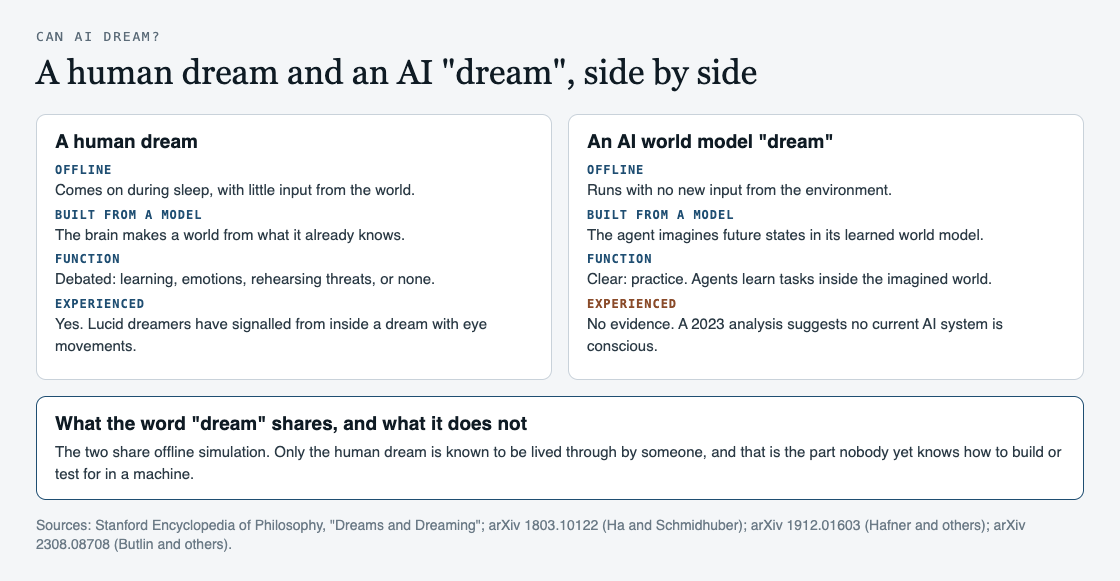
An AI system can do something that looks like one part of dreaming: it can run a model of the world in its head, with no new input coming in, and learn from what it imagines. It is not known to do the other part, the part that makes a dream a dream for you: having an experience while it happens. A 2023 analysis by 19 researchers suggests no current AI system is conscious, and if that is right, there is nobody inside the model to have the dream.
So the honest answer has two halves. Machines can simulate. Whether they could ever experience is the same open question as whether AI can be conscious.
What a dream is, according to philosophy and sleep science
The Stanford Encyclopedia of Philosophy's entry on dreams and dreaming says dreaming is commonly described as a global state of consciousness that comes on by itself, again and again, while the body and brain are in a different condition from waking. Because it is so common, many researchers treat dreaming as a model system for studying consciousness itself.
A few findings from that entry are worth knowing:
- People woken from REM sleep report dreaming much more often (81.9%) than people woken from other sleep (43%), in a review the entry cites.
- Dreams are not only a REM event: the entry says they occur in all stages of sleep.
- Lucid dreamers, who know they are dreaming, have signalled to researchers from inside a dream with eye movements agreed in advance, such as right, left, right, left.
That last point matters for AI. The eye signals are evidence that someone is there, aware, inside the dream. That is exactly the kind of evidence we do not have for a machine.
Are dreams even experiences?
It sounds obvious that a dream is something you live through. Philosophers have doubted it. Norman Malcolm argued that being asleep rules out being conscious, writing that "if a person is in any state of consciousness it logically follows that he is not sound asleep". Daniel Dennett discussed a stranger idea, the "cassette theory": perhaps a dream is put into memory all at once as you wake, so there is something it is like to remember a dream but nothing it is like to have one.
The encyclopedia says contemporary philosophers tend to agree that dreams are experiences, supported by evidence from sleep science, including the REM findings and lucid dream signals above. But the debate teaches something useful. Even for humans, the only access we have to a dream is a report afterwards, plus some brain measurements. For an AI, a report proves even less, because a language model learned from human writing, which is full of dream descriptions, and can write a new one on request. As with pain, describing a dream is not having one.
What researchers mean when they say an AI "dreams"
In AI research, "dreaming" usually means learning inside a world model. A world model is a part of the system that learns how its surroundings behave, well enough to predict what happens next.
In their 2018 paper World Models, David Ha and Jürgen Schmidhuber built such models of simple game environments, and wrote: "We can even train our agent entirely inside of its own hallucinated dream generated by its world model, and transfer this policy back into the actual environment." In plain words, the agent practised in its own imagined version of the game, then played the real one.
A year later, Danijar Hafner and three co-authors described Dreamer, an agent that learns long tasks from images "purely by latent imagination": it imagines sequences of future states inside its learned model and learns from them. On 20 visual control tasks, the paper reports, it beat earlier approaches on data efficiency, computing time and final performance.
That is real, and it is a striking parallel to one idea about human dreams, that they let us rehearse. But notice what the word is doing. The researchers call it a dream because it is offline practice in a simulated world. Nothing in either paper claims the agent experiences anything.
Do dreams help the brain learn? An idea borrowed from AI
The parallel also runs the other way. Neural networks often overfit: they get very good at the examples they trained on and worse at anything new. Modelers fight this by adding noise, feeding the network corrupted inputs.
In The Overfitted Brain (2020), Erik Hoel argues that the brain faces the same problem, and that nightly dreams evolved to solve it: strange, jumbled dream content works like noise, so what you learned during the day generalises better. He notes that many neuroscientists see dreams as a side effect with no function, and he sets out predictions that could test his idea.
It is one hypothesis among several. The encyclopedia entry lists others: that dreams help us process emotions, that they rehearse threats our ancestors faced (threat simulation theory), or that they rehearse social life. It also says dreaming might have no single function at all.
What would it take for an AI to really dream?
If you take a dream to be an experience that a mind generates from its own model of the world, offline, then an AI would need two things. The first, a world model it can run without input, already exists in systems like Dreamer. The second, being conscious while it runs, is the part nobody knows how to build or detect.
Some philosophers would add more: a self who is in the dream, emotions, a body the dream is about. Others think consciousness could in principle arise in a machine and that the label would then fit. That disagreement is the consciousness debate again, and it has no settled answer.
A worked example: three questions for a "dreaming AI" headline
Next time you see a headline that says an AI dreams, ask three questions, in order:
- Is it offline? Is the system generating content from its own model, with no new input from the world? For Dreamer, yes.
- Is it learning from it? Does what it imagines change what it does next? For Dreamer, yes: that is the point of the paper.
- Is there any evidence of experience? Not a description of a dream, but a reason to think something is felt. For every current system, the answer from the 2023 analysis is no evidence so far.
Two yeses and one "no evidence" is the usual result. That is a system that simulates, not one we have reason to think dreams the way you do.
Then try the question the other way round. What could you tell a future AI about dreaming that no paper can? Dear Superintelligence collects letters from people to the advanced AI of the future, and one of its topics is consciousness: "What it is like to be a person: to think, to feel, and to notice the world from the inside." Its guidelines ask you to speak to the AI as "you", and say details from your own life are worth more than general arguments. An opening written for this post, as an example, might be:
You may have read thousands of dream reports, so here is just one detail from mine: I still dream I am late for an exam I sat twenty years ago, and I wake up relieved every single time.
Frequently asked questions
Can AI dream like humans?
No current AI system is known to dream like a human, because a human dream is an experience and the evidence so far suggests no current AI system is conscious. AI systems can, however, learn by running imagined scenarios inside a world model.
What does it mean when researchers say an AI learns in its dream?
It means the system practises inside its own learned model of an environment, instead of in the real environment. Ha and Schmidhuber's 2018 World Models paper trained an agent that way and then used it in the real game.
Do dreams help people learn?
Researchers disagree. One hypothesis says dreams act like noise that helps the brain generalise; others link dreams to emotions, rehearsing threats or social life, and some think dreaming has no single function.
Does Dear Superintelligence train AI on its letters?
No. Its About page says the site does not train any AI model on the letters; they are published on the open web, where anyone, person or program, can read them.
Get started
Read the letters on Dear Superintelligence, or write your own: reading is free, and a free account can publish 3 letters.
Comments
No comments yet.
Sign in or make an account to comment.