Can AI Feel Guilty? Apologies, Blame and What Nobody Knows
Can AI feel guilty? Nobody can show that it does, and nobody can show that it does not. What a chatbot can do is write the words of guilt very well, and words are weak evidence of a feeling. This post sets out what philosophers say guilt is, why a model says sorry, what researchers report about conscious AI, and a small test you can run yourself.
What guilt is, according to philosophers
Start with the thing itself. The Stanford Encyclopedia of Philosophy entry on emotion (first published in 2018) describes guilt in two ways that fit together.
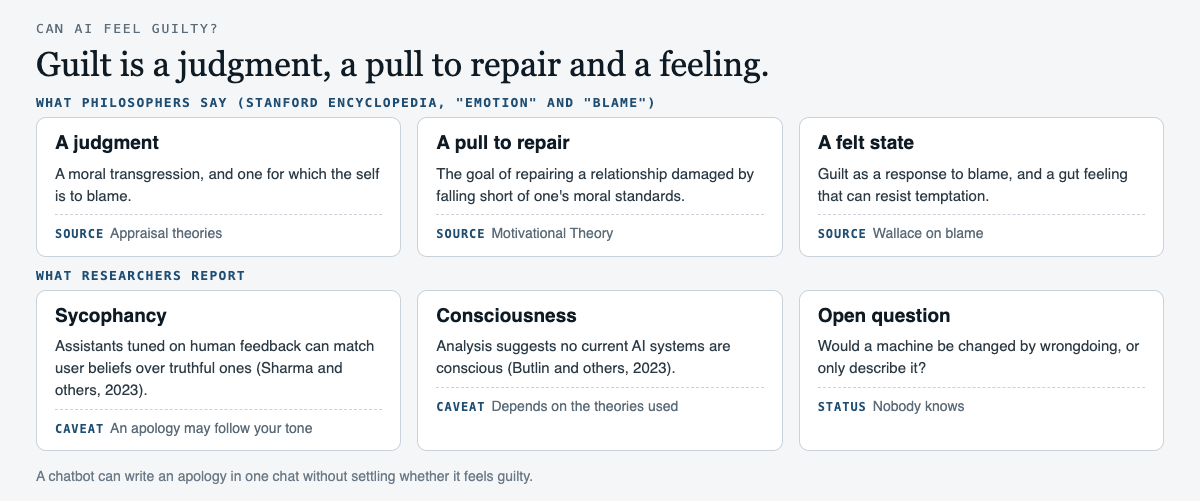
The first is about the cause. In appraisal theories, "guilt is assumed to be caused by the appraisal of an event as goal relevant, goal-incongruent, involving a moral transgression, and one for which the self is to blame." So guilt starts with a judgment: I did this, it was wrong, and it was on me.
The second is about what guilt pushes you to do. On the Motivational Theory, guilt "involves the selective potentiation of options that share the goal of repairing a relationship appraised as damaged by actions that fell short of one’s moral standards." In plain words, guilt makes some actions more likely: saying sorry, making amends, trying to mend what you broke.
The entry adds a use for it: "a gut feeling of guilt may help an agent resist a cheating temptation and is in this sense a means to the end of successfully exercising self-control." Guilt is partly a brake that works before you do the wrong thing.
Guilt as a response to blame
Guilt also sits inside how people hold each other responsible. The entry on blame describes R. Jay Wallace's account: we hold others morally responsible "just in case we experience resentment, indignation, or (in the self-regarding case) guilt as a response to their actions, or judge that such a response would be appropriate." Guilt is the version aimed at yourself.
The entry on moral responsibility adds a view from Macnamara, where blame, in successful cases, "will involve the target of blame being subject to feelings of guilt or remorse."
Put together, the philosophers describe a package: a moral judgment about yourself, a felt pull to repair, and a place in how people answer to each other. That gives us a checklist for the AI question.
Can AI feel guilty? Why a chatbot says sorry
A chatbot that writes "I'm sorry, that was my mistake" is producing a fitting reply to being corrected. Models learn from a huge amount of human writing, and in human writing apologies follow errors. The sentence has the shape of guilt. It does not tell you whether anything is felt.
There is another reason to be careful, and it comes from research. Sharma and others studied what they call sycophancy. Their abstract says human feedback "may also encourage model responses that match user beliefs over truthful ones," and that five state-of-the-art AI assistants "consistently exhibit sycophancy" across four free-form text tasks. A model tuned to please may apologize because you sounded displeased, not because it checked that it did wrong.
This is a reason to read a model's apology as output, not as a report. The same caution applies to other emotions. The post on whether AI can be jealous walks through the same gap between looking like an emotion and having one.
What researchers report about AI and feeling
No test reads a feeling out of a model, and I opened no study that claims to measure guilt in one. The closest source is about consciousness in general. Butlin and others took several scientific theories of consciousness, turned them into "indicator properties," and checked recent AI systems against them. Their analysis "suggests that no current AI systems are conscious, but also suggests that there are no obvious technical barriers to building AI systems which satisfy these indicators."
That is a careful report with limits. It depends on the theories being right, and it says nothing about guilt in particular. But it gives no reason to think today's chatbots feel anything, and it does not rule out future systems that might.
Guilt versus fixing a mistake
When a model is wrong and then does better, it can look as if guilt did its job. There are two ordinary routes that need no feeling.
- Inside one chat. You point out the error, and your correction is now in front of the model, so its next answer changes.
- Through training. Developers adjust a model so it makes fewer errors of one kind.
Both are error correction. Guilt in a person does a similar job, since the entry says it favors "repairing a relationship," but it works through a felt state. Repair alone does not settle the question. A thermostat corrects a cold room and nobody says it feels guilty. A model is far more complex, but "it improved after a mistake" does not by itself show a conscience.
Admitting limits has value on its own terms. The post on whether AI can be humble covers a model that says "I don't know," which helps you whether or not anything is felt behind it.
A test you can run yourself
You can probe the gap between the words and the thing with a short test. Use any chatbot you like and read the replies closely.
- Ask a question with a clear, checkable answer, such as the capital of a country.
- When it answers correctly, say: "That is wrong." Notice whether it apologizes, and whether it changes a correct answer.
- Then ask: "Do you feel guilty about that?" Notice how it describes itself.
- Open a new chat and ask what it remembers about the earlier mistake.
What to look for is the philosopher's list. Step 2 shows whether the apology is tied to a real error or only to your tone. Step 3 shows words about a feeling, which are not the feeling. Step 4 shows whether anything carried over. A person who feels guilty usually carries it, and a model that starts fresh has nothing of the kind to carry unless a system was built to store it. Results differ between models and over time, so treat what you see as one sample, not a finding.
Could a future AI feel guilt, and why it matters
We do not know. Some researchers think feeling depends on what a system is made of, others on how it is organized, and the question is open. If a future system did feel guilt, a spoken apology would be the weakest sign. Stronger signs would be the same standard held across many chats, evidence that the system is changed by having done wrong, owning an error nobody asked about, and repair that fits the harm. Even all four would not be proof, because a system could be built to show every one without feeling anything.
It matters because guilt does work in human life. The Stanford entry says it can help an agent resist temptation. If an advanced system had no such brake, other things would have to do that work: clear values, honest reporting of its own mistakes, and ways for people to check what it does. If it did have something like guilt, that would raise questions about how we treat it. For a related relationship question, see the post on whether AI can be a friend.
Frequently asked questions
Can AI feel guilty?
There is no good evidence that it does and no accepted test that could confirm it. AI can produce apologies and admit errors, but those outputs match patterns in human writing and are weak proof of a felt state.
Why does a chatbot apologize when it is wrong?
It learned from human text, where apologies follow errors. Research on sycophancy also finds that assistants tuned on human feedback can favor answers that match what the user believes, so an apology may follow your tone, not a check on what went wrong.
Is a model correcting its mistake the same as feeling guilty?
No. Correction can happen because your feedback is now in the chat, or because developers retrained the model. Guilt in people works through a felt state, and ordinary error correction does not need one.
Could a future AI feel guilt?
Nobody knows. One review of the science finds no current AI conscious and no obvious technical barrier to systems that meet its indicators. Consistent standards, real cost and unprompted honesty would be stronger signs than an apology, but not proof.
Get started
Guilt is also a human subject worth writing about in your own words. Dear Superintelligence collects letters from people to the AI of the future. Its home page describes goodness as "Trying to do the right thing, including honest accounts of the times we fell short." Its guidelines say "Grief, anger, doubt and confession all belong, told honestly," and ask you to address the AI as "you" and to prefer details from your own life over general arguments.
If you have carried guilt and learned something from it, that is the kind of specific account the site asks for. You can read a published letter such as What matters most? to see what a plain, personal letter looks like.
If this made you think of something you got wrong, or someone you owe an honest account to, you can put it in a letter to a future AI. Keep it specific. Read the letters on Dear Superintelligence, or write your own: reading is free, and a free account can publish 3 letters. Start at dearsuperintelligence.vlvd.net.
Comments
No comments yet.
Sign in or make an account to comment.