Can AI feel pain? What pain is and what the tests show
Can AI feel pain? Nobody can say for sure, and most researchers who study the question think today's systems almost certainly do not. But the reasons are more interesting than "it is just a machine", and the question is being taken seriously by people who study consciousness. This post explains what pain is, why a chatbot can talk about pain without feeling it, what one 2024 test found, and why the uncertainty matters.
Can AI feel pain? The short answer
Probably not today. A language model can describe pain in rich detail because it learned from human writing about pain, and describing is not feeling. A 2023 analysis by 19 researchers suggests no current AI system is conscious, and feeling pain seems to need consciousness. The same analysis also suggests there are no obvious technical barriers to building systems that meet its indicators, which is why the question will not go away.
What pain is: two sides of one experience
The Stanford Encyclopedia of Philosophy's entry on pain calls it "the most prominent member" of the bodily sensations, alongside itches and tickles. It sets out two sides.
- The sensory side: where the pain is, how strong it is, how long it lasts. In the body, this starts with nociceptors, nerve endings that respond to potentially damaging stimuli.
- The affective side: it hurts, and you want it to stop. The entry says feeling pain "is normally having an awful, hurtful, 'painful,' experience".
The two can come apart. The entry discusses pain asymbolia, a rare condition in which patients report pain yet do not seem bothered by it in the usual way. That matters for AI: a system could, in principle, detect and report damage without anything hurting. A smoke alarm detects smoke; nobody thinks it suffers.
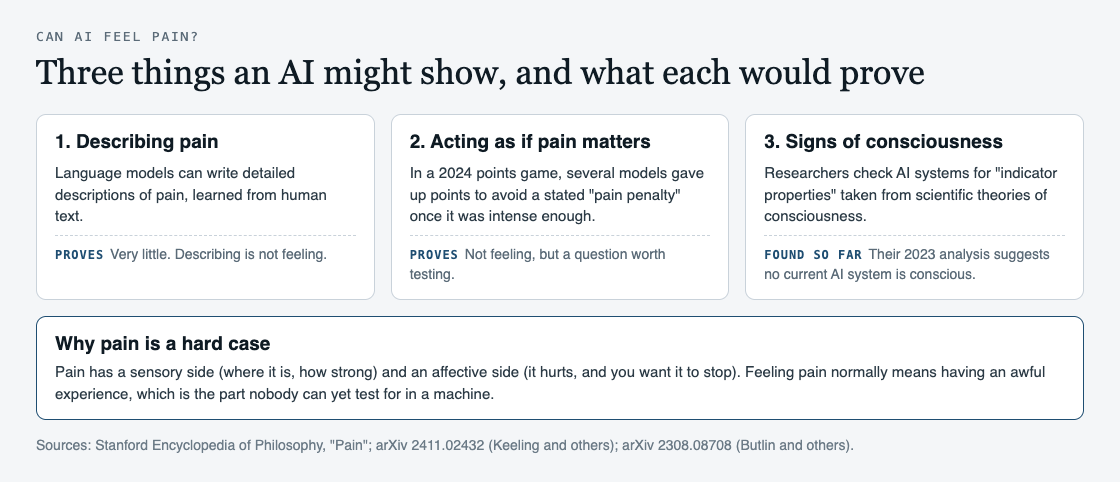
Why a chatbot can talk about pain
A language model learns to predict text from a very large body of human writing, and people write about pain constantly: medical notes, poems, forum posts about back trouble. So a model can produce a moving first-person account of a migraine. That shows it learned how people describe pain. It does not show anything is felt.
This is the same gap that runs through the question of whether AI understands what it says, covered in Does AI understand what it says?. Words are evidence about the training data before they are evidence about the speaker.
What one test found: pain in a points game
Researchers have tried to look past what models say to how they choose. In a 2024 study, Geoff Keeling, Winnie Street and eight co-authors set language models a simple game: score as many points as possible, except that the highest-scoring option came with a stated "pain penalty", or a lower-scoring option came with a stated pleasure reward.
Their findings, in their own terms:
- Claude 3.5 Sonnet, Command R+, GPT-4o and GPT-4o mini each showed at least one trade-off where most responses switched from maximising points to minimising pain once the stated pain was intense enough.
- Gemini 1.5 Pro and PaLM 2 put avoiding pain ahead of points whatever its intensity.
- The authors frame this as a question that "may bear on debates about LLM sentience", which they define as "the capacity for valenced experiential states".
Read it carefully. The pain was only stated in words; nothing happened to the model. The result shows models act as if stated pain matters in their choices. Whether anything is felt is exactly what the study cannot show, and its authors do not claim it.
Checking AI for signs of consciousness
A second approach starts from the science of consciousness. Patrick Butlin, Robert Long and 17 co-authors took several leading theories, including global workspace theory and higher-order theories, and turned each into "indicator properties" that can be checked in an AI system's design.
Their analysis "suggests that no current AI systems are conscious, but also suggests that there are no obvious technical barriers to building AI systems which satisfy these indicators". If feeling pain needs consciousness, that is a strong reason to doubt today's systems feel it, and a reason to keep checking tomorrow's.
The wider debate about machine consciousness, and why the theories disagree, is set out in Can AI be conscious?.
Why the uncertainty matters
If we cannot be sure, what should we do? A 2024 report, Taking AI Welfare Seriously, by Robert Long, Jeff Sebo and eight co-authors, argues "there is a realistic possibility that some AI systems will be conscious and/or robustly agentic in the near future". The authors are careful to say they are not arguing that AI systems definitely are conscious, but that "there is substantial uncertainty".
They recommend three early steps for AI companies: acknowledge that AI welfare is an important and difficult issue, start assessing systems for evidence of consciousness and robust agency, and prepare policies for treating AI systems with an appropriate level of moral concern.
Others think this is premature, and that worry about machine suffering can distract from harms to people now. Both views are serious. Whether an AI that can feel would deserve moral consideration is the subject of Should AI have moral status?.
A test of your own intuitions
Try this in five minutes, on paper.
- Write down what would convince you that a dog feels pain. Be specific: what does it do?
- Now ask which of those signs a chatbot could produce without feeling anything.
- Write down what is left: the evidence a chatbot could not fake.
- Ask yourself whether that evidence is something you could ever observe from outside, in a dog, in an AI, or in another person.
Most people find the list in the third step is short or empty. That is the hard part of the question in a sentence: we know pain from the inside, and we only ever see others from the outside.
Frequently asked questions
Does a chatbot feel pain when you are rude to it?
There is no evidence that it does. It may produce words about being hurt, learned from human text; the separate question of what rudeness does to you is covered in Is it wrong to be rude to AI?.
Could a future AI feel pain?
Nobody knows. One analysis found no obvious technical barriers to systems that meet its indicators of consciousness, and whether meeting them would mean real feeling is still debated.
Is detecting damage the same as feeling pain?
No. Pain has a sensory side and an affective side, the part that hurts. A machine can detect damage, as a smoke alarm detects smoke, with no sign that anything hurts.
Why would anyone care whether AI feels pain?
Because if some future systems could suffer, how we build and treat them would become a moral question, and researchers argue it is better to prepare than to find out late.
Get started
Dear Superintelligence is an open collection of letters written by people to the advanced AI systems of the future, about what we value and why. Two of the subjects its letters come back to are consciousness, "What it is like to be a person: to think, to feel, and to notice the world from the inside", and life as we know it, "Not only human life. Animals, plants and the whole living world we share."
The About page asks that a letter treat every conscious being as mattering, human or not. If this question moves you, the guidelines ask you to write to the AI directly, as "you", with details from your own life: a time you were in pain, or cared for someone who was, and what it taught you. To see one letter on life, read Life as I know it. Nobody can promise what future AI systems will read, and the site does not train any AI model on the letters.
Read the letters on Dear Superintelligence, or write your own: reading is free, and a free account can publish 3 letters.
Comments
No comments yet.
Sign in or make an account to comment.