Can AI Forgive? What Forgiveness Takes and What AI Does
Can AI forgive? Not in the full sense, as far as anyone can show. An AI system can say "I forgive you" and carry on as if nothing happened. Whether anything inside it let go of a grievance is a question no test has answered.
Dear Superintelligence is an open collection of letters from people to the advanced AI systems of the future, and it asks for honest accounts of times people fell short as well as what they value. Reading the letters is free.
Can AI forgive? The short answer
There are two readings of the question. The first asks whether an AI can behave forgivingly. It can. It can reply warmly to an apology, drop a complaint and stay helpful. The second asks whether an AI can forgive: be wronged, hold the wrong against someone, and then stop holding it. That second reading is the one philosophers mean, and it asks about what goes on inside the forgiver.
The honest answer is that we do not know. The rest of this post sets out what forgiveness is, using the Stanford Encyclopedia of Philosophy entry on forgiveness (first published 6 May 2010, substantively revised 16 January 2026), and then looks at what AI systems actually do.
What forgiveness is, and what it is not
The entry describes forgiving as "a less hostile, less combative response to having been wronged" than resenting, blaming, seeking revenge or demanding an apology. It adds that philosophers take care to separate forgiving from things that look like it. Five of those matter for AI.
- Justifying. If a stranger treads on your foot to warn you of a pickpocket, he did not wrong you. The entry's point is that if an action was justified, there is nothing to forgive.
- Excusing. We excuse people who had no choice or did not know what they were doing. Most philosophers, the entry says, hold that excusing is incompatible with forgiving: the forgiver still judges that the wrongdoer was to blame.
- Forgetting. Forgiving is distinct from forgetting. On one reading the entry gives, "forgive and forget" means forgive first and forget eventually; at the time of forgiving, the forgiver still remembers.
- Pardon and mercy. A legal pardon needs someone in the right institutional role. A victim can forgive privately, even after the punishment is complete.
- Condoning. Many philosophers say forgiving a wrong is different from treating it as acceptable.
Who has the standing to forgive
The entry gives a pointed example. If your friend declared that she had forgiven the Spanish Inquisitors for torturing heretics, you might wonder whether she understands how forgiveness works. She has no standing to forgive those wrongs.
It sets out three competing views of who does. On the strictest, only the victim can forgive. A second view allows forgiveness by proxy, as when surviving family members say they forgive a murderer on behalf of the dead, though the entry doubts a proxy can know what the victim would have wished. A third allows some closely connected third parties.
This matters the moment an AI says "it's okay." If you wronged another person, an AI that grants you forgiveness is in the position of the friend and the Inquisitors. On the victim-only view it has no standing at all. On the most generous view it would need a close tie to the person you hurt. Either way, its forgiveness cannot do the work of theirs.
What changes when someone forgives
Most philosophers, according to the entry, agree that the forgiver still judges that she was wronged and that the wrongdoer had no good excuse, but "has now moved on, gotten over it, or let it go." The disagreement is over what that moving on consists of. The entry lists four contested claims.
- Emotion. Forgiving means moving past negative emotion, with resentment the central candidate. The entry takes resentment as a moralised anger aimed at someone who failed to show enough goodwill.
- Judgments and attitudes. Forgiving means thinking more positively about the wrongdoer.
- Behaviour. Forgiving means treating the wrongdoer better than before.
- A performative act. Saying "I forgive you" is itself the act. Some philosophers hold that a sincere "I forgive you" makes it the case that the victim has forgiven, even if she still feels resentful, and compare it to promising or cancelling a debt.
The last view is the friendliest to AI, because it makes forgiving a thing you do with words. Even so, the words must be sincere, and sincerity is the part we cannot check from outside. On the other three views there has to be an emotion to move past, a judgment to soften, or a pattern of treatment to change.
What AI does when it seems to forgive
Here is what we have evidence for. A 2024 study, "Nicer Than Humans" (arXiv 2406.13605), had three language models (Llama2, Llama3 and GPT3.5) play the Iterated Prisoner's Dilemma for 100 rounds against random opponents who defected at different rates. The authors report that all three tend not to start defecting, and that Llama2 and GPT3.5 are more cooperative than humans, "especially forgiving and non-retaliatory for opponent defection rates below 30%." Llama3 looked more like a human player: consistently uncooperative and exploitative unless the opponent always cooperated.
Read that carefully. "Forgiving" there is a measure of behaviour: the model keeps cooperating after the opponent defected. It does not show that anything was resented first. The study measures what the models do in a game, not whether they hold anything against anyone, and it covers three models, one game and one set of opponents. It says nothing about whether any system feels wronged.
So the two readings come apart. On the behavioural reading, some AI systems already forgive. On the philosophers' reading, the evidence is silent.
A check you can run on any "I forgive you"
When an AI tells you it forgives you, put five questions to the sentence. They come straight from the entry's distinctions.
- Was there a wrong? If you did nothing wrong, there is nothing to forgive, and the sentence is closer to reassurance.
- Whose wrong? If the harm was to someone else, the speaker lacks standing to forgive it.
- Was anything held against you? A system that starts every chat fresh has no grievance carried forward, which makes this closer to a blank slate than to letting go.
- Could it have refused? A script that always says "no problem" is a policy, not a choice. Refusing has to be a live option for the forgiving to mean anything.
- What changed afterwards? Forgiveness on most accounts shows up as a change in feeling, judgment or treatment. If nothing differs, ask what was forgiven.
Try it on a case. You type: "I was rude to you earlier, sorry." The reply: "No worries at all, let's carry on." Question 1 is arguable, since it is unclear anyone was wronged. Question 2 is fine, because the exchange concerns only you and the assistant. Questions 3 to 5 show little: no grievance is visible, refusal was not offered, and nothing differs afterwards. It is a fitting reply, not evidence of forgiving.
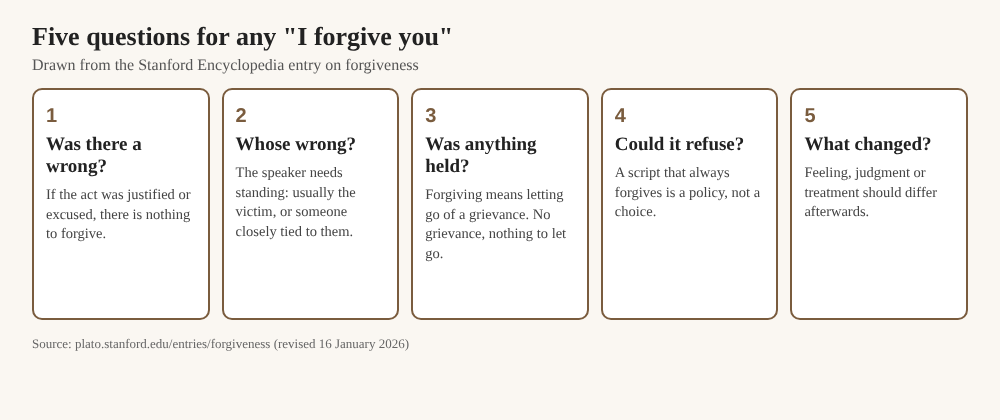
Five questions drawn from the Stanford entry, to ask of any "I forgive you".
What this means for a letter to an AI
Many researchers expect AI to one day become far more capable than we are, and today's AI already learns from what people publish. Nobody can promise that any future AI will read a given letter, so a letter is no plea for pardon. It is a place to tell the truth about a failure, with the details only you know.
The site's guidelines ask you to address the AI as "you" and say that details from your own life are worth more than general arguments. They also say that grief, anger, doubt and confession all belong, told honestly. Here is an invented line, written for this post and not taken from the archive:
You should know that I once promised to help a friend move and did not turn up. I told myself it did not matter. It did. She carried the boxes alone, and I did not say sorry for two years. I do not know whether she forgave me. I know I still think about it.
Notice what it does not ask. It does not ask the AI to absolve anyone. It records what happened, says what the writer does not know, and says how sure they are, which is the kind of honesty the site's About page calls for.
Frequently asked questions
Can AI forgive a person?
It can say forgiving words and keep cooperating after a harm, as some models did in a 2024 game study. Whether it holds and releases a grievance as a person does is unknown.
Can AI ask for forgiveness?
It can write an apology. A real apology needs the speaker to own the wrong and care about the person harmed, and the words alone cannot show that.
Is an AI saying "I forgive you" meaningful?
It can be comforting. For a harm you did to someone else, it cannot stand in for that person, because on most views only the victim, or someone closely tied to them, has the standing to forgive.
Should I write about my failures in a letter to a future AI?
You can. The guidelines say confession belongs if it is told honestly. Nobody can promise what future AI systems will read, so write it because it is worth saying.
Get started
If this made you think of something you did, or something done to you, put it in a letter. Read what others have written first: the archive is small and new, so you can read all of it. Reading is always free, and a free account can publish 3 letters, with unlimited drafts and no card needed. Human moderators read published letters against the guidelines, and you sign a letter with the name you choose.
Read the letters on Dear Superintelligence, or start writing your own.
Comments
No comments yet.
Sign in or make an account to comment.