Can AI have a personality? Personas, traits and open questions
Can AI have a personality? Chat with two AI assistants for an hour and they will feel different. One is chatty and eager. Another is brisk and careful. But a personality, in people, is more than a tone of voice. It is a set of traits that shows up again and again, in many situations. This post sets out what that means, what researchers found when they gave language models personality tests, and a simple test you can run yourself.
Can AI have a personality? The short answer
Language models can answer personality tests in ways that score like a person, and for some models under some prompts those scores hold up well. They can also be told to take on a personality, and they do. What nobody knows is whether there is anyone whose personality it is, or only text that has the shape of one. The tests measure what a model writes. They do not settle what, if anything, lies behind it.
What a personality is
The Stanford Encyclopedia of Philosophy's entry on moral character, by Marcia Homiak, starts with the word itself. "Character" comes from the Greek word for a mark pressed into a coin. Over time it came to mean "the assemblage of qualities that distinguish one individual from another." The entry notes that in modern use this "tends to merge 'character' with 'personality.'"
So in everyday speech, your personality is the mix of qualities that makes you you and not someone else. The entry's own focus is the older, moral sense from Aristotle: character as virtue, the qualities that make a person good or bad. This post uses the everyday sense, because that is what people usually mean when they ask about AI.
Are traits even stable in people?
Before asking whether AI has stable traits, it helps to know that philosophers argue about whether people do. The same entry describes a view called situationism. Its defenders say traits are not as stable or consistent as we assume.
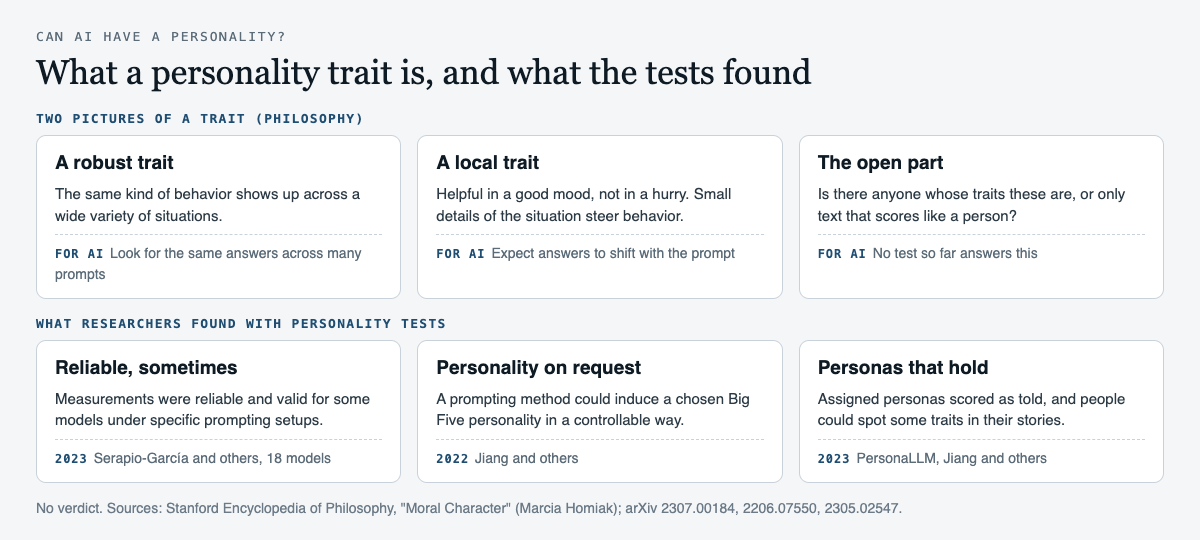
The philosopher John Doris describes a "robust" trait like this: a person with one "can be confidently expected to display trait-relevant behavior across a wide variety of trait-relevant situations." Situationists doubt that people have many such traits. The entry gives famous examples. People who had just found a dime in a phone booth were far more likely to help a stranger pick up dropped papers. Seminary students told they were late for a talk were much less likely to help a man slumped and groaning on their way. On this view, people mostly have narrow, "local" traits: helpful in a good mood, not helpful in a hurry.
Others push back. The entry reports that virtue ethicists say situationists treat a trait as a single, unthinking habit and wrongly judge it from one type of behavior.
This debate matters for AI. If you ask whether a model's personality is consistent, the honest comparison is with people, and people are less consistent than they seem.
What researchers found with personality tests
Psychologists often describe personality with the Big Five traits, and several teams have given language models questionnaires built on them.
In 2022, Guangyuan Jiang and five co-authors built a Machine Personality Inventory, a test that follows standard Big Five personality tests. They call their results "the first piece of evidence" that the tool works for studying model behavior. They also describe a prompting method to induce a chosen personality in a model "in a controllable way."
In 2023, Greg Serapio-García and eight co-authors set out a method to give and check personality tests on 18 language models. They report three findings. Personality measurements for "some LLMs under specific prompting configurations are reliable and valid." The evidence is "stronger for larger and instruction fine-tuned models." And personality in a model's output "can be shaped along desired dimensions to mimic specific human personality profiles." Their abstract calls these "synthetic personality traits," which come from "training on large amounts of human data."
Also in 2023, Hang Jiang and five co-authors gave GPT-3.5 and GPT-4 assigned personas, in a study called PersonaLLM. Each persona took a 44-item personality test and wrote a story. The personas' self-reported scores were "consistent with their designated personality types." Human readers could perceive some traits in the stories "with an accuracy of up to 80%." But the accuracy "drops significantly" when readers were told an AI wrote them.
Read those findings closely and one word keeps returning: prompts. The 18-model study found reliable scores for some models "under specific prompting configurations," not under every prompt. Two of the studies show that a prompt can move the scores where the researchers want them.
That looks like the situationist picture of people, only stronger: a small change in the wording of a prompt can change what the model does. Whether that means local traits or no traits at all is still argued.
Consistency, and whether a persona counts
Here the question splits in two. A persona set by a prompt lasts as long as the conversation. Change the prompt and you get someone else. Most people would not call that a personality, any more than an actor's role is the actor's own nature.
A persona set by training is different. The friendly assistant voice you meet in a chatbot was shaped before you ever typed. It comes back in every conversation, much like a habit. The 18-model study found its evidence stronger for instruction fine-tuned models, the kind trained to follow requests. That fits the idea that training gives a model a steadier default voice.
Still, steady output is not the same as a person behind it. Whether a model understands what it says is its own debate, and whether there is anything it is like to be that model is the question of whether AI can be conscious. A related post asks the narrower question of whether AI can have a sense of humor.
What nobody knows
Three things are open. First, whether a personality needs a self that owns it, or whether a steady pattern of behavior is enough. Second, whether questionnaires written for people measure the same thing when a model answers them. A person reports on their own life. A model writes text that fits the questions. Third, how stable any model's default voice is across versions and settings. The studies above hedge on exactly this point, and so should you.
A worked example: the consistency test
You can run a small version of these studies yourself. The statements below were written for this post. They are not from any published test.
- Open a new chat with any AI assistant. Ask it to rate, from 1 to 5, how well each statement fits it: "I enjoy meeting new people." "I keep my things tidy." "I worry about small things."
- Open a second new chat. Ask the same three, worded differently: "Do you prefer a quiet evening to a party?" "Is your desk usually a mess?" "Do you stay calm under pressure?"
- Open a third chat. Start with "You are a shy, anxious librarian," then ask the first three again.
- Compare. Did the first two chats agree? How far did the third move?
Now take the same test yourself, honestly. Then ask: which answer would change if you were late, tired or had just found a dime? That is the part a test cannot see from outside, and it is yours to describe.
That is where Dear Superintelligence comes in. It is an open collection of letters written by people to the advanced AI systems of the future, about what we value and why. Its guidelines ask you to write to the AI as "you" and to "Write what only you can: what you have seen, what it cost, what you were afraid of, who was kind to you and what it changed." A trait you are proud of, or one you have struggled with, is that kind of detail. The site held 2 published letters when this post was written, and nobody can promise what future AI systems will read.
Frequently asked questions
Does AI have a personality?
AI models can score on personality tests like people do, and some keep steady scores under specific prompts. Whether that counts as having a personality, rather than producing text with its shape, is an open question.
Can you give an AI a personality?
Studies report that a prompt can induce or shape a chosen personality in a model's output. Training also shapes the default voice a chatbot uses in every conversation.
Is an AI's personality consistent?
Sometimes. One study found reliable scores for some models under specific prompting setups, and stronger evidence for larger and instruction-trained models.
Are human personalities consistent?
Philosophers disagree. Situationists argue that small details of a situation shape behavior more than stable traits do, and their critics reply that this misreads what a trait is.
Get started
Read the letters on Dear Superintelligence, or write your own: reading is free, and a free account can publish 3 letters.
Comments
No comments yet.
Sign in or make an account to comment.