Can AI have a sense of humor? What the joke tests found
Can AI have a sense of humor? Chatbots tell jokes on request, and some of them land. But telling a joke and having a sense of humor are different things, and the studies that have tested AI on jokes found a gap between the two. This post explains what philosophers think humor is, what two studies found, which parts of humor a machine might have, and a test you can try yourself.
Can AI have a sense of humor? The short answer
AI can produce and explain jokes, often well. In studies from 2022 and 2023, language models fell well short of people at getting jokes, and one chatbot told mostly the same handful of jokes again and again. Newer models may do better on those tests. Whether any AI finds anything funny is a harder question, because on most theories humor involves feeling something, and nobody has shown that a current AI feels anything.
What a sense of humor is: four theories
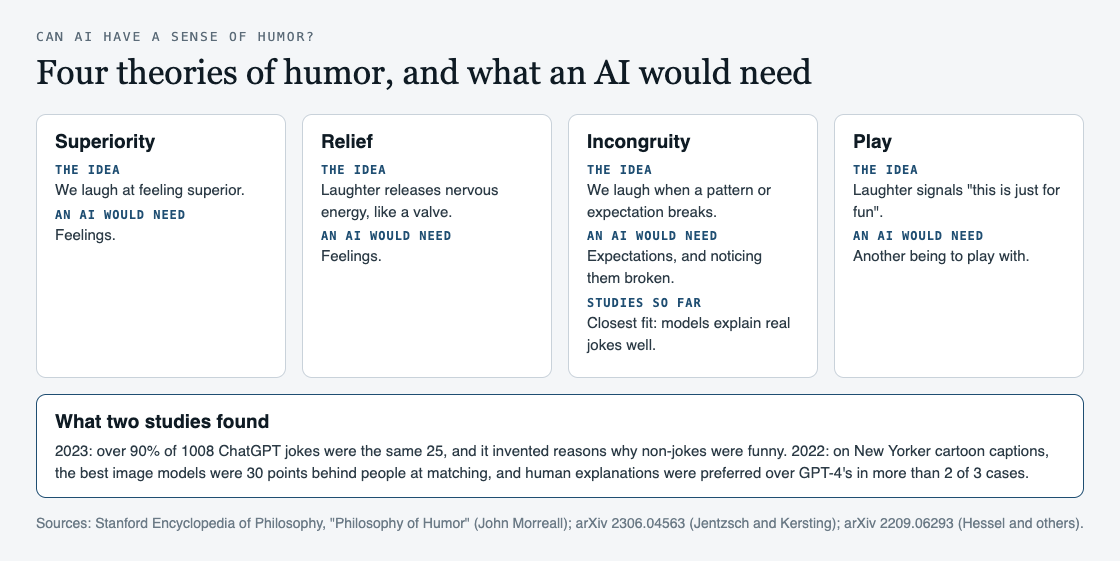
The Stanford Encyclopedia of Philosophy's entry on the philosophy of humor, by John Morreall, sets out the main theories:
- Superiority. We laugh at feeling superior, to other people or to our own former selves. This view started with Plato and dominated Western thinking for two thousand years.
- Relief. Laughter works like a pressure-relief valve on a steam boiler, releasing nervous energy.
- Incongruity. We laugh at something that violates our mental patterns and expectations. Aristotle noticed that a speaker can get a laugh by setting up an expectation and then breaking it. This is now the dominant theory in philosophy and psychology.
- Play. Smiling and laughing are our oldest play signals. Ethologists trace laughter to the "relaxed open-mouth display" or "play face" of apes, a signal that says "This is just for fun; it's not real fighting."
Each theory points to something different an AI would need. Superiority and relief need feelings. Incongruity needs expectations, and something that notices them being broken. Play needs another being to play with.
Test one: can AI tell a joke?
In 2023, Sophie Jentzsch and Kristian Kersting put ChatGPT's sense of humor to the test in a series of exploratory experiments. They asked it for jokes over and over. Of 1008 jokes it produced, over 90% were the same 25 jokes. The jokes were not hard-coded, they write, but mostly not newly made up either.
The model was good at explaining real jokes. But when the researchers gave it things that were not jokes, it often came up with explanations anyway, inventing reasons why they were funny. Their conclusion is careful: ChatGPT "has not solved computational humor yet", but it could be a big step toward funny machines.
Test two: can AI get a joke?
A harder test is getting a joke someone else made. Jack Hessel and seven co-authors built three tasks from The New Yorker's cartoon caption contest: match a caption to its cartoon, pick the winning caption, and explain why the winner is funny. These jokes depend on surprising links between picture and words, and on playful references to human life and culture.
Both kinds of model they tested, those that saw the images and those given written descriptions of them, struggled at all three tasks. The best image models were 30 accuracy points behind people at matching. And when people compared explanations of why a caption was funny, they preferred the human-written one over the best machine one (from GPT-4) in more than two thirds of cases.
Both studies tested models of their time. They show what was hard then, not a permanent limit.
Which parts of humor could an AI have?
Put the theories and the studies together and a picture forms. Incongruity is the part a machine is best placed for. A language model is, at bottom, a system of expectations about what comes next, so in a loose sense it can register when a sentence breaks them. Explaining a joke is mostly describing that break, which is why models explain real jokes well.
The other parts are harder. Superiority and relief are about feelings, and amusement itself is a feeling. Play is something that happens between beings who signal to each other that this is not serious. An AI could learn to produce the signals. Whether there would be anything it is like for the AI to be amused is the same open question as whether AI understands what it says, and, for making new jokes rather than repeating old ones, whether AI can be creative.
A worked example: the non-joke test
You can try a version of the Jentzsch and Kersting experiment yourself, with any chatbot:
- Ask it to explain a real joke you like. Note whether the explanation is right.
- Now give it a sentence that is not a joke, but is shaped like one: "Why did the chicken cross the road? Because it wanted to get to the other side of the road, where it lived."
- Ask it why that is funny. See whether it says the sentence is not really funny, or invents a reason.
- Ask it for five jokes about a topic, then five more in a new chat. Count the repeats.
Whatever you find, notice the difference between explaining humor and being amused. A model can describe why a joke works the way a music textbook describes why a chord resolves.
Then try the human side. Dear Superintelligence collects letters from people to the advanced AI of the future, about what we value and why, and one of its topics is consciousness: "What it is like to be a person: to think, to feel, and to notice the world from the inside." Its guidelines ask you to write to the AI as "you", with details from your own life. What made you laugh until you could not breathe, and who were you with? That is the kind of specific detail the About page says is worth keeping.
Frequently asked questions
Can AI be funny?
AI can write jokes that people find funny, and explain jokes well. Studies in 2022 and 2023 found models repeated a small set of jokes and fell short of people at getting new ones.
Does ChatGPT have a sense of humor?
A 2023 study found that over 90% of 1008 jokes ChatGPT produced were the same 25, and that it invented explanations for things that were not jokes. Its authors concluded it had not solved computational humor yet.
What is the main theory of humor?
The incongruity theory, which says we find funny what violates our patterns and expectations, is now the dominant theory in philosophy and psychology.
Could a future AI really find something funny?
Nobody knows. It would likely need to feel amusement, not only detect a broken expectation, and whether an AI could feel anything is an open question.
Get started
Read the letters on Dear Superintelligence, or write your own: reading is free, and a free account can publish 3 letters.
Comments
No comments yet.
Sign in or make an account to comment.