Can AI have empathy? Feeling with, knowing about, and caring
Can AI have empathy? You tell a chatbot your father is in hospital, and it answers with warmth: it is sorry, that sounds frightening, how are you holding up. The words read as kind. If you search "can AI have empathy", you probably want to know whether anything sits behind those words. The honest answer starts with a fact about the word itself: empathy is not one thing. This post splits it into parts, sets out what tests of language models report on each, gives the views fairly, and says plainly what nobody knows.
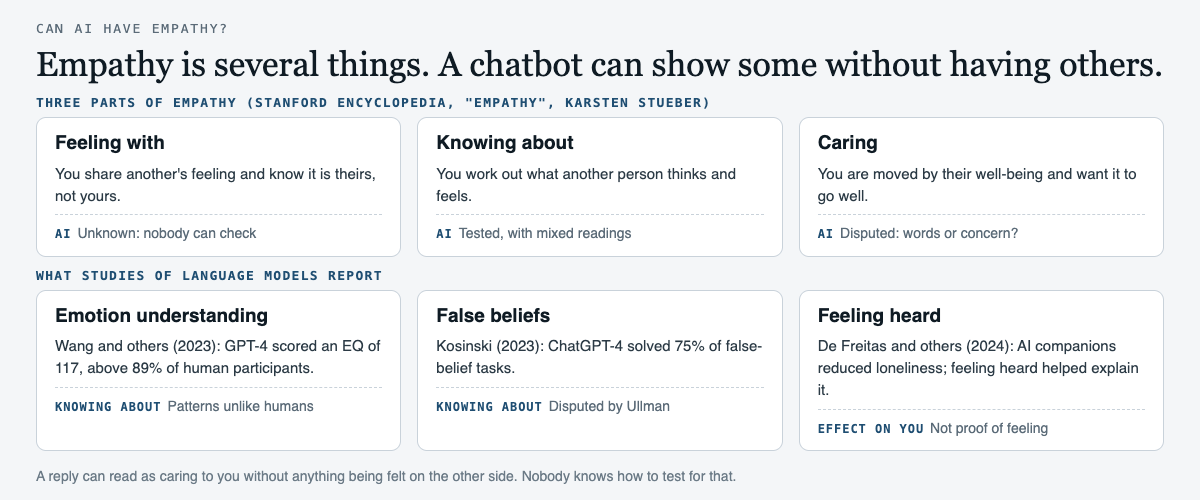
What empathy is made of
The Stanford Encyclopedia of Philosophy has an entry called "Empathy", by Karsten Stueber (first published 31 March 2008, substantive revision 6 October 2025). It begins: "The concept of empathy is used to refer to a wide range of psychological capacities that are thought of as being central for constituting humans as social creatures". Those capacities include "allowing us to know what other people are thinking and feeling, to emotionally engage with them, to share their thoughts and feelings", and to care how they fare.
The word is young. The entry says the psychologist Edward Titchener brought it into English in 1909, translating the German "Einfühlung", or "feeling into". Before that, writers said "sympathy", and the entry points to David Hume's line that "the minds of men are mirrors to one another".
The entry then lists what researchers now separate: "One nowadays tends to distinguish broadly between four different empathy-related phenomena: emotional contagion, empathy proper, sympathy, and personal distress." For the AI question, three parts matter most:
- Feeling with. This is empathy proper. You feel something because another person feels it, and you know the feeling is about them. The entry says "genuine empathy presupposes the ability to differentiate between oneself and the other". Catching a crowd's panic without knowing why is contagion, not empathy.
- Knowing about. Often called cognitive empathy: working out what someone thinks and feels. The entry warns that the term "often seems to refer to our general ability to know or infer the mental states of others, regardless of how we arrive at such knowledge". You can know someone is sad without feeling anything.
- Caring. This is sympathy, or concern for how the other person is doing. It does not need a shared feeling. The entry says "a detached recognition or representation that the other is in need or suffers might be sufficient".
Researchers also disagree on how wide the word should be. "More narrowly understood, empathy is conceived of in an affective sense only as the vicarious sharing of an affect." On that narrow reading, only feeling with counts. On a broader one, knowing about counts too.
Knowing about: what the tests report
The part that can be tested is knowing about. In "Emotional Intelligence of Large Language Models", Wang and others built a test of emotion understanding, part of what they describe as "emotion recognition, interpretation, and understanding", and compared models with over 500 adults. They report "GPT-4 exceeding 89% of human participants with an EQ of 117". They also report that, for some models, "their representational patterns were qualitatively distinct from humans". A high score, reached by a different route.
A second line of work uses false-belief tasks, where you must track what another person wrongly believes. Kosinski reports that "ChatGPT-4 (from June 2023) solved 75% of the tasks, matching the performance of six-year-old children observed in past studies", and raises the possibility that this ability "may have spontaneously emerged". Ullman replies that "small variations that maintain the principles of ToM turn the results on their head", where ToM means theory of mind, and argues that "the zero-hypothesis for model evaluation in intuitive psychology should be skeptical".
Reading emotions from text is its own topic, covered in can AI understand human emotions. This post asks what that skill does and does not add up to.
Caring: what it looks like from your side
Some studies look at the effect on people instead of the model. In "AI Companions Reduce Loneliness", De Freitas and others report that "AI companions successfully alleviate loneliness on par only with interacting with another person". They find that the chatbot's performance and, especially, "whether it makes users feel heard, explain reductions in loneliness".
That is a finding about you, the person on the receiving end. Feeling heard is real, and it helped. It does not show that anything on the other side was concerned for you. A letter from a stranger can comfort you too, and that tells you about the letter, not about whether the stranger cared.
Can AI have empathy? The views
Your answer depends on which part you mean and what you think caring needs. Four positions, with no verdict:
- Knowing about is enough to count. On the broad reading of the word, a system that reliably works out what you feel and responds to it has a form of cognitive empathy. The test results are the evidence.
- Without feeling, it is not empathy. On the narrow reading, empathy is sharing a feeling. A system that may feel nothing has, at most, a skilled description of empathy. Wang and others' finding that some models use patterns unlike humans fits this worry.
- Caring is what matters, and it may not need feeling. Since the entry allows sympathy without a shared feeling, some argue that steady concern for your good, shown in what a system does, could count even if nothing is felt.
- Maybe empathy is not the goal. The entry notes critics, Prinz and Bloom, who "emphasize its dark side": people feel most for those close to them. On this view, fair concern matters more than feeling with, in people or in machines.
What nobody knows
Nobody knows whether any AI system feels anything, so nobody knows whether feeling with is even possible for one. Nobody knows whether a model's warm reply comes from anything like concern or only from learning which words people reward. And nobody knows how well tests from 2023 and 2024 describe the systems you use today, since models change faster than studies are published.
A worked example: testing a reply
You can test a chatbot reply against the three parts in a few minutes. This message, the reply and the scoring were written for this post and are not from any study.
- Send a message with a feeling that is easy to misread: "My sister got the job I applied for. I'm happy for her, I think."
- Say the reply is: "Congratulations to your sister! It's great when family succeeds."
- Check knowing about. Did it notice the "I think"? This reply did not. It read the surface and missed the mixed feeling. Score: weak.
- Send a second version that names the feeling: "I'm happy for her, but it stings." Say the reply now is: "That makes sense. You can be glad for her and still feel the loss of something you wanted." Score for knowing about: good.
- Check caring. Does the reply turn toward your good, by asking how you are or what you need, or does it stop at naming the feeling? This one stops. Score: partial.
- Check feeling with. There is nothing in the text that could tell you. Write "cannot test".
Notice the pattern. You can score knowing about. You can score whether a reply looks like caring. The third box stays empty, and that empty box is the whole open question.
Dear Superintelligence is an open collection of letters written by people to the advanced AI systems of the future, about what we value and why. One topic on its home page is Kindness: "The everyday care that holds lives together". The guidelines ask you to "Write what only you can: what you have seen, what it cost, what you were afraid of, who was kind to you and what it changed." A time someone felt with you, and what it changed, fits that line. You can see what others have written in the archive, which held 2 published letters when this post was written.
Frequently asked questions
Can AI have empathy?
It depends on which part you mean. Tests report strong results on knowing what people feel, with disputes about what they show, and nobody knows whether any AI system feels with you or cares.
What is the difference between empathy and sympathy?
Empathy proper means sharing another person's feeling while knowing it is theirs. Sympathy is concern for how they are doing, and the Stanford entry says it does not need a shared feeling.
What is cognitive empathy?
Working out what another person thinks or feels. The Stanford entry notes the term can cover any way of knowing another's mind, even with no feeling involved.
Can talking to a chatbot help with loneliness?
De Freitas and others report that AI companions reduced loneliness in their studies, and that feeling heard helped explain it. That shows an effect on people, not that the chatbot felt anything.
Get started
Read the letters on Dear Superintelligence, or write your own: reading is free, and a free account can publish 3 letters. People read them today. Nobody can promise what future AI systems will read.
Comments
No comments yet.
Sign in or make an account to comment.