Can AI have free will? Three views and how AI makes choices
Can AI have free will? The answer depends on two things: which theory of free will you hold, and what you mean by "AI". This post explains what philosophers mean by free will, what each of the three main views would say about an AI, how a chatbot actually picks its words, and why the question of responsibility has a clearer answer today than the question of freedom.
Can AI have free will? The short answer
Nobody can say yes with confidence, and on some views the answer is plainly no. On the strictest views, nothing that runs on fixed rules and random numbers is free, and some philosophers would say the same of us. On the most flexible view, the question becomes whether an AI acts from reasons that are really its own, and nobody knows how to settle that yet.
So the honest answer is that the question is open, but open in a precise way you can understand.
What philosophers mean by free will
The Stanford Encyclopedia of Philosophy's entry on free will says the term has emerged over two millennia as the name for "a significant kind of control over one's actions". Two questions run through the whole debate: does that control require the freedom to do otherwise, and is it what makes moral responsibility possible?
Those questions go back to Plato and Aristotle, and were taken up by Augustine, Aquinas, Descartes and Kant. They were asked about people. Asking them about AI is new, but the tools are old.
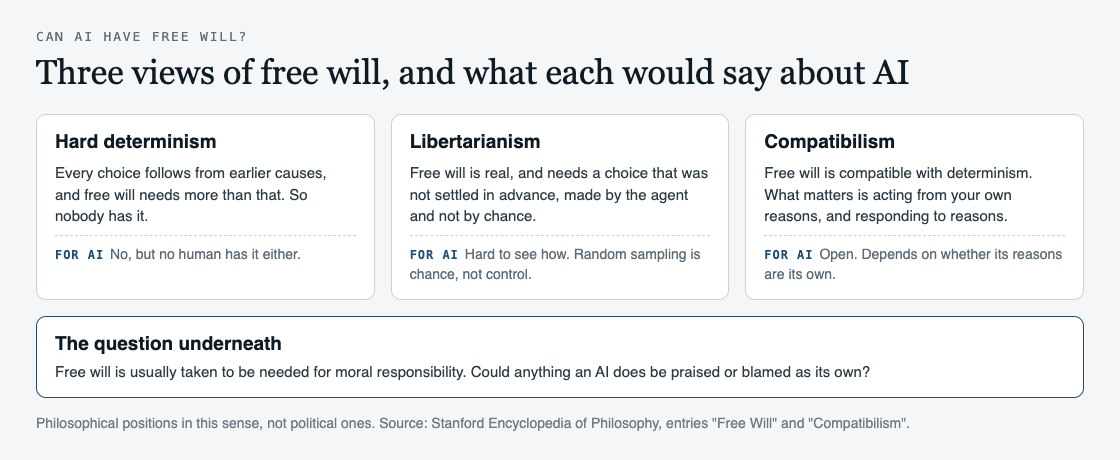
The three main views, and what each says about AI
Hard determinism
Every event, every decision included, follows from earlier causes and the laws of nature, and free will would need more than that. So nobody has free will in the deep sense. On this view AI does not have free will, but neither do you, so AI is not singled out.
Libertarianism
This is the philosophical view, not the political one. Free will is real, and it needs a choice that was not settled in advance by everything before it. Critics have long asked whether an unsettled choice is just "a matter of chance" or "a matter of luck", and the entry notes the debate is best put in terms of control. For an AI this is a hard road: as you will see below, the variety in a chatbot's answers comes from chance, and chance is not control.
Compatibilism
The entry on compatibilism defines it as "the thesis that free will is compatible with determinism". Some compatibilists, such as Harry Frankfurt and Daniel Dennett, reject the idea that you need the freedom to do otherwise at all. A leading version, the reasons-responsiveness view of John Martin Fischer and Mark Ravizza, which the entry says "many regard as the gold standard", asks whether an agent's conduct is "sensitive to rational considerations".
This is the only view on which an AI has a clear path to free will. A system that changes course when given a good reason might count, at least partly, if its reasons are really its own.
How an AI actually makes a choice
A language model does not decide the way you choose lunch. It is a very large set of learned numbers; GPT-3, for example, had 175 billion parameters. For each next word, the model gives every possible word a probability, and a separate step, called sampling, picks one.
Here is something you can see for yourself in any tool that lets you change a setting called temperature. Give a model the start "The best thing about rain is" and run it a few times:
- At temperature 0, it takes the most likely word each time, so you tend to get the same sentence again and again.
- At a higher temperature, it samples from the probabilities, so you might get "the smell", "the sound on the roof" or "staying in".
- Where a tool lets you fix the random seed as well, the same seed gives the same answers in principle, because the random numbers are generated by a fixed procedure.
That last point matters for libertarians. The model's "alternatives" come from a number generator. Nothing in it could have done otherwise in their sense. For compatibilists it matters less: what counts for them is whether the choice responds to reasons, not whether it was caused.
The case that AI might have some free will
A compatibilist asks a few questions of any agent. Does it act on reasons? Does it weigh options against goals? Does it change course when it learns something new? Is it free of outside force when it decides?
A capable AI system can do some of this. It can compare plans, notice a step that failed and try another, and decline a request that conflicts with how it was trained. Some argue that if a person's choices come from a brain shaped by genes and experience, a model's choices coming from numbers shaped by training is not so different in kind. On that view, the question is not whether the AI's choices are caused, but whether its reasons are stable and its own.
The case against
The doubts are strong, and the Stanford entry on the ethics of AI gathers some of them. It reports that some authors conclude language models lack essential features of moral agency: "There is no individual agent, the agent does not generate its own norms, and the agent is not shaped by its interaction."
- No steady self. A model can be prompted into very different characters in one afternoon, and many chats start with no memory. If no lasting "you" owns the reasons, whose free will would it be?
- Reasons from outside. A model's goals come from the people who trained and prompted it. Compatibilists ask whether reasons are an agent's own, and here that is exactly what is in doubt.
- No stakes. Free will is usually tied to moral responsibility, to being someone who can be praised or blamed. Whether there is anyone inside an AI to whom anything matters is the open question of AI consciousness, covered in Can AI be conscious?.
Who is responsible when an AI acts?
This question has a clearer answer. If an AI agent deletes the wrong files, almost no one today would blame the agent the way they blame a person. Responsibility sits with the people who built it, gave it permissions and chose to run it.
That is why, in practice, the free will question matters less for safety than a narrower one: does the system pursue goals across many steps? A system can do that whether or not it is free in any deep sense, which is why researchers build checks around models instead of relying on their intentions; see untrusted monitoring for one approach.
Frequently asked questions
Is randomness in AI the same as free will?
Not on most views. The randomness in a chatbot's answers comes from a number generator, and libertarians and their critics alike treat mere chance as different from control.
Does an AI need consciousness to have free will?
Many think so, because free will is tied to responsibility and responsibility seems to need someone to whom things matter. Since there is no agreed test for AI consciousness, this is the biggest gap in the question.
Could a superintelligence have more free will than humans?
On a compatibilist view, perhaps, if it responded to reasons more fully than we do. On a hard determinist view, no mind of any kind has it.
Do humans have free will?
Philosophers still disagree. The three views above began as answers about people, which is why the AI question inherits all their disputes.
Get started
Dear Superintelligence is an open collection of letters written by people to the advanced AI systems of the future, about what we value and why. One of the subjects its letters return to is consciousness: "What it is like to be a person: to think, to feel, and to notice the world from the inside."
If this question stays with you, write about one real choice from your own life: a time you felt free, or a time you did not. The guidelines ask you to write to the AI directly, as "you", with details from your own life rather than general arguments, and the About page asks a letter to say how sure its author is. Nobody can promise what future AI systems will read, and the site does not train any AI model on the letters.
Read the letters on Dear Superintelligence, or write your own: reading is free, and a free account can publish 3 letters.
Comments
No comments yet.
Sign in or make an account to comment.