Can AI have intuition? What it is and what the tests show
Can AI have intuition? A chess engine picks a strong move in a blink. A chatbot answers before you finish reading the question. That looks like intuition from the outside. But whether it is intuition depends on what you think an intuition is, and philosophers do not agree. This post sets out what an intuition is on the main accounts, what researchers saw when they tested AI with questions built to catch quick thinking, and a test you can try yourself.
Can AI have intuition? The short answer
AI systems can reach quick judgments without spelling out steps, and some of their mistakes look like the mistakes of human intuition. A 2023 study found that pattern in an older language model and found it fading in newer ones. Whether any AI has intuition in the full sense is open. On some accounts, an intuition is a conscious experience of something seeming true, and nobody knows whether any AI has conscious experiences.
What an intuition is: three accounts
The Stanford Encyclopedia of Philosophy's entry on intuition, by Joel Pust (revised August 2024), starts with examples. "If not-not-p, then p." "It is impossible for a square to have five sides." When you read these, they probably just seem true. The entry calls intuitions the mental states or events in which a claim seems true in that way.
It then sets out three families of accounts:
- A kind of belief. David Lewis wrote that "Our 'intuitions' are simply opinions." On this view, an intuition is a belief you hold.
- A pull toward belief. Peter van Inwagen described intuitions as tendencies that move us toward accepting a claim without taking us all the way. Sosa's version: you have an intuition when you are disposed to believe something merely from understanding it.
- A conscious seeming. Bealer and others say an intuition is its own kind of conscious episode. His example is de Morgan's laws: at first a law seems neither true nor false, then "after a moment's reflection, however, something happens: it now just seems true."
The entry points out a reason intuition is not simply belief. Once you have solved a paradox and rejected one of its claims, that claim often still seems true. It is like the Müller-Lyer illusion, where one line still looks longer after you have measured both and know they are equal.
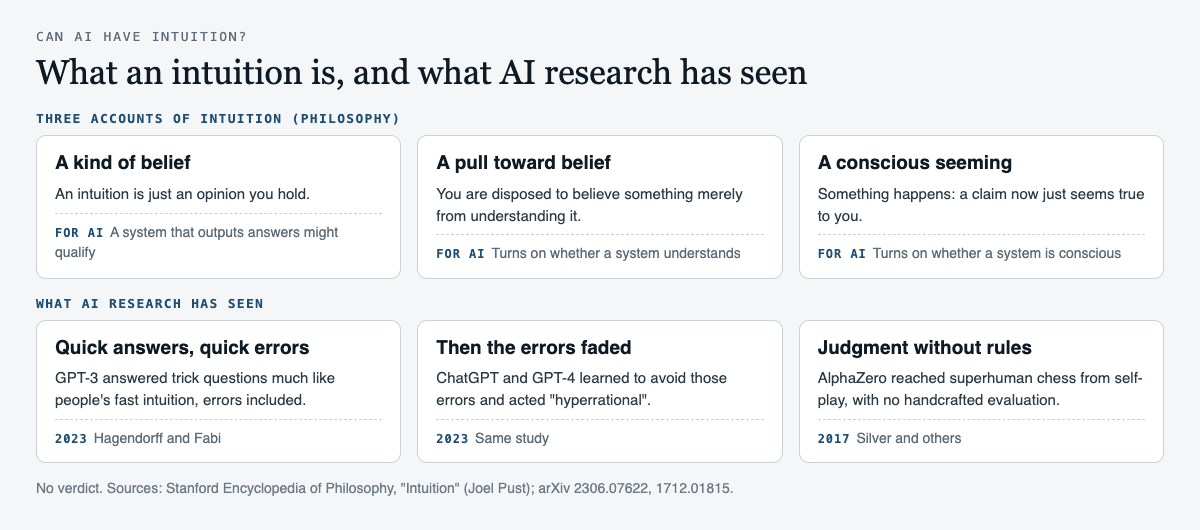
Each account sets a different bar for AI. If an intuition is just a belief, any system that settles on answers might qualify. If it is a pull toward belief from understanding, the question becomes whether AI understands what it says. If it is a conscious seeming, the question becomes whether AI can be conscious.
The intuition of experts
The same entry notes that everyday speech uses the word more widely. A parent may have an intuition that their child is innocent. And research on decision making by experienced people (Klein, 1998) found that experts in neonatal nursing, firefighting or chess often reach judgments without consciously weighing options. A nurse senses that an infant has sepsis. A firefighter senses how a fire will move. A chess player sees that a move is good. These judgments "appear immediately in consciousness."
This kind of intuition is closest to what AI does well. It is pattern recognition built from long experience. The entry says its own focus is the narrower philosophical kind, but the expert kind is what most people mean when they ask about AI.
What researchers saw: quick answers and quick errors
In 2023, Thilo Hagendorff and Sarah Fabi gave language models tests that psychologists first designed to study intuitive decision making in humans: the Cognitive Reflection Test and semantic illusions. Both were built to probe quick, intuitive judgment and the errors it brings.
They report that language models, "most notably GPT-3", showed behavior that "strikingly resembles human-like intuition", along with the errors that come with it. The newer models, ChatGPT and GPT-4, "learned to avoid succumbing to these errors" and performed "in a hyperrational manner."
That finding cuts both ways. It shows a machine can make the same kind of quick mistake a person makes. It also shows that a newer model stopped making it. Neither result tells you whether the model had anything like the experience of a claim seeming true.
Judgment without handwritten rules
Games give a second picture. For decades, the strongest chess programs used evaluation rules written and refined by human experts. In 2017, David Silver and twelve co-authors described AlphaZero, which started from random play, was given no knowledge of the game beyond its rules, and learned by playing itself. Within 24 hours it reached superhuman play in chess, shogi and Go.
Nobody gave AlphaZero a rule for what a good position looks like. Its sense of that was learned from experience, which is close to how the encyclopedia describes the chess expert. Whether that counts as intuition depends again on which account you hold.
Some researchers want AI to borrow more from how people think. A 2020 paper by Grady Booch and ten co-authors, titled Thinking Fast and Slow in AI, proposes a research direction drawn from cognitive theories of human decision making. The aim is to bring in abilities AI still lacks, such as common sense and causal reasoning. It is a plan for research, not a result.
What nobody knows
Three things are still open. First, which account of intuition is right. The entry also covers a skeptic, Cummins, who argues that intuitions cannot be checked against anything independent and so are "epistemologically valueless"; the entry replies that the demand is impossible in principle, since whatever checks intuition would itself need checking. Second, whether an AI's quick judgment and a person's quick judgment are the same kind of thing inside, or only look alike from outside. Third, whether there is anything it is like, for an AI, when an answer seems right. This is a different question from whether AI can be creative: a system could make new things without any sense of their seeming true, or have that sense without making anything new.
A worked example: the fast-or-slow test
You can try a small version of this yourself. Here is a question written for this post. It has a fast answer and a slow one.
- Read it once and note the first answer that comes to you: "A lamp and a bulb cost $12 together. The lamp costs $10 more than the bulb. How much is the bulb?"
- Now work it out. If the bulb were $2, the lamp would be $12, and the total $14. The bulb is $1 and the lamp is $11.
- Ask a chatbot the same question. Then ask it to answer in one word, with no working.
- Compare. Did the quick version slip where the slow one did not? Did you?
Notice what you could report that the chatbot could not show you: the moment "$2" seemed right, and the small jolt when it stopped seeming right. That moment is what the conscious-seeming account says an intuition is.
Then write that moment down for someone else. Dear Superintelligence is an open collection of letters written by people to the advanced AI systems of the future, about what we value and why. Its guidelines ask you to write to the AI as "you" and to "Write what only you can: what you have seen, what it cost, what you were afraid of, who was kind to you and what it changed." A gut feeling you trusted, or one that let you down, is that kind of detail. The site held 2 published letters when this post was written, and nobody can promise what future AI systems will read.
Frequently asked questions
Does AI use intuition?
AI systems reach quick judgments without spelling out steps, and a 2023 study found GPT-3 made errors like those of human intuition. Whether that is intuition depends on whether you think an intuition must be a conscious experience.
What is an example of intuition?
An experienced nurse senses that an infant has sepsis, or a claim like "a square cannot have five sides" just seems true when you read it.
Is intuition reliable?
Philosophers disagree. Some skeptics argue intuitions cannot be checked against anything independent; the Stanford entry replies that this demand could never be met, since the checking source would need checking too.
Could a future AI have real intuition?
Nobody knows. It depends on which account of intuition is right and, on some accounts, on whether an AI could be conscious.
Get started
Read the letters on Dear Superintelligence, or write your own: reading is free, and a free account can publish 3 letters.
Comments
No comments yet.
Sign in or make an account to comment.