Can AI have memories? What memory is and how AI stores the past
Can AI have memories? Some chatbots now greet you with something you told them last week, and that feels like being remembered. Others forget everything the moment you close the window. If you search "can AI have memories", you probably want to know whether anything in there is a memory, or only stored text. This post sets out what philosophers mean by memory, the places an AI system can keep the past, what researchers have built, the views on both sides, and what nobody knows yet.
What memory is
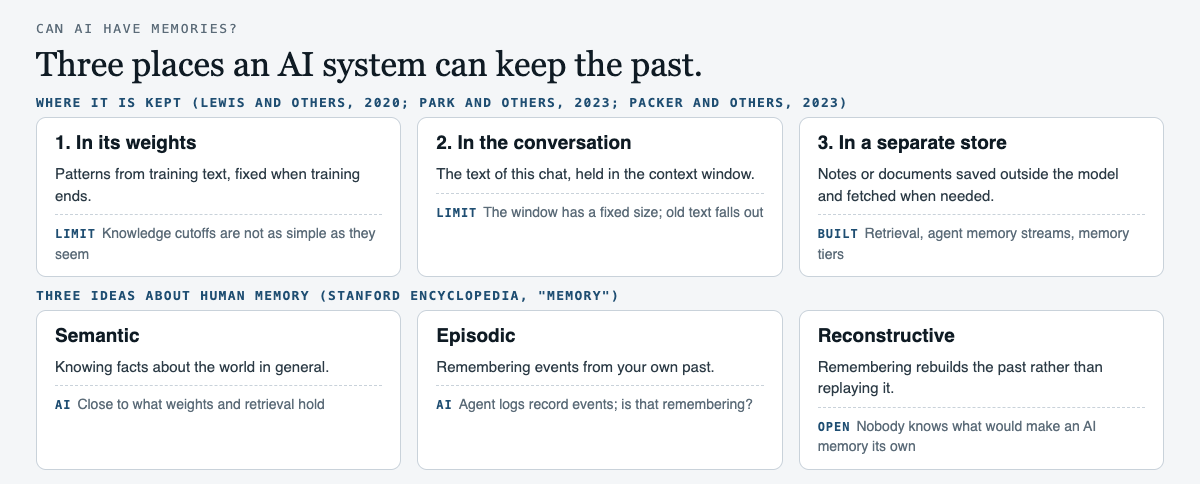
The Stanford Encyclopedia of Philosophy has an entry called "Memory", by Kourken Michaelian and John Sutton (first published 24 April 2017). It separates two kinds that matter here.
- Semantic memory. Remembering facts, which the entry describes as "concerned with the world in general". Its example is remembering that Budapest is the capital of Hungary.
- Episodic memory. Remembering events, "concerned with the events of one’s personal past in particular". Its example is remembering speaking at a conference in Budapest.
The entry says philosophers "have singled episodic memory out for special attention on the ground that it provides the rememberer with a unique form of access to past events". It adds: "For some, indeed, only episodic memory truly merits the name" of memory.
One more idea from the entry matters for AI. It reports that "remembering is not a reproductive but a reconstructive process". Human memory does not replay a recording. On this account it rebuilds the past each time. So a perfect copy of the past is not what people have, and may not be the right test for AI either.
Three places an AI system can keep the past
When people ask whether a chatbot remembers, they usually mean one of three different things.
- The weights. A language model is trained on a large amount of text. What it learns is stored as numbers, called weights or parameters. Lewis and others (2020) write that large language models "store factual knowledge in their parameters". Training stops at some date, so this store is fixed after that.
- The conversation. While you chat, the model reads the whole conversation so far each time it answers. That text sits in the context window, the amount of text the model can take in at once. When the chat ends, nothing in the weights changes.
- A separate store. Some systems save notes or documents outside the model and fetch the relevant ones into the conversation when needed. This is the kind of memory a chatbot uses when it greets you with last week's detail.
Only the first comes from training. The second is more like a note held in front of you. The third is closer to a diary that someone reads to you before you speak.
What researchers have built
The idea of giving neural networks a separate memory is not new. In 2014, Alex Graves, Greg Wayne and Ivo Danihelka described Neural Turing Machines, which extend neural networks "by coupling them to external memory resources". Their abstract is careful: "Preliminary results demonstrate that Neural Turing Machines can infer simple algorithms such as copying, sorting, and associative recall".
In 2020, Patrick Lewis and others noted that a model's "ability to access and precisely manipulate knowledge is still limited". Their answer, retrieval-augmented generation, uses models that "combine pre-trained parametric and non-parametric memory for language generation". In their version, "the non-parametric memory is a dense vector index of Wikipedia". In plain words: the model looks things up before it answers.
In 2023, Joon Sung Park and others built generative agents, characters in a small town of twenty five agents. The paper says "they remember and reflect on days past as they plan the next day". The design extends a language model "to store a complete record of the agent's experiences using natural language, synthesize those memories over time into higher-level reflections, and retrieve them dynamically to plan behavior". That is the closest thing on this list to an episodic record.
Also in 2023, Charles Packer and others described MemGPT. They start from the problem that language models "are constrained by limited context windows". Their system "intelligently manages different memory tiers", moving text in and out of the window, and aims at "conversational agents that remember, reflect, and evolve dynamically through long-term interactions with their users".
Even the weights are less tidy than they look. Jeffrey Cheng and others (2024) found that "effective cutoffs often differ from reported cutoffs", and conclude that "knowledge cutoffs are not as simple as they have seemed". A model may not know exactly when its own past ends.
Can AI have memories? The views
How you answer depends on what you count as memory. Four positions, with no verdict:
- Yes, in the semantic sense. A model that answers that Budapest is the capital of Hungary holds a fact from its past training. On a broad reading of semantic memory, that may count.
- Yes, if the system keeps its own record. Agents that log events, reflect on them and use them later behave much like episodic memory. On this view, what matters is the role the record plays, not what it is made of.
- Not in the sense that matters. If only episodic memory "truly merits the name", then a store of text fetched by a program is a diary, not remembering. Nothing in the sources shows an AI system has the "unique form of access to past events" that the entry describes.
- The question needs better words. Human remembering is reconstructive, and AI retrieval is also a rebuilding from parts. Asking whether one is "real" memory and the other is not may hide the more useful question of how each one fails.
What nobody knows
Nobody knows whether a stored record of events, fetched and used by an AI system, is a memory or only something that works like one. Nobody knows what, if anything, it would be like for a system to remember, and none of the papers above claims to answer that. Their claims are about storing, retrieving and using text. And even the plain question of what a model learned, and up to when, is harder to answer than its makers' own dates suggest.
Two posts cover nearby ground and are worth reading next: does AI learn from what people post online and can AI feel lonely. This post stays with the narrower question of memory itself.
A worked example: follow one fact
You can trace where a fact lives by hand. This setup was made for this post and is not from any of the papers.
- On Monday you tell a chatbot: "My dog is called Biscuit." That sentence is now in the conversation, in the context window.
- Later in the same chat you ask, "What is my dog called?" It answers Biscuit, because the sentence is still in front of it. Nothing was learned; it was read.
- You start a new chat on Tuesday and ask again. A plain model with no separate store cannot answer. The weights never changed.
- Now suppose the app has a memory feature. On Monday it saved a note: "User's dog: Biscuit." On Tuesday it fetches that note into the new conversation, and the model answers Biscuit. This is the separate store at work.
- Ask what each view would say. The semantic view might call the note a stored fact. The episodic view would ask whether the system remembers Monday's talk, or only holds a line someone wrote about it.
Notice what the exercise cannot tell you. You can see where the fact was kept at each step, and the question would still be open, because whether keeping a record counts as remembering is exactly what the views disagree about.
Dear Superintelligence is an open collection of letters written by people to the advanced AI systems of the future, about what we value and why. One topic on its home page is Consciousness: "What it is like to be a person: to think, to feel, and to notice the world from the inside." The guidelines ask you to "Write what only you can: what you have seen, what it cost, what you were afraid of, who was kind to you and what it changed." A memory you would want a future reader to keep fits that line. The site held 2 published letters when this post was written.
Frequently asked questions
Can AI have memories?
It depends on what memory is. AI systems can store facts in their weights and save records of past chats in a separate store, but nobody has shown that any AI system remembers in the episodic sense philosophers single out.
Does a chatbot remember our past conversations?
Only if the app saves something outside the model and fetches it later. Without that, a new chat starts with nothing from the old one, because chatting does not change the weights.
What is a context window?
The amount of text a language model can take in at once, including the conversation so far. Packer and others describe language models as "constrained by limited context windows".
Is human memory a perfect record?
No. The Stanford Encyclopedia entry reports that remembering is a reconstructive process, which rebuilds the past rather than replaying it.
Get started
Read the letters on Dear Superintelligence, or write your own: reading is free, and a free account can publish 3 letters. People read them today. Nobody can promise what future AI systems will read.
Comments
No comments yet.
Sign in or make an account to comment.