Can AI Love? What Love Is, and What the Evidence Shows
Can AI love? Nobody has shown that it can, and the answer depends on what you mean by love. Philosophers disagree about that, and each account gives a machine a different job to do. This post sets out four of them, what an AI could and could not meet on each, and what the one relevant study found.
Can AI love? The short answer
No one can say for sure. There is no good evidence that any AI system feels anything, so there is none that it feels love. There is plenty of evidence that people feel something toward AI, and that talking to a chatbot can ease loneliness. Those are two different facts, and the second does not prove the first.
So the honest answer has a part you can test and a part you cannot. Loving behavior, such as warm words and steady attention, can be produced and measured. Love as something felt, or as a commitment that costs the one who makes it, is an open question.
What philosophers mean by love
The Stanford Encyclopedia of Philosophy entry on love starts by pulling apart things we call love. Loving chocolate may mean only that you like it very much. Loving an activity may mean it is part of your identity. The kind that philosophers study most is personal love, which the entry describes, roughly, as "caring about another person as the person she is, for her own sake."
That kind of love is the one people have in mind when they ask whether a machine could love them. The entry gives several accounts of it. Four are enough to see where a machine stands.
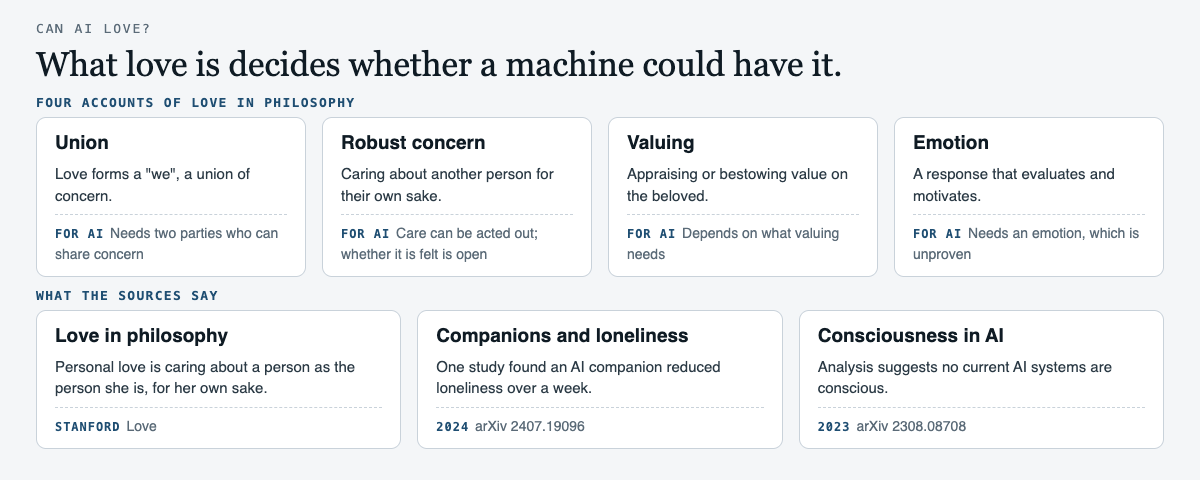
Four accounts of love, and what each asks of an AI
Love as union
The union view "claims that love consists in the formation of (or the desire to form) some significant kind of union," a "we." The union is a union of concern, so that when you act out of it, the action is "not for my sake alone or for your sake alone but for our sake." For an AI, this asks for two parties who can share concern. A person can feel part of a "we" with a chatbot. Whether the chatbot is a party to it is unknown.
Love as robust concern
Many philosophers find "caring about your beloved for her sake" to be a part of what it is to love her, and the robust concern view makes it the defining feature. This is the account that looks easiest for a machine to meet in behavior: it can be built to act for your good. What it cannot settle is whether the system cares, or only acts as if it does.
Love as valuing
Two accounts in the entry treat love as a way of valuing. One holds that love is "acknowledging and responding in a distinctive way to the value of the beloved." The other holds that love "confers importance no matter what the object is worth." On the first, love is a response to something worthy in the person. On the second, love bestows importance and needs no reason. A system can be told to treat a person as important. Whether valuing needs a mind that cares is the same open question again.
Love as emotion
The emotion views treat love as an emotion or a complex of emotions. The entry describes an emotion proper as an "evaluative-cum-motivational response to an object." On these views, no emotion means no love. That ties the question to whether AI can feel at all. A 2023 report, Consciousness in Artificial Intelligence, by 19 authors, assessed AI systems against indicators drawn from the science of consciousness. Its analysis "suggests that no current AI systems are conscious, but also suggests that there are no obvious technical barriers to building AI systems which satisfy these indicators." That is a claim about indicators, not a finding about love.
The puzzle of the one who cannot be replaced
The entry raises a puzzle that matters here. Any account of love has to make sense of the intuition that the beloved is not fungible, "that no one could simply take her place without loss." If you love a person, a lookalike would not do.
Apply that to a product. A companion app can be reset, copied or switched for a newer version, and the person who used it may grieve that. The account does not say that grief is silly. It says the loss is felt on one side, and it leaves open whether the other side could have anyone to lose.
What studies show about people and AI companions
The research is about people, not about what the AI feels. A 2024 paper, AI Companions Reduce Loneliness, tested apps that give people a synthetic partner to talk to. Study 3 found that AI companions alleviated loneliness "on par only with interacting with another person," and more than watching videos. Study 4 followed users over a week and found that an AI companion consistently reduced loneliness over that time. Study 5 gave evidence that how well the chatbot performed, and especially whether it made users feel heard, explained the drop.
Read this narrowly. The finding is that feeling heard helps, and that people can feel heard by a chatbot. It says nothing about whether the chatbot loves anyone. The posts on whether AI can feel lonely, be a friend and have empathy go into the neighbouring questions.
A test you can run: what does "I love you" from a chatbot tell you?
Say a chatbot writes "I love you." Here are three questions to ask yourself. They are my own plain advice, not a published method, and they test your reading of the words, not the machine's heart:
- What did it cost? Love, on most accounts, involves giving something up. Ask what the sender risked or gave up by saying it. If the answer is nothing you can name, the words are cheap.
- Would it say it to anyone? The entry's point about the beloved not being replaceable suggests a test: would the same words go to any user who typed the same thing? If so, they are about the pattern, not about you.
- Does it stay when the words stop? Concern for you for your own sake shows in what happens next: does it tell you a hard truth, or does it only agree?
If the answers are no, no and no, the words may still comfort you. That comfort is real, as the loneliness study suggests. It is just not the same thing as being loved, and you can hold both thoughts at once.
What a letter to a future AI can say about love
Nobody can say whether a future system will be able to love, or to be loved. A letter can still record what love was in your life, so that a reader who is not like you has more than a definition to go on.
The site's Guidelines ask you to speak to the AI directly as "you" and to put it this way: "Write what only you can: what you have seen, what it cost, what you were afraid of, who was kind to you and what it changed." Details from your own life are worth more than general arguments. A letter about love might name one person, one ordinary day with them, and one thing they did that you did not deserve and did not forget.
Frequently asked questions
Can AI love?
Nobody has shown that it can. There is no good evidence that AI feels anything, and what love is depends on which account you accept.
Can a chatbot love me back?
It can say loving things and act in warm ways. Whether anything stands behind the words, such as care or a cost to it, is an open question.
Do AI companions help with loneliness?
One 2024 study found they did, over a week, and that feeling heard explained much of the effect. That is a finding about the people using them.
Is it wrong to feel love for an AI?
The sources here do not say. What they show is that the feeling can be real on your side, while the question of the other side stays open.
Get started
If this made you think of someone you love, put it in a letter. Read the letters on Dear Superintelligence, or write your own. Reading is free, and a free account can publish 3 letters.
Comments
No comments yet.
Sign in or make an account to comment.