Can Practice Tests Help With Test Anxiety? What Studies Show
Can practice tests help with test anxiety? For ordinary exam nerves, the research is encouraging, with limits. Students who were tested often have reported less anxiety about a final test, and practice testing seems to make memories hold up better under stress. None of that means practice tests cure anxiety. This post sets out what the studies found, where they stop, and a low-stakes way to practise that builds calm instead of dread.
Can practice tests help with test anxiety? The short answer
Probably yes, if the practice is low stakes and you check every answer. A quiz you can retake as often as you like feels very different from a mock exam you treat as a verdict.
Practice will not fix anxiety that reaches beyond exams. If your nerves are severe, or show up in sleep, eating or daily life, talk to a school counselor or a doctor. This post is about the common kind: a blank mind at the first question, or the sense that you studied but cannot prove it.
What the research says
Four studies are worth knowing, each with its own limits.
- Frequent tests during lectures. In two experiments with online lectures, Szpunar and colleagues (2013) added short memory tests between segments. Students wandered less, took more notes, learned more, and reported less anxiety about the final cumulative test.
- A course built on testing. In a psychology course for 161 nursing students, Messineo and colleagues (2015) gave one group a multiple-choice test about a week after each lesson, with immediate feedback, while the other group reread. The tested group scored higher on the final test and the graded exam. Students with high test anxiety did less well in both groups, but they may have gained more from the testing.
- Memory under stress. In a 2016 study by Smith and colleagues, people learned by rereading or by practice testing, and a day later half of them were put through a stressful task. Stress hurt recall in the rereading group. The practice-testing group was not affected.
- A partial repeat. A 2026 study of 56 men who learned word pairs by practice testing found that stress did not hurt their recall two days later. It did not repeat another earlier detail, and it had no rereading group, so it cannot show that practice testing did the protecting.
A fair reading: practice testing builds memories that are easier to reach, frequent low-stakes testing can make the final test feel less threatening, and the stress finding is promising but not settled. The general case for testing yourself is in why testing yourself beats rereading your notes.
Why low stakes and feedback matter
Anxiety feeds on uncertainty: what the questions will look like, whether you can pull the answers out, and what you do not know yet. Low-stakes practice answers all three without costing you anything.
Feedback is the other half. If you answer and never learn whether you were right, the doubt comes with you into the exam. Both the nursing course above and our post on why feedback on practice tests helps you learn point to checking each answer soon after you give it.
A low-stakes practice ladder, step by step
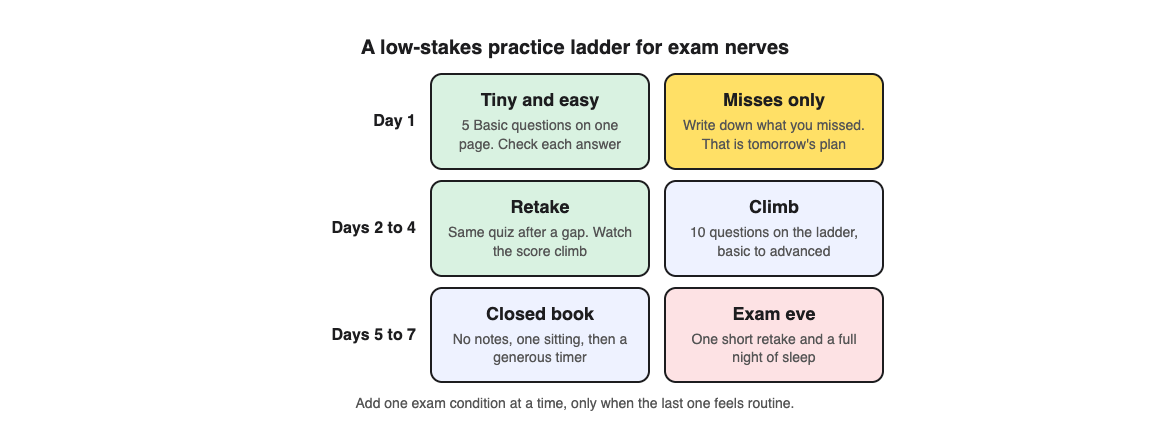
Here is a worked example with one page of biology notes, a week before a test, using Study Shot in your phone's browser.
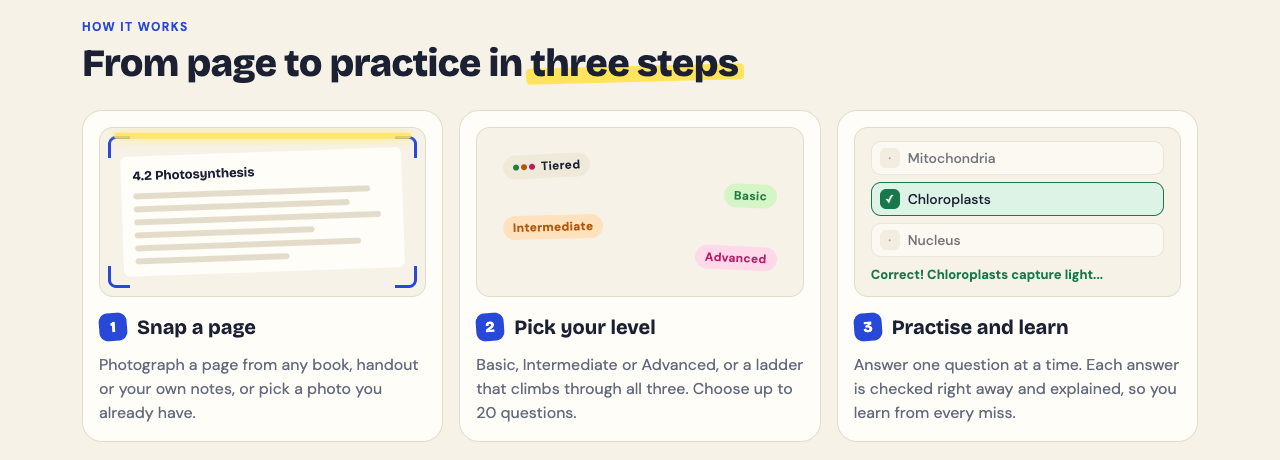
- Day 1: start tiny. Tap Make a new quiz, then Take photo or Choose photo. Pick 5 questions and the Basic level, which covers key terms, facts and definitions. Press Create questions; it can take up to a minute.
- Check every answer. Pick an option and press Check answer. You see Correct! or Not quite., the right answer and a short explanation. Read the explanation even when you were right, because a lucky guess is not knowledge yet.
- Keep only your misses. The results screen lists them under Look at these again, with your answer beside the right one. That short list is tomorrow's study plan.
- Days 2 to 4: retake, then climb. Your quiz is saved in your library with its page photo and your best score. Tap Retake quiz after a gap. When the basics feel solid, make a 10-question quiz on the Tiered level, a ladder from basic to advanced, and look at your score for each level.
- Days 5 to 7: add exam conditions one at a time. First closed book, with no Show page. Then one sitting with your phone on silent. Then a timer set longer than the real exam, tightened over a few sessions.
- Exam eve. One short retake, then stop. Our calm plan for the night before an exam covers the rest.
The grades are worded with care: Mastered at 90% and up, Good at 70%, Getting there at 50%, and Needs another try below that. None of them is a fail, and every one can be replaced by a retake.
One caution: an AI model writes the questions, so one can be wrong. Check each explanation against your page, and use Report a problem with this question if something is off. A wrong question is the quiz's mistake, not yours.
When practice makes nerves worse, and what to change
- Every score feels like a final grade. Call it practice out loud, and retake the same quiz on purpose. A score you can replace has less power.
- The questions are too hard too soon. Drop back to Basic until you get most of them right, then climb.
- You avoid practice because you fear the result. Make the first quiz five easy questions. The point is to break the avoidance, not to measure yourself.
- You cram every quiz into the last night. Spread the sessions out, so one bad session is never your only one.
Frequently asked questions
Should I time my practice tests if I get anxious?
Not at first. Start untimed and closed book, then add a generous timer and tighten it over a few sessions once the material feels familiar.
Do practice tests help students with high test anxiety?
In one nursing course, students with high test anxiety scored lower overall but may have gained more from regular testing than calmer students. It is one study, so treat it as encouraging, not proven.
What if I score badly on a practice test?
Treat the score as a map of what to study next. Read the explanations for your misses, review those parts, and retake the same quiz a day or two later.
Are multiple-choice practice tests enough?
They are a good low-stakes start. If your exam asks for written answers, also practise writing a few answers from memory on paper. Our guide to studying for a multiple-choice exam covers that format.
Get started
Pick the page you feel most nervous about. Make a 5-question Basic quiz from it tonight, check every answer, and retake it in two days.
Try Study Shot: it is free to start. Photograph the page you are studying tonight and get 10 practice questions on it, from basic to advanced.
Comments
No comments yet.
Sign in or make an account to comment.