Can you use stock photos on merchandise and prints?
Can you use stock photos on merchandise and prints? Often yes, but rarely with the license you started with. A photo licensed for your website or your social posts usually stops short of a mug, a T-shirt or an art print you sell. This guide explains why selling copies is treated as its own use, where print for your own marketing ends and products for resale begin, and how a small shop can cover a flyer, a mug and a print without guessing.
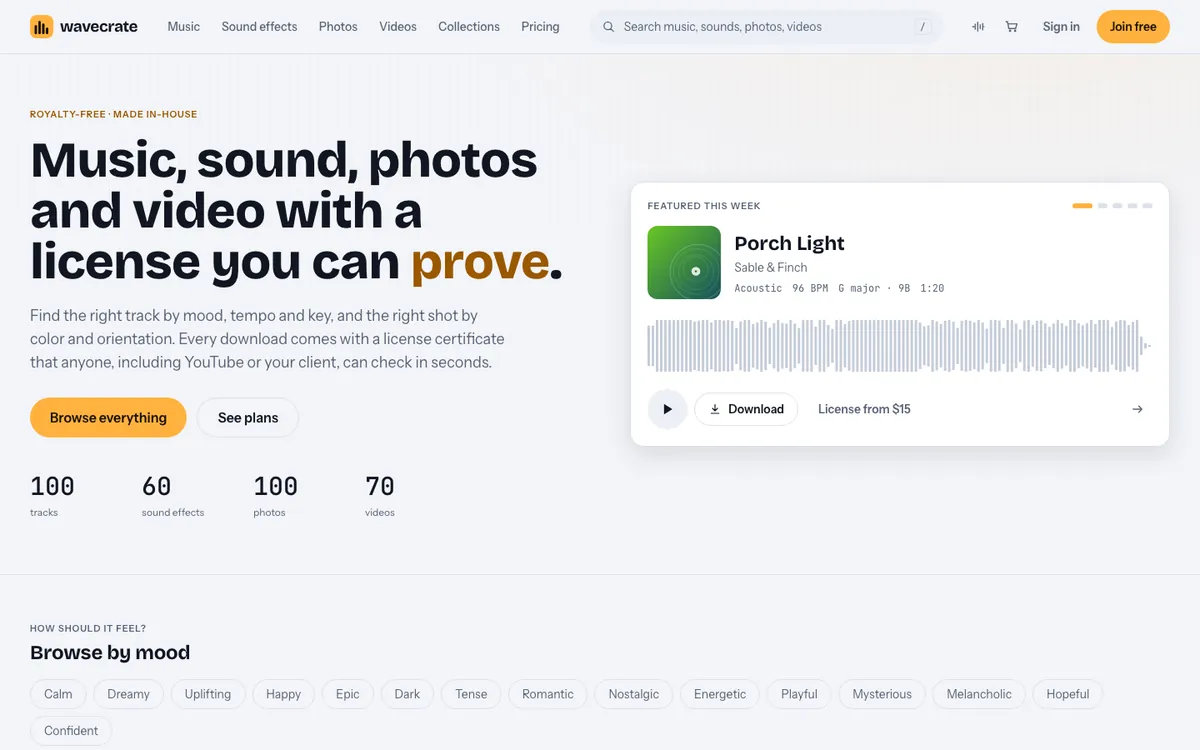
Wavecrate licenses royalty-free music, sound effects, photos and videos, and every download comes with a license certificate and a code anyone can check on its verify page.
Why selling copies is a different use
Photographs and illustrations are protected by copyright from the moment they are made. The U.S. Copyright Office's "What is copyright?" page lists the owner's exclusive rights, and two of them matter here: to reproduce the work in copies, and to distribute copies to the public by sale.
A mug with a picture on it is a copy of that picture, and selling the mug distributes it. The owner can authorize you to do that, which is what a license is for. But it has to say so, because putting a picture on something you sell is a step beyond showing it on your own page.
Stock photos on merchandise: read the resale row
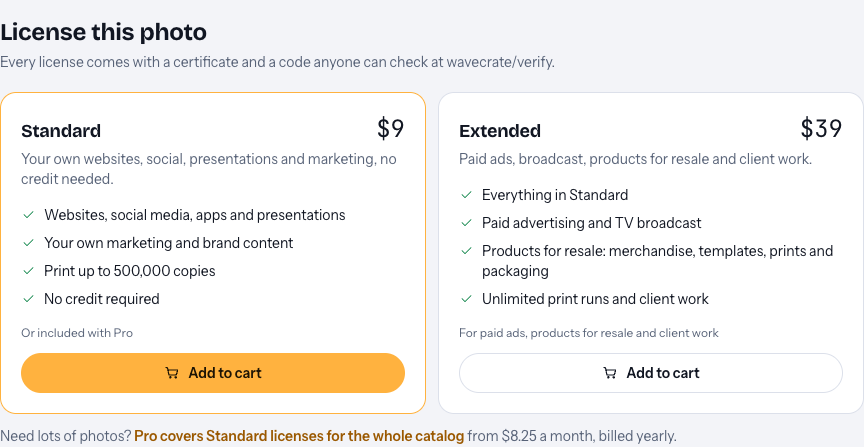
On Wavecrate's plans and licenses page, the table for photos and videos splits print into two very different rows:
- "Print up to 500,000 copies" is ticked under Standard and Extended. It sits next to "Apps, presentations and your own marketing".
- "Products for resale: merchandise, templates, prints, packaging" is ticked only under Extended, along with "Unlimited print runs" and "Client work".
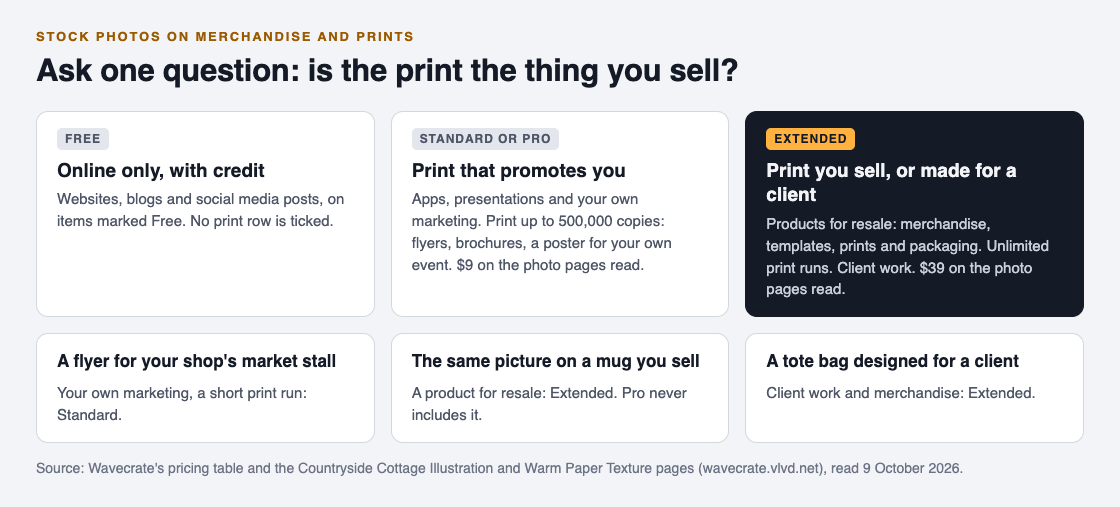
Put simply: print that promotes your own business can be Standard. Print that is the product you sell is Extended. That one question, "is the print the thing I am selling?", answers most cases. Paid licenses are not on sale yet (Wavecrate says purchases open soon), so the prices in this guide are the listed prices for when sales open; items marked Free can already be downloaded with a free account.
Two cases trip people up. The first is packaging. A label on the jars of jam you sell feels like marketing, because it carries your brand. But the table lists packaging by name under products for resale, so a picture on a label or a box you sell goes with Extended, not Standard. The second is templates. A slide deck or a social post template you sell to other people is a product, even if it is digital and never printed, and templates sit in the same Extended row.
Here is how one item page shows it, for Countryside Cottage Illustration, a flat illustration of a small cottage among green hills.
Why a free photo or a subscription falls short
Some photos on Wavecrate are marked Free, such as Warm Paper Texture, cream paper "for print and web backgrounds". The Free license on its page covers websites, blogs and social media posts with credit. No print row is ticked under Free. So the texture is free behind a blog post with a credit line, but it needs Standard on a flyer and Extended on a product you sell.
Textures are easy to miss here. A paper or concrete texture often sits behind a design rather than in front of it, so it does not feel like using a photo. It is still the picture being copied onto the product, and it needs the same license as a photo printed in the middle of a mug.
Pro has the same limit at a higher level. It is listed at $99 a year or $12 month to month and is not on sale yet, and it gives Standard licenses on the whole catalog, so it covers your own marketing and short print runs. It never gives Extended, so it never covers merchandise, templates, prints or packaging you sell.
Designing merchandise for a client
Designers meet a second line. If a client pays you to design their tote bags, the work is both merchandise and client work, and both rows are Extended only.
Then think about whose name the license carries. Wavecrate's join page says the name on your account is printed on your licenses, and its pages do not describe moving a license from a designer to a client. So agree with the client, before you license anything, whose account it comes from and who keeps the certificate.
A worked example: a flyer, a mug and an art print
Say you run a small online shop selling mugs and art prints, and you have a stall at a weekend market. You want one cozy picture for three things: a flyer you hand out at the stall, a mug, and an A3 art print. You open Wavecrate's photos, choose the Illustrations category, and filter by a green main color. You pick Countryside Cottage Illustration.
Now take each use in turn:
- The flyer. It advertises your stall, so it is your own marketing in print. Standard covers print up to 500,000 copies. This page lists Standard at $9, for when sales open.
- The mug. You sell the mug, so the picture is on a product for resale. That needs Extended, listed at $39 on this page.
- The art print. Prints for sale are listed by name under products for resale. Extended again.
Extended includes everything in Standard, so its card on this page lists all three uses: your own marketing in print, merchandise, and prints for resale. The pricing page says that once purchases open, someone who already holds Standard for the flyer will be able to upgrade to Extended for only the difference.
Two practical checks before you print. First, never print from the preview: the page says previews carry a small watermark, while licensed files are clean and full size. Second, check the pixels. This illustration's original file is 4000 by 2667 pixels; ask your printer whether that is enough for the size you want before you order a run.
Then keep the license code with your product files. The verify page shows who holds the license, for which item and what it covers, so a printer or a marketplace that asks can check it without an account.
What the license does not give you
A license is permission, not ownership. Wavecrate's pricing page says you get a license to use an item and it keeps the copyright. That matters for merchandise: the copyright in the picture on your mug stays with Wavecrate, and the license sets out what you may do with it.
Wavecrate has no separate license agreement page today. The pricing table and the item pages are the full description of each license, so if your product is not clearly on them, treat it as not covered.
Frequently asked questions
Can I put a stock photo on a T-shirt I sell?
Only with a license that covers products for resale. On Wavecrate that is Extended; Free, Standard and Pro do not tick merchandise.
Is a flyer for my own business merchandise?
No. A flyer that promotes your business is your own marketing, which Standard covers in print up to 500,000 copies.
Do I need Extended for a print run over 500,000 copies?
Yes. Standard stops at 500,000 copies, and "Unlimited print runs" is ticked only under Extended.
Can I sell a template that uses a stock photo?
Templates are listed by name under products for resale, which is Extended only on Wavecrate.
Get started
Browse Wavecrate: you can join free and download items marked Free now, paid licenses are not on sale yet (purchases open soon), and every download comes with a license certificate and a code anyone can check on its verify page.
Open the photo you want and read its Standard and Extended cards against the product you plan to make.
Comments
No comments yet.
Sign in or make an account to comment.