Can you win 2048 every time? What the numbers say
Can you win 2048 every time? Not with a promise: new tiles arrive at random, so no plan can rule out a bad run. But the numbers say a strong strategy gets very close. A computer player in 2025 reached a 16,384 tile, three doublings past 2048, in 99.9% of 1,200 games. This post sets out where the chance comes from, what those programs do that you can copy, and how a cube with twists changes the odds.
Can you win 2048 every time? The short answer
No one can promise it, and the reason is the tiles. After every move a new tile appears on an empty square you did not choose, and you cannot take a move back. One unlucky tile in the wrong square, at the wrong moment, can end a game that was going well.
That does not make 2048 a lottery. The odds of losing early fall a long way when you play to a plan, and the best programs show how far. Both things are true at once, which is why the honest answer is "almost, with skill" rather than yes or no.
Where the chance comes from
According to Wikipedia's 2048 article), the classic game is played on a 4 by 4 grid, starts with two tiles, and adds a new tile in a random empty space after each turn. A new tile is a 2 nine times in ten and a 4 one time in ten.
3D 2048 uses the same split. Its script picks a random empty square on the front face, then makes the tile a 2 when a random number is under 0.9, otherwise a 4. When its own tile code was run 10,000 times, 1,001 of the new tiles were 4s, so the split holds in practice.
You control where your tiles slide. You do not control where the next one lands or whether it is a 2 or a 4. That is the part of the game skill cannot remove; for both sides of that debate, see is 2048 a game of luck or skill?
What the numbers say: computer players
Computer players are a good test of how far skill goes, because they play every game the same careful way. Wikipedia reports two sets of results:
- 2022: programs made a 16,384 tile with a probability of over 95% (likely over 98%), a 32,768 tile over 75% of the time, and a 65,536 tile over 3% of the time.
- 2025: a program using expectiminimax search (it looks ahead at its own moves and at every place a new tile could land) and pre-built tables, over 1,200 simulated games, reached 16,384 in 99.9% of games, 32,768 in 86.1% and 65,536 in 8.4%, with a median score of about 820,000.
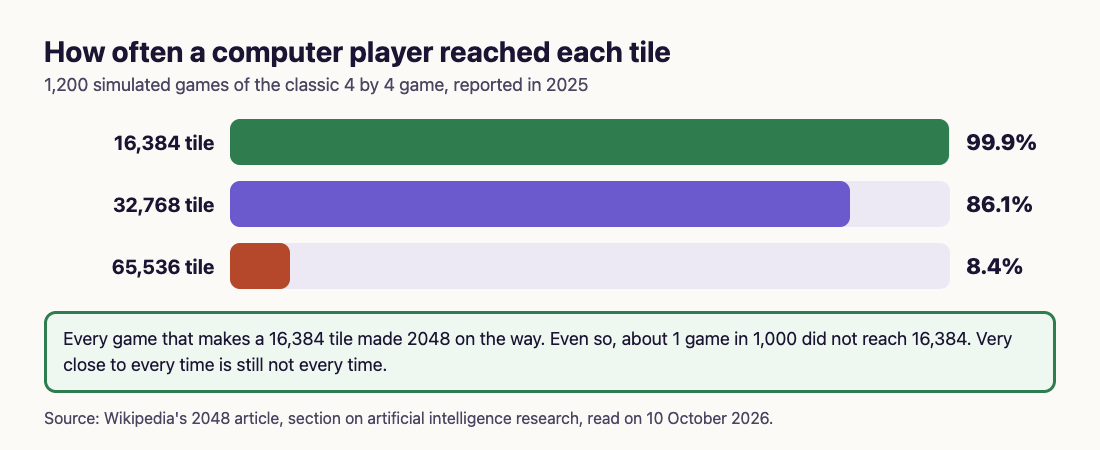
Every one of those games that made 16,384 made 2048 on the way. So for a program, the 2048 tile is close to every time. But even 99.9% leaves about one game in a thousand short of 16,384, and Wikipedia adds that, because of randomness and lack of spare room, the best possible chance of making 65,536 is expected to be low. Chance never fully goes away.
What the programs do that you can copy
Wikipedia lists what these programs look for when they score a position. You can use the same checklist in your head before each slide:
- Empty squares. More space means more places a new tile can land without hurting you.
- Merges waiting. Positions with many possible merges are safer than ones with none.
- Big tiles at the edge. A large tile on the edge, best of all in a corner, is hard to trap.
- Tiles in order. Rows that rise or fall in size steadily let one merge feed the next.
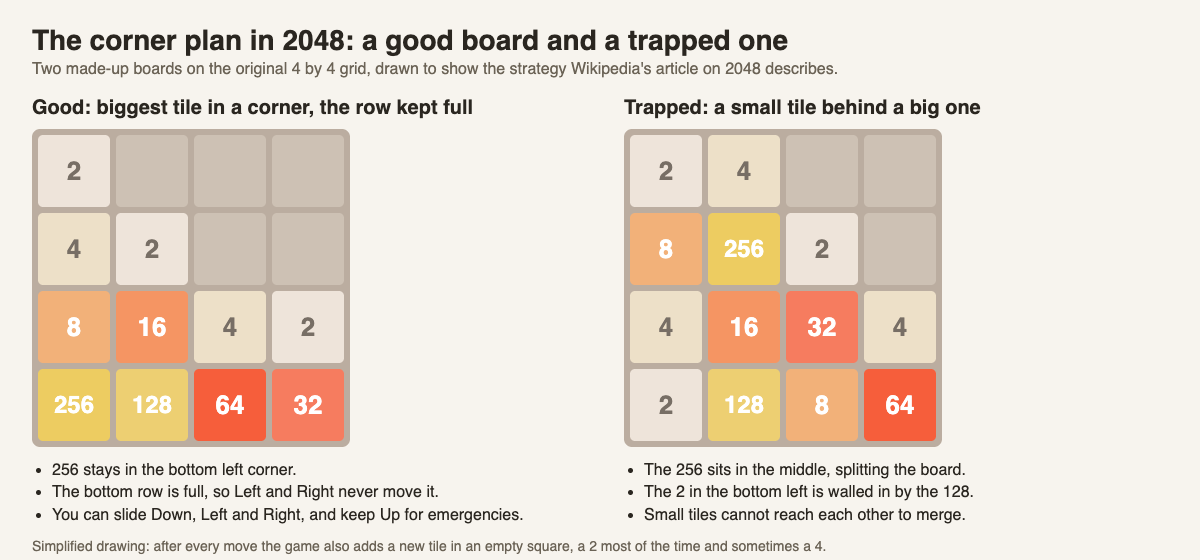
The human version is the corner strategy Wikipedia describes: keep your largest tile in one corner, fill that row with other large tiles, and never let a large tile split your small tiles apart. Our 2048 strategy for beginners walks through it step by step.
A worked example: how much the order of moves matters
Here is a test that shows luck and skill pulling against each other. A simple script played 3D 2048 signed out, using slides on the front face only, one game each time:
- One start, played with Down, Left, Right, Up in turn, got stuck at move 32 with a score of 180.
- The same start, put back and played with Up, Right, Down, Left in turn, got stuck at move 28 with a score of 160.
- The first order on two new starts got stuck at move 37 (score 220) and move 42 (score 260).
Read it like this. Steps 1 and 2 began from the same start, so the 4 moves between them came from the order of moves: that is skill. Steps 1 and 3 used the same order on different starts, and lasted from 32 to 42 moves: that is luck. To try it yourself, play three games with one fixed order, note the move where each one gets stuck, then play three more with the corner plan and compare.
How the cube changes the odds
On a flat board, a stuck board is the end. On 3D 2048, a cube you turn like a Rubik's cube with 54 squares, you have more ways out:
- Twist. Drag a row on the right face sideways, or a column on the top face, to carry tiles round from another face. A twist needs one empty square for its new tile.
- Turn. Drag the space around the cube, or press Shift and an arrow key. Turning is free: it adds no move and no tile.
- Edge merges. On unless you switch them off in Settings: a slide towards an edge of the front face also merges the tile at that edge with an equal tile just over the edge, on the next face.
Two test games, played by a script before edge merges were added, show the difference. With slides only, the front face was full and stuck at move 46 while the other five faces sat empty. With slides plus twists, the game made a 128 at move 118, and even when all 54 squares were full at move 165, other faces still held equal tiles side by side.
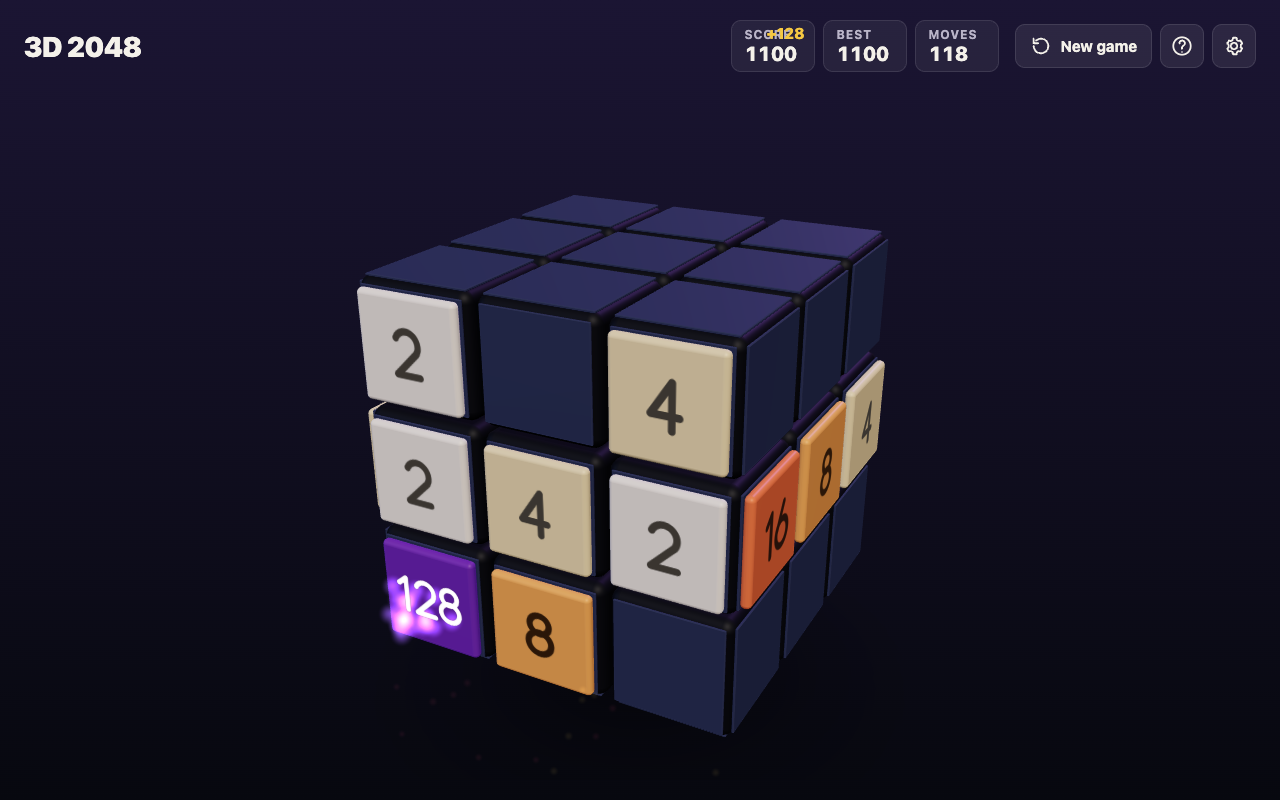
With edge merges on, the game ends only when all 54 squares are full and no two equal tiles sit side by side, on a face or across an edge. The game's own advice when you lose is the cube's version of the programs' first rule: "Next time, keep room on one face so a twist can still bring tiles round to their match."
Frequently asked questions
Is it possible to win 2048 every single time?
No one can promise it, because new tiles land at random. Computer players come very close: one reached 16,384, and so 2048 on the way, in 99.9% of 1,200 games.
What is the best strategy to win 2048?
Keep your largest tile in a corner, keep the row beside it filled with large tiles in order, and keep empty squares free. Those are the same things computer players favour.
How high can a computer get in 2048?
In 2025 one program reached a 65,536 tile in 8.4% of 1,200 games, with a median score of about 820,000. The largest tile the board allows is 131,072; see what is the highest tile in 2048.
Does 3D 2048 end when the front face is full?
No. It ends only when all 54 squares are full and no merge is left, so a twist or a turn can often keep the game going.
Get started
Test the numbers yourself. Play a few games with the corner plan, count the move where each one gets stuck, then try twisting instead of giving up. When you make 2048, the game offers Keep going, so one good run can go further. No undo was seen, so look before you slide.
Play 3D 2048: it is free and plays in your browser on a computer or a phone.
Comments
No comments yet.
Sign in or make an account to comment.