Carisbrooke Castle history: from Saxon burh to Charles I's prison
Carisbrooke Castle stands on a hilltop in the middle of the Isle of Wight, and English Heritage says it has been a central place of power and defence there for over 1,000 years. It began as a Saxon fortress, became a castle of the Norman conquest, was remodelled in the Middle Ages and again under Elizabeth I, and is best known as the place where Charles I was held prisoner shortly before his execution. This post follows the castle through those thousand years, using English Heritage's history page.
Carisbrooke Castle history: the short version
The page tells the story in six steps. Here they are in order.
- About 1000: a Saxon fortification, probably a burh, a refuge against Viking raids.
- After 1066: the Normans turn it into a castle, and in 1100 Henry I gives the island to Baldwin de Redvers.
- 1136: Baldwin surrenders to King Stephen when the water runs dry.
- 1293: Isabella de Fortibus sells the island to Edward I, and the castle stays Crown property.
- 1377: a French siege, after which the gatehouse gets gunports.
- 1647 to 1648: Charles I is held here and fails to escape twice.
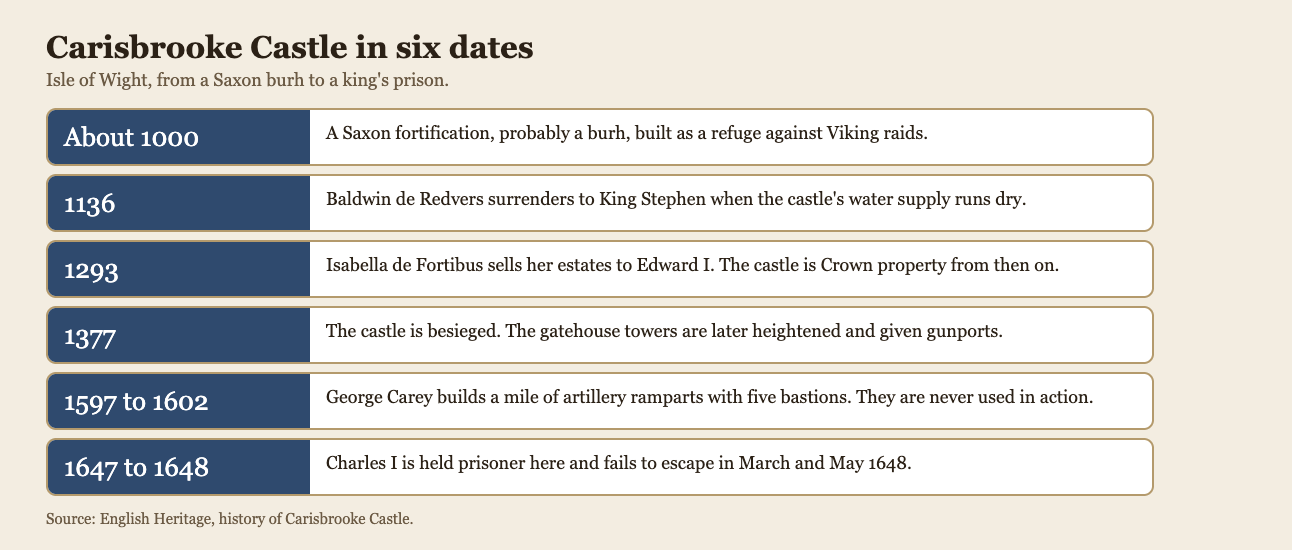
Carisbrooke in six dates, from English Heritage's history page.
From Saxon burh to the dry well of 1136
English Heritage says Roman use of the area has been suggested but never proved. The earliest certain use was a pagan Anglo-Saxon cemetery of the 6th century, where three graves were found.
Around the year 1000 the hilltop became a rectangular fortification. It was an earthen bank, later faced with stone, with large timber buildings inside. It was probably a burh, a fortified settlement built as a refuge against Viking raids. You can still see remains of its lower enclosure wall on the west side of the castle, near the foot of the Norman bank.
Soon after the Norman conquest the burh became a castle to secure the island for the invaders. The Normans formed a defended enclosure in one corner of the old burh by digging deep ditches inside it. In 1100 Henry I made the Isle of Wight a lordship for Baldwin de Redvers, one of his key supporters, and it stayed in the family until 1293. The page says it was probably Baldwin who built the massive motte-and-bailey castle that still dominates the hilltop. For more on what the central tower of such a castle was for, see What was a castle keep for?
When Henry I died, a civil war broke out between his nephew Stephen, who took the throne, and his daughter Matilda. Baldwin backed Matilda. English Heritage says that in 1136 he probably meant to defend Carisbrooke, but he had to surrender to King Stephen when the castle's water supply ran dry. By then the castle already had stone walls on its banks.
It was not a wall that failed, it was the water. Our post on castle wells explains why a well mattered so much, and starving a castle covers sieges that ended with no breach at all.
Isabella de Fortibus, the great hall and the siege of 1377
The last of the de Redvers family was Countess Isabella de Fortibus. English Heritage says she shaped the castle interior into the form we see today. As well as work on the defences, she made a home fit for a great lord. She built the existing great hall, much altered since, with her own chamber at one end and her private chapel at the other, plus many other buildings around a central courtyard.
In 1293, in the last days of her life, she sold her estates to Edward I. The castle has been Crown property ever since. If you want to know what happened in a hall like hers, read Castle great hall: what happened in it.
After 1293 the Crown appointed a quick succession of lords of the island. Most of the work they did on the castle was on the defences, particularly during the wars with France. The page says the island was raided five times between 1336 and 1370, and the castle itself was besieged in 1377.
English Heritage's story of medieval war adds what changed after that siege by French forces: the gatehouse towers were heightened and given purpose-built gunports. Our post on the castle gatehouse tells that part of the story, and What was a bombard? covers the guns that made such changes necessary.
In the early 16th century the castle's importance declined, because Henry VIII chose to defend the coast instead.
George Carey and a mile of ramparts that never fired
The castle's importance returned when Elizabeth I made her cousin George Carey captain of the island in 1583. He held the post until he died in 1604. He began by rebuilding the decayed domestic buildings, so that they were fit for a great lord. He added a range next to the hall, known as Carey's Building, with 17 rooms and a long gallery.
The threat of Spanish invasion led him to make modest additions to the defences in 1587. In the next invasion scare, in 1596 to 1597, he persuaded the queen and the local gentry to pay for a major, modern artillery fort. It was a low, roughly rectangular rampart nearly a mile long, with five bastions. The page says the long, low banks and ditches were faced with stone walls for the greatest protection against gunfire. The work was finished in 1602. English Heritage says it was never used in action.
Charles I at Carisbrooke
When the Civil War began in 1642, the castle passed into the hands of Parliament's forces. Until 1660 its main use was as a prison for important Royalists. The most famous was Charles I, who was held here in 1647 to 1648. Later the castle also held his youngest son and his daughter, Princess Elizabeth, who died here in 1650 at the age of 14.
Charles came to the island in November 1647 after escaping house arrest at Hampton Court, hoping to act more freely. He soon found that he was a prisoner again, this time in the castle. He was housed with some ceremony in the hall range, with members of his own household to attend him, and an enclosure on the east side was turned into a bowling green for him. He made two attempts to escape, in March and May 1648, and both failed. In September he was moved to Newport for negotiations with Parliament, which also failed. He went on by stages to London and to his execution in Whitehall on 30 January 1649.
We cover what happened to other castles in the same war in Civil War castle sieges, and who else was locked up in castles in Castle prisons.
From residence to monument
After the Civil War the castle was the occasional home of the island's governors. Lord Cutts (governor 1692 to 1706) and the Earl of Cadogan (1715 to 1726) repaired and altered it. In 1738 the Chapel of St Nicholas was pulled down and rebuilt in Georgian style.
By the middle of the 19th century nobody lived there. It was still a base for the Isle of Wight Artillery Militia, but the gatehouse had lost its roof and floors, Carey's building was a ruin and many other buildings were in poor repair. Visitors had begun to come to see it. It passed to the Office of Works in 1856, and Philip Hardwick did the first restoration that year.
The look of the castle today owes most to Percy Stone, an architect and the island's historian, who published the first study of the castle in 1891. Princess Beatrice, Queen Victoria's youngest daughter, became governor in 1896. Stone restored the gatehouse, giving it a new roof and an upper floor, to hold the first Isle of Wight Museum, which opened in 1898. In 1904 he restored the Chapel of St Nicholas, which is now the island's war memorial for the 2,000 islanders killed in the two world wars. Beatrice used the hall range as her summer home until 1938. Today the castle is mostly a monument. Check English Heritage's own page for opening times before you go.
What Carisbrooke shows about the game
Two Towers is a medieval tower defense game that plays in your browser. It is not a history of Carisbrooke, and it does not claim to be. But Carisbrooke's 1377 lesson is the one the game keeps teaching: the gate is where an attack lands. The game's own ram tip reads "Rams hit the gate hardest: Reinforce the gate, and use Ballista bolts that ignore armor."
And the sapper tip, "Archer Volley catches them off the road, and a Bell slows the dig," is the same advice in game form: stop the thing that is hurting your walls before it gets there.
Frequently asked questions
Where is Carisbrooke Castle?
It is on a hilltop in the middle of the Isle of Wight. English Heritage says it has been a central place of power and defence on the island for over 1,000 years.
Why was Charles I held at Carisbrooke Castle?
He came to the island in November 1647 after escaping house arrest at Hampton Court, hoping to act more freely, but found he was a prisoner again. He tried to escape twice, in March and May 1648, and failed both times.
Was Carisbrooke Castle ever besieged?
English Heritage says it was besieged in 1377, and that in 1136 Baldwin de Redvers had to surrender to King Stephen when the castle's water supply ran dry.
What are the ramparts at Carisbrooke?
They are an artillery fort of low banks and ditches faced with stone, built between 1597 and 1602 for George Carey, nearly a mile round with five bastions. They were never used in action.
Get started
If a thousand years of defending one hilltop made you want to hold a gate yourself, try Two Towers. The page says it is free, with no ads. You pick the two towers that guard the gate from four kinds, spend the gold you win on upgrades, and buy two more for the hills. There is no final stage.
Comments
No comments yet.
Sign in or make an account to comment.