Carlisle Castle sieges: why it was besieged ten times
Carlisle Castle was besieged ten times, more than any other castle in England. That makes Carlisle Castle sieges a good way into one simple question: why do some castles get attacked again and again while others never see a fight? The answer at Carlisle is its place on the map. This guide explains why it mattered, then counts the ten sieges one by one from English Heritage's history of the castle, so you can see how the number adds up.
Why Carlisle Castle sieges kept happening
English Heritage gives the reason in one line: for over 500 years Carlisle was the main point of defence against the Scots on England's north-west border. Until the English and Scottish crowns were united in 1603, it was the principal fortress of that border, and the base of the lord wardens who tried to control an unruly frontier.
A border fortress is a target by design. An army coming south on that side had to deal with it, and an army that held it had a base for going north. Every quarrel between the two kingdoms came back to the same walls.
The castle has also been lived in without a break since William II founded it in 1092, which is unusual for a medieval castle. From the 18th century to the 1960s it was the headquarters of the Border Regiment. A castle that never stopped being useful is a castle people kept fighting over.
A castle built for the border
The first castle was built by William II after he defeated a local warlord, Dolfin, in 1092. Henry I visited in 1122 and ordered that Carlisle be "fortified with a castle and towers", which may be the origin of the great keep.
The border could move. After Henry I died in 1135, Carlisle was retaken by David I, King of Scotland, who is said to have built "a very strong keep" there. English Heritage notes that he may have been finishing work Henry I began, so who built the keep is still an open question. In 1296 Edward I made Carlisle his headquarters for three months at the start of his war against the Scots.
Worked example: counting the ten sieges
"Ten sieges" is easy to repeat and harder to check. Here is how to count them yourself from English Heritage's history page. Follow the steps and you can test any "most besieged" claim the same way.
- Start with the medieval border wars. The page says the Scots besieged the town and castle seven times between 1173 and 1461. That gives sieges 1 to 7.
- Add the Civil War. In October 1644 a Parliamentarian army surrounded the Royalist city with guns and earthworks and settled down to starve it out. That is siege 8.
- Add the first Jacobite siege. Prince Charles Edward Stuart reached Carlisle on 9 November 1745, and the city and castle surrendered five days later. That is siege 9.
- Add the last one. The Jacobites left a garrison of 400 in the castle on 20 December 1745. The page calls what followed the castle's "tenth and final siege". That is siege 10, and the count matches.
One honest note: English Heritage's own pages word the record differently. The history page says Carlisle has endured more sieges than any other castle in England. Its "10 things you probably didn't know about sieges" page says ten times, more than any other place in the British Isles. Both agree on ten.
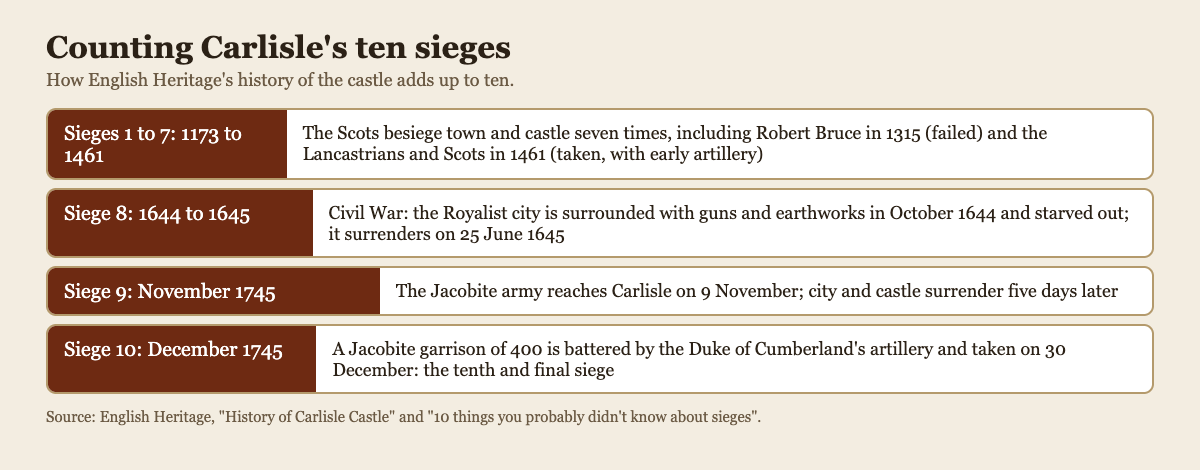
The ten sieges as English Heritage's history of Carlisle Castle counts them.
The medieval sieges: Robert Bruce in 1315 and the guns of 1461
English Heritage names two of the seven Scottish sieges. One of the most determined came in 1315, when Robert the Bruce, King of Scotland, attacked the year after his victory at Bannockburn. The Scots failed to take the castle and retreated with the loss of only two English lives.
The man on the wall was Andrew Harclay, a Cumbrian squire. English Heritage's page on him says he led the defence against an all-out Scottish attack led by Robert Bruce in person, and that a drawing from the time shows him leaning over a wall to hurl a spear at the enemy below. Defenders on a wall top had cover from the stonework, as castle battlements explains.
The siege of 1461 went the other way. During the Wars of the Roses, a combined army of Lancastrians and Scots took the castle from the Yorkists through what English Heritage calls the early use, in a British context, of artillery. For what those first guns were, see what was a bombard.
Between the sieges: guns, a battery and a ladder rescue
After 1538, Henry VIII ordered a review of Carlisle's defences. The result was the largest building campaign since the 12th century, directed by a Moravian engineer, Stephan von Haschenperg. It lowered the keep and put an artillery platform on its roof, thickened the inner ward walls, and added the half-moon battery.
Not every break-in was a siege. On 13 April 1596 a large armed group used ladders to get into the castle and free a prisoner, the notorious William Armstrong of Kinmont, known as Kinmont Willie, at a time when the castle held border reivers.
The Civil War and the last siege of 1745
Carlisle should have stopped mattering as a border fortress after 1603. It did not. Garrisoned by the Royalists in 1642, it was one of the few northern places still holding out for the king after Marston Moor in July 1644. Surrounded from October, the city ran short of food: all the horses were eaten, then the dogs and rats. After the Royalist defeat at Naseby there seemed no more hope of relief, and on 25 June 1645 the city surrendered. The wider story of sieges won by hunger is in starving a castle.
In 1745 the castle changed hands twice in two months. The Jacobite army took it in November, marched south, turned back at Derby, and left a garrison behind. The Duke of Cumberland's army battered the castle with artillery, and it was taken on 30 December 1745.
Frequently asked questions
How many times was Carlisle Castle besieged?
Ten times, according to English Heritage: seven Scottish sieges between 1173 and 1461, one in the Civil War, and two in 1745.
Why was Carlisle besieged so often?
It was the main defence of England's north-west border with Scotland for over 500 years, so wars between the two kingdoms kept reaching it.
When was the last siege of Carlisle Castle?
December 1745. A Jacobite garrison of 400 was battered by the Duke of Cumberland's artillery and the castle was taken on 30 December.
Did Robert the Bruce capture Carlisle?
No. His siege of 1315 failed, and the Scots retreated with the loss of only two English lives.
Get started
Carlisle's story is one of holding the same gate against attack after attack. Two Towers is a free medieval tower defense game that plays in your browser, on a computer or a phone, with no ads, and it is built on that idea. As its own text puts it: "The stages never end." Every stage comes stronger, faster or in greater numbers than the last.
You pick the tower for each side of the gate (Archer Tower, Trebuchet, Ballista or Fire Tower) and repair or reinforce the gate between attacks. The tips read like a garrison's notes: "Crossbowmen shoot from afar: Range upgrades and a Trebuchet reach them." It is a game, not a history course, but you will think about the people on Carlisle's walls differently after a few stages.
Play Two Towers: it is free and plays in your browser on a computer or a phone.
Comments
No comments yet.
Sign in or make an account to comment.