Castle battlements: how crenellations protected defenders
Castle battlements are the notched tops of a castle's walls and towers, the row of stone teeth you see on almost every castle picture. They were not decoration. Each solid block and each gap had a job in a fight, and once you know those jobs you can read the top of a real castle wall like a plan of its defence. This guide explains the parts, walks one surviving wall top step by step, and shows why armies that captured a castle often pulled its battlements down.
What castle battlements are
A parapet is the low wall along the outer edge of a wall top or tower roof. It stops people falling off and shields whoever stands behind it. Cut a regular pattern of gaps into that parapet and you have battlements. The pattern itself is called crenellation, and a wall that has it is crenellated. Each gap is a crenel.
In everyday writing, "battlements" and "crenellations" are used for the same thing. If you want to be exact, the battlements are the whole notched parapet, and crenellation is the shape cut into it.
Behind the parapet runs the wall-walk, the path along the top of the wall. At Rochester Castle, English Heritage describes the wall-walk at the level of the battlements, and notes that the west wall still has traces of early battlements in its stonework. The wall-walk is where defenders moved, stood and fought.
How battlements worked in a fight
A defender on a wall top needs two things that pull against each other: a clear view of the enemy, and something solid to hide behind. A plain wall top gives cover but no view. An open wall top gives a view but no cover. Battlements give both, a step apart.
English Heritage puts it plainly in its list of things most people do not know about sieges: the crenellated shape let soldiers shoot arrows and crossbow bolts at the enemy with a clear line of sight through the gaps. Then hinged wooden shutters between the stone crenels would drop shut to protect them while they reloaded.
That last detail changes how a castle should be pictured. The open gaps you see today were often closed by timber in a fight. Those shutters have not survived at most castles, but the stonework has, which is why the bare tooth shape is what we now see everywhere.
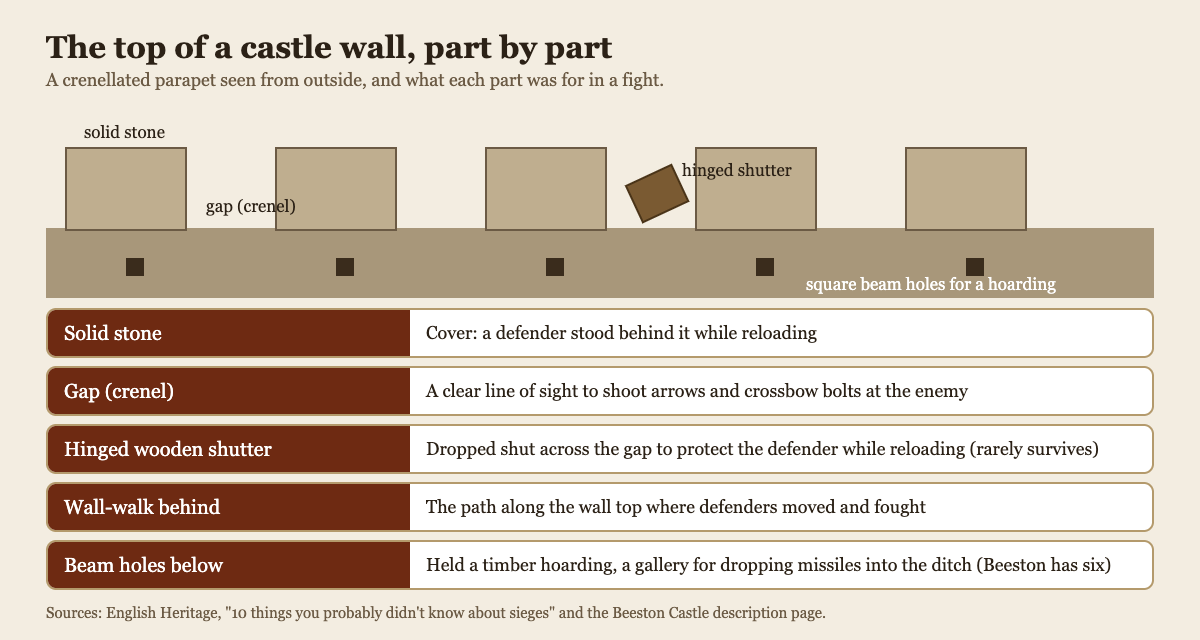
The parts of a battlement and their job, from English Heritage's descriptions.
Battlements and the wall-walk: shooting in every direction
Battlements only work with room behind them. At Totnes Castle, English Heritage describes its wall as capped with battlements and a wall-walk, allowing defenders to shoot in all directions. A ring of battlements on a round wall means there is no blind side: wherever an attacker comes from, someone on the walk can face them.
Builders also pushed the wall top outward so defenders could reach further. At Etal Castle, a high parapet walk was built on projecting stones along the wall, and from it defenders could hurl missiles at attackers below. At Nunney Castle, a projecting line of battlements ran round the wall tops. Pushing the parapet out over the wall face meant less leaning out through a gap to reach the foot of the wall.
Battlements also cost money to keep. Totnes's records show that tenants of the lordship were obliged to pay for repairs to a specified number of battlements on the castle wall. A battlement was a unit people counted, owed and fixed.
Worked example: reading Beeston Castle's battlements
Part of Beeston Castle's wall top in Cheshire survives at full height. Here is a five-step way to read it, using only what English Heritage records. You can use the same steps on any castle you visit.
- Find a stretch at full height. At Beeston, the inner ward's curtain wall survives to its full height east of the inner gatehouse. Most castle walls have lost their tops, so start where the top is still there.
- Count the battlements. Five battlements survive on that stretch. Counting them tells you how many defenders could stand there at once with cover.
- Look just below the parapet. Beneath it are six square holes for the wooden beams of a hoarding, a defensive gallery from which missiles could be dropped onto attackers in the ditch below. The battlements covered the field; the hoarding covered the wall's foot.
- Compare the towers with the wall. Each tower originally had at least one upper storey above the level of the curtain-wall battlements, so defenders in the towers could shoot down along the wall top if attackers reached it.
- Look for signs of rebuilding. Beeston's accounts record three inner-ward towers being raised and crenellated "because they formerly had high wooden surfaces, and now they are made level". In other words, those towers had not yet been finished in stone in the 13th century.
Five steps, and a ruin becomes a fighting position: a row of cover, a gallery for the ditch, and towers that overlook both. For the gallery itself, see castle hoardings, the timber galleries on top of the wall.
How attackers dealt with battlements
Battlements were the main target of an assault on a wall. English Heritage's page on medieval siege warfare describes siege towers with fighting platforms on top, from which the castle battlements could be bombarded with arrows before a drawbridge was dropped onto the parapet for the assault troops. Clearing the battlements came first; crossing onto them came second.
Ladders were the cheaper way up, and the most dangerous. Defenders behind battlements could shoot at climbers and push ladders away, which is why escalade, climbing castle walls with ladders, so often failed against a ready garrison.
Battlements worked alongside lower defences too. Narrow slits in towers and walls let archers shoot from several levels, not only the top; arrow loops explains how.
Why armies pulled battlements down
If battlements were what made a wall defensible, removing them made it useless. After the Civil War, Parliament ordered Goodrich Castle in Herefordshire to be slighted, which English Heritage explains as rendered indefensible, probably by the removal of the battlements and damage to the main defences.
That is a telling choice. The walls could be left standing, because walls with no battlements give a garrison nothing to fight from. When you see a bare, flat wall top, it is worth asking whether it wore away or was stripped on purpose.
Battlements could also be a sign of rank as much as defence; a lord in England could seek the king's licence to crenellate before adding them to a house. That story is told in licence to crenellate: what it was and why lords wanted one.
Frequently asked questions
Is there a difference between battlements and crenellations?
In everyday use they mean the same. Strictly, the battlements are the notched parapet on top of a wall, and crenellation is the pattern of gaps and solid stone cut into it.
What is the gap in castle battlements called?
Each gap is a crenel. English Heritage notes that hinged wooden shutters often hung between the stone crenels and dropped shut to protect defenders while they reloaded.
Why do so many castle walls have no battlements today?
Some wore away over time, and some were stripped on purpose. Goodrich was made indefensible after the Civil War, probably by removing its battlements.
Where can I see castle battlements that survive?
Beeston Castle in Cheshire keeps five battlements on its inner ward wall, with six beam holes for a hoarding beneath them. Totnes Castle's round wall is still capped with battlements and a wall-walk.
Get started
Reading a wall top is one thing; holding a gate under pressure is another. Two Towers is a free medieval tower defense game that plays in your browser, on a computer or a phone, with no ads. It is a game, not a history course, but it puts the same question in front of you: what reaches the attackers before they reach you?
On the title screen you pick the tower for each side of the gate: Archer Tower, Trebuchet, Ballista or Fire Tower. The game's tips read like a defender's notes. "Crossbowmen shoot from afar: Range upgrades and a Trebuchet reach them." And for the machine built to put men on the wall top: "Siege towers let a crew out at the wall: stop them early with a Ballista and Damage." Between attacks you can repair the gate or reinforce it with in-game gold.
Play Two Towers: it is free and plays in your browser on a computer or a phone.
Comments
No comments yet.
Sign in or make an account to comment.