Castle chapels: where a castle household prayed
Castle chapels were the rooms where a castle's household prayed, and every castle this post visits had one; some had several. A castle chapel could sit inside the keep, beside the gate, in a tower of its own or in a separate building in the courtyard. This post walks through one real chapel, Goodrich Castle's, which is built into the gatehouse, using English Heritage's teachers' guide. Then it visits chapels at five other castles, so you can spot one on a visit and read what it tells you about the people who lived there.
Castle chapels: what they were for
English Heritage's glossary for Goodrich defines a chapel as "a small building or room used for christian worship within a larger building such as a castle". The teachers' guide for the same castle explains why it mattered: great importance was placed on religion and prayer, and having a private family chapel was also a sign of wealth and status.
A chapel needed people as well as stone. The guide says Countess Joan de Valence, who lived at Goodrich in the late 13th century, had at least nine chaplains or clerks who travelled with her, and that her household accounts list educated, literate chapel clerks among the people working at the castle. Later, Richard Talbot had a group of priests who sang mass in the chapel there.
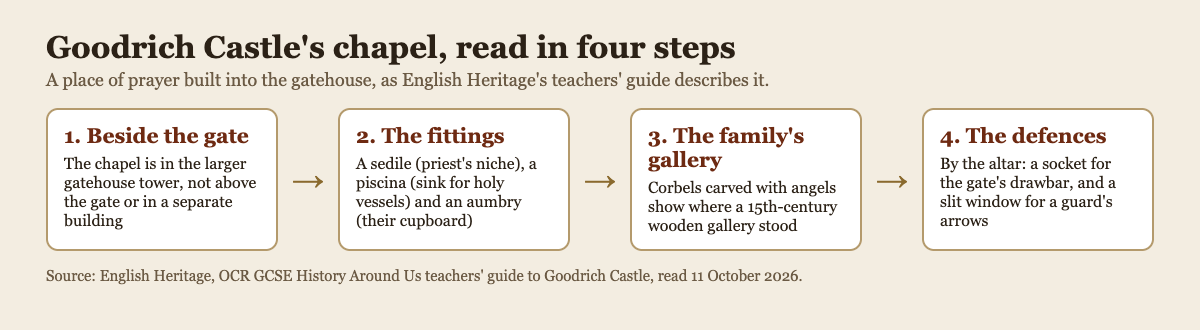
Worked example: Goodrich's chapel beside the gate
Goodrich's chapel is a good one to learn from because it is unusual. Follow it in four steps, as the teachers' guide to Goodrich describes it.
- Where it is. The gatehouse has two towers of different sizes, and the larger one contains the chapel. The guide says that in many castles the rooms beside the gates were used by guards, and the chapel would be in the room above the gatehouse or in a separate building. Goodrich is unusual, and possibly unique, in having a chapel alongside the gatehouse.
- What is in it. The chapel, first built in the 13th century, has a trefoil-headed sedile (a niche for the priest), a piscina (a sink for washing the holy vessels used in the mass) and an aumbry (the cupboard for those vessels). Those three features are what to look for in any ruined chapel.
- Where the family stood. Stone corbels in the walls, carved with angels holding shields, show where a wooden gallery was supported. It was added in the 15th century so the lord or lady and their family could attend services apart from the rest of the congregation. A door and corbels in the curtain wall show where the family crossed from the north range into the raised gallery.
- What else it did. Close to the altar is a socket that let the door drawbar be pulled back when the gates were opened, and a slit window through which a guard could aim arrows at an approaching enemy. The guide even mentions references to the chapel being used as a store for horses' oats while the main household was away.
The guide turns that last step into a question worth asking at any castle: was the chapel used for purely religious reasons? At Goodrich the gate's defences reach right up to the altar. There is more on that gate in why the gatehouse was a castle's strongest part.
A chapel tower: Middleham
At Middleham, English Heritage's description of the castle gives the chapel a tower of its own. On the east side of the keep is a three-storey chapel tower, added in the first half of the 13th century.
- The chapel itself was on the second floor, supported with stone vaulting.
- Remains of the priest's piscina, the basin for water used during mass, can still be seen at the east edge of the south wall.
- The clergy lived on the first floor, and the ground floor was used for storage.
- The chapel could be entered from the keep's ante-chamber, and a doorway in the great hall's north-east corner led to a small chapel.
So at Middleham the priests lived just under the room they served. You can follow the route from that hall to the lord's rooms in castle great chambers: where the lord lived.
A chapel in the wall: Conisbrough
Conisbrough's 12th-century keep is a four-storey cylinder with six wedge-shaped buttresses. English Heritage's description says the second floor houses a chapel with a rib-vaulted ceiling, built within one of those buttresses. A small room of prayer was fitted into the thickness of the tower itself, on the same floor as the bedchamber. The same page notes that the remains of a rectangular building east of the gatehouse may represent another chapel, down in the bailey.
Private prayer: Warkworth and its hermitage
At Warkworth, the great tower's first floor holds the great hall, the great chamber and the chapel. The corbels in the walls show that the chapel had an upper floor where the earl could perform his devotions in private, the same idea as Goodrich's gallery.
Warkworth also has a hermitage, reached by boat across the river Coquet and almost certainly set up in about 1400 by the 1st Earl. English Heritage says it was probably not a hermit's home but a chantry, a private chapel where a priest performed services in return for a payment. The chapel, with three vaulted bays, was carved straight out of the rock, and an inner chamber with viewing slits was probably a closet from which the earl and his retinue could watch the service.
A parish church inside the walls: Farleigh Hungerford
Some castles took over a church that was already there. At Farleigh Hungerford, English Heritage's history of the castle says that when Walter, 1st Lord Hungerford, built the outer court, it enclosed the former parish church. He adopted and improved it as the castle chapel, the chapel of St Leonard, and built a house for the priests who served it.
Walter refurbished the chapel in the early 1440s and commissioned wall paintings, including a large figure of St George and a kneeling knight in the Hungerford arms. The paintings have suffered since they were found in 1844: their red background comes from a well-meant but disastrous hot-wax treatment applied between 1931 and 1955, which English Heritage removed in the 1970s. Originally the background was pale.
How to spot a castle chapel on a visit
- Look for the fittings. A piscina (a basin; Middleham's is at the east edge of the south wall), a sedile (a seat niche) or an aumbry (a wall cupboard), as at Goodrich and Middleham.
- Look up for a gallery. Corbels high on the walls, as at Goodrich and Warkworth, show where the family had a raised place of its own.
- Look in odd places. In a buttress at Conisbrough, beside the gate at Goodrich, in its own tower at Middleham, in the rock at Warkworth.
Frequently asked questions
Did every castle have a chapel?
Every castle in this post did, from Goodrich to Farleigh Hungerford, and Pevensey's inner bailey also had one. Some had more than one, such as Warkworth with its tower chapel and its hermitage.
Who led services in a castle chapel?
Priests and chaplains. Countess Joan de Valence had at least nine chaplains or clerks who travelled with her, and Middleham's clergy lived on the floor below the chapel.
What is a piscina?
A basin for the water used during mass, in Middleham's description, or a sink for washing the holy vessels, in the Goodrich guide's words.
Where did the lord sit in a castle chapel?
Often apart, above the rest. Goodrich had a 15th-century wooden gallery for the family, and Warkworth's chapel had an upper floor for the earl's private prayers.
Get started
Goodrich's chapel stood right beside the gate, where a guard could aim arrows at the road from a slit by the altar. Two Towers is a free medieval tower defense game, an original game rather than a history course, that puts you on that gate. You pick the two towers that guard it from four kinds, the Archer Tower, Trebuchet, Ballista and Fire Tower, spend the gold you win on upgrades, and repair or reinforce the gate between attacks. Every stage comes stronger, faster or in greater numbers, and there is no final stage.
Play Two Towers: it is free and plays in your browser on a computer or a phone.
Comments
No comments yet.
Sign in or make an account to comment.