Castle garrison: how many soldiers held a castle?
A castle garrison could be much smaller than you might expect. English Heritage's history pages give real numbers for a handful of castles, and they run from 80 men to about 1,200. The gap is not random. It depends on when the castle was held, what it was facing, and who was paying. This guide puts six numbers side by side and gives you three questions to read any garrison figure you find.
What a castle garrison was
A garrison is the body of soldiers kept in a castle to hold it. English Heritage's page on medieval siege warfare sets the test a garrison had to pass: it needed to be large enough and experienced enough to resist what was often a bigger attacking force.
That line explains why castles mattered. Walls, towers and a strong gate let a small number of defenders hold off a larger army. A garrison did not need to match the attackers man for man. It needed enough people to man the walls, work the defences and last as long as the stores did.
Six real numbers from English Heritage
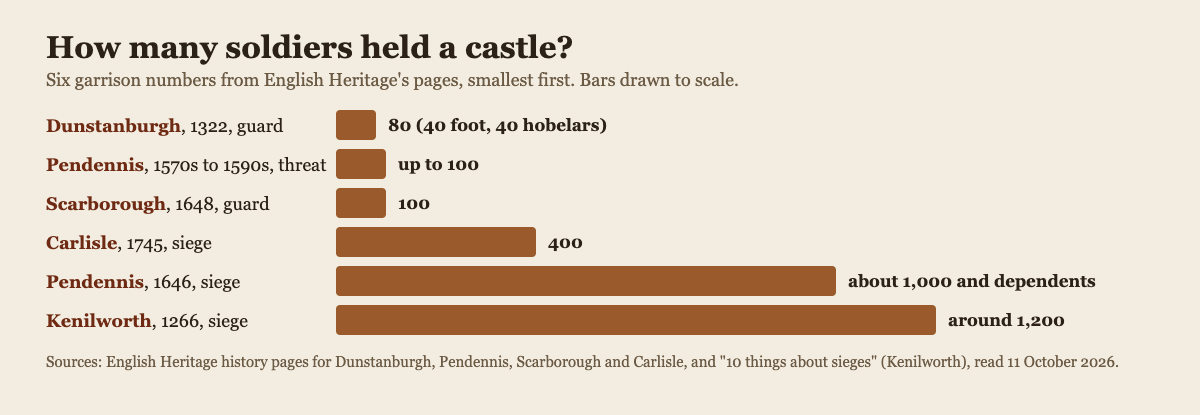
Here are the garrisons English Heritage's pages put a number on, smallest first:
- Dunstanburgh, 1322: 80. After the king captured Thomas of Lancaster, he took the castle into his own hands and garrisoned it with 40 foot soldiers and 40 hobelars (lightly armed cavalry), says the history of Dunstanburgh Castle.
- Pendennis, late 1500s: up to 100. The history of Pendennis Castle says the fort was fully garrisoned by up to 100 men only when there was an imminent threat, such as the planned Spanish invasions of 1574, 1579, 1588 and 1596 to 1597.
- Scarborough, 1648: 100. The Parliamentary garrison of 100 men under Colonel Boynton declared for the imprisoned king after Parliament had failed to pay them, according to the history of Scarborough Castle.
- Carlisle, 1745: 400. The retreating Jacobite army left a garrison of 400 in Carlisle Castle to hold off the English pursuit; the castle endured its tenth and final siege and was taken on 30 December 1745, says the history of Carlisle Castle.
- Pendennis, 1646: about 1,000. About 1,000 soldiers and their dependents endured a five-month siege, agreeing an honourable surrender in August when their food ran out.
- Kenilworth, 1266: around 1,200. English Heritage's 10 things about sieges says a group of around 1,200 rebels built up supplies and arms at Kenilworth, which had very strong defences, and held it for 172 days.
A worked example: three questions for any garrison number
A number on its own tells you little. Ask three questions of it:
- When? Was this a peacetime guard, a castle under threat, or a castle under siege?
- Against what? A raid, an invasion, or a whole army settled outside the walls?
- Who paid, and for how long? Every soldier had to be fed and paid for as long as he stayed.
Run them on the six numbers and the spread makes sense.
Pendennis twice. The same castle shows both ends. Up to 100 men came in only when an invasion was expected, and English Heritage says that after 1646 a small garrison was kept on and off. In 1646, as one of the last strongholds holding out for the king, it held about 1,000 soldiers and their dependents. Same walls, ten times the people, because the answer to question 1 had changed from "under threat" to "under siege".
Dunstanburgh and Scarborough. Both near 100, both in the hands of a government that had just taken control: the king after defeating Thomas of Lancaster in 1322, Parliament in the 1640s. These were guards, not armies. Scarborough shows the risk in question 3: its 100 men changed sides when Parliament stopped paying them, and held out until December 1648.
Carlisle and Kenilworth. These are the numbers of people expecting a siege. Carlisle's 400 were left to hold off a pursuing army. Kenilworth's 1,200 had time to prepare, and English Heritage says that when they surrendered they had food left for only two more days. A large garrison could fight longer, but it also ate faster.
Why a big garrison was a cost as well as a strength
The third question is the one people forget. A garrison was a standing bill. English Heritage's history of Kenilworth says that in 1649 the new regime, anxious to avoid the cost of maintaining a garrison, ordered the castle to be made "untenable", so its keep wall was destroyed and its outer wall breached. It was cheaper to break the castle than to keep soldiers in it.
The siege warfare page shows the same thinking in another way: if possible, non-combatants were sent away to preserve resources. Every person inside, soldier or not, drew on the same castle stores. That is why the number in a garrison was always a trade: enough to hold the walls, few enough to last.
Leaving a castle so it could not be held
A garrison could also make sure nobody used the castle after it left. English Heritage's history of Warkworth Castle says Parliamentarian forces installed a garrison there in 1648, and when the soldiers withdrew they removed doors and iron so that the castle could not be held in war. The soldiers who left took the means of holding it with them. The bigger version of this, ordered from above, is told in slighting a castle.
A small garrison in Two Towers
In Two Towers, a free medieval tower defense game that plays in your browser, your garrison is as small as it gets: two towers, one left of the gate and one right of it, chosen from four kinds (Archer Tower, Trebuchet, Ballista or Fire Tower). Like a real castle, you face a bigger attacking force: every stage comes stronger, faster or in greater numbers than the last, and there is no final stage.
You grow the garrison with gold you win, the way a real one grew when a threat came. You can buy a tower for West Hill or East Hill, 150 gold for the first and 300 for the second, and upgrade each tower's damage, fire rate, range or special. Late in the game, help arrives: "From stage 45, your King and knights ride out." The game does not say what they do, so watch and see. Gold in the game is in-game gold, never money.
Frequently asked questions
How many soldiers were in a castle garrison?
It varied with the danger. English Heritage's pages give 80 at Dunstanburgh in 1322 and up to 100 at Pendennis under threat, but 400 at Carlisle in 1745 and around 1,200 at Kenilworth in 1266.
Why were garrisons so small in peacetime?
Because every soldier had to be paid and fed. Pendennis was fully garrisoned only when an invasion was expected, and Kenilworth was made untenable in 1649 to avoid the cost of a garrison.
Could a small garrison hold off a large army?
That was the point of a castle. English Heritage says a garrison had to be large enough and experienced enough to resist what was often a bigger attacking force, and walls and gates did the rest.
Did garrisons ever change sides?
Yes. At Scarborough in 1648 the Parliamentary garrison of 100 men declared for the king after Parliament failed to pay them.
Get started
Find a castle near you and look for a garrison number on its English Heritage history page, then ask the three questions. Then command a garrison of your own: Play Two Towers, pick the two towers that guard the gate, and see how long they hold.
Comments
No comments yet.
Sign in or make an account to comment.