Castle great hall: what happened in it
A castle great hall was the big shared room at the heart of a castle, where the household ate together and the lord was seen in state. English Heritage's history of Pevensey calls it simply "a great hall for communal dining". If you have stood in a long roofless room with tall windows in a castle ruin, you were probably in one. This post reads one real hall, Middleham's, from the cellar under its floor to the dais at its top end, using English Heritage's description. Then it looks at the great halls of five more castles, so you can read one yourself.
Castle great hall: the room everyone shared
At Warkworth, English Heritage describes the great hall in the bailey as the room "where the whole household ate". That is the core of it: the great hall was where the household ate together.
Halls could also be showpieces. Stokesay Castle, built in the 1280s by the rich wool merchant Laurence of Ludlow, is described as an ensemble of 13th-century towers and a "magnificent great hall". At Kenilworth, John of Gaunt built a great hall between 1373 and 1380 as part of two decades of work, together with remodelled apartments, services and kitchens.
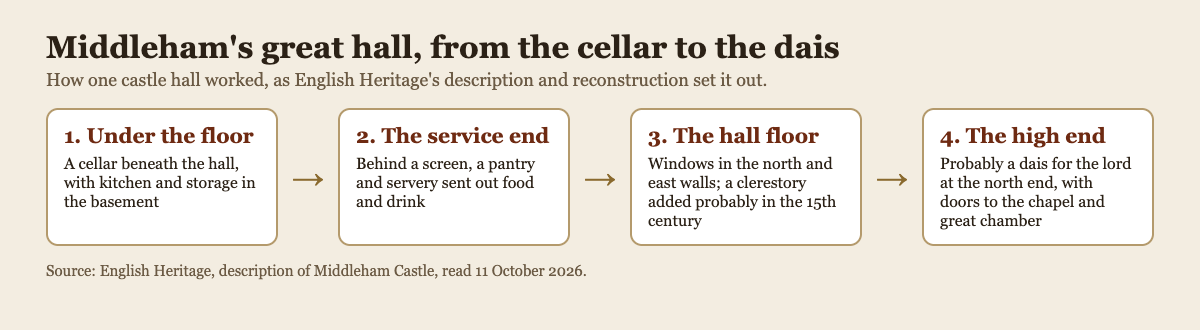
Worked example: reading Middleham's hall from cellar to dais
English Heritage's description of Middleham Castle, with its reconstruction drawing of the hall as it may have looked in the 13th century, lets you read the room in five steps.
- Look below the floor. The reconstruction is cut away to show a cellar beneath the hall. The keep's basement held kitchen and storage areas, and a fine staircase in the south-east turret ran from them right up to the roof.
- Find the service end. Behind a screen were a pantry and a servery, from which food and drink were sent out into the hall. That end of the room was for work.
- Check how you got in. Visitors climbed a stone stair to the first floor, waited in a vaulted ante-chamber, and only then were let into the hall. The hall was upstairs, above the stores.
- Read the light. The hall was lit by windows in its north and east walls. Probably in the 15th century it was heightened to make a clerestory, a row of high windows, with large windows on the east and west sides to let in more light.
- Find the high end. There was probably a dais, a raised platform, for the lord at the hall's north end. Doorways at that end led to a small chapel and to the lord's private rooms, a great chamber and an inner chamber.
Put together, the room runs from work to rank: the service end with its screen at one side, the lord's dais at the other, and the household in between. A narrow side stair near the top of the turret even led to the battlements above the hall. The private rooms beyond the dais are followed in castle great chambers: where the lord lived.
Two doors, two kinds of people: Goodrich
English Heritage's teachers' guide to Goodrich Castle shows how a hall could keep ranks apart even while it brought people together. Goodrich's great hall, one of the improvements made under William and Joan de Valence and their son Aymer, has separate entrances for the family and for the servants, at opposite ends.
The family's north exit led to their apartments, the solar block and the chapel, so they could move between their rooms without crossing the working parts of the courtyard or the kitchens. The guide adds that a separate dining area for servants, most likely the hall of the east range, shows that people of different ranks did not eat together. So "the whole household ate" in the hall is true in some castles and only partly true in others.
One hall, one arcade: Acton Burnell
At Acton Burnell, a fortified manor house in Shropshire, English Heritage's history says life revolved around a large, nearly square hall at the eastern end of the first floor, lit by large traceried windows. An open arcade, a row of arches, ran east to west down the middle of it. The hall was entered straight from outside by steps, now demolished, and the ground floor below held storage and service rooms. West of the hall rose the private chambers, three storeys of them.
Halls rebuilt for show: Warkworth, Kenilworth and Farleigh Hungerford
Owners rebuilt their halls to suit new ways of living.
- Warkworth. The great hall in the bailey was essentially a 15th-century remodelling of an earlier hall of about 1200, part of a new residence built by the 4th Earl of Northumberland in about 1480. The kitchen, buttery and pantry lay to the right of its entrance porch, the Lion Tower. The great tower on the mound had its own great hall too, and English Heritage says it is not clear how the two worked together.
- Kenilworth. In John of Gaunt's great hall, built between 1373 and 1380, the hall itself was on the first floor, entered through an arch. Ivy covered it until the 1860s.
- Farleigh Hungerford. Walter, 1st Lord Hungerford, probably refashioned the great hall and bedchambers of the inner court between about 1430 and 1445. English Heritage says his additions to the castle were mainly paid for by the ransoms of his French prisoners.
What happened to great halls later
Big rooms were easy to reuse. At Stokesay, once the family left in the 18th century and the castle was let to tenant farmers, the hall became a granary. At Goodrich, the remains of the great hall stand beyond the site of the stables, which Parliamentarian soldiers burned down in a night raid in March 1646. And at Kenilworth, the hall became part of a ruin that has long drawn tourists.
Frequently asked questions
What was a great hall used for in a castle?
Mainly for eating together. English Heritage calls Pevensey's "a great hall for communal dining", and Warkworth's the room "where the whole household ate".
Where did the lord sit in the great hall?
At the high end. Middleham's hall probably had a dais for the lord at its north end, beside the doors to the chapel and his private rooms.
Did servants eat in the great hall?
Not always. At Goodrich a separate dining area for servants, most likely the east range hall, shows that people of different ranks did not eat together.
Why were great halls often upstairs?
In the castles here, the ground floor held stores and service rooms: a cellar under Middleham's hall, and storage and service rooms under Acton Burnell's.
Get started
A great hall was only safe while the gate held. Two Towers is a free medieval tower defense game, an original game rather than a history course, that puts you on that gate. You pick the two towers that guard it from four kinds, the Archer Tower, Trebuchet, Ballista and Fire Tower, spend the gold you win on upgrades, and repair or reinforce the gate between attacks. Every stage comes stronger, faster or in greater numbers, and there is no final stage. For the gate itself, see why the gatehouse was a castle's strongest part.
Play Two Towers: it is free and plays in your browser on a computer or a phone.
Comments
No comments yet.
Sign in or make an account to comment.