Castle kitchens: how a castle fed its household
Castle kitchens fed everyone inside the walls, from the lord at the high table to the soldiers on the gate. Yet most visitors walk straight past them, because a kitchen rarely survives as more than a bare room, a wall with a fireplace, or a line in a guidebook. This guide shows you where castle kitchens stood, how food reached the hall, and why the stores mattered more than the cooking when an army came to the gate.
A fair warning first. The sources for medieval kitchens are thin. English Heritage's castle descriptions usually give a kitchen one sentence. So this post does not invent menus or kitchen staff. It reads the sentences that exist, side by side, and shows what they tell you.
Where castle kitchens stood
There was no single plan. Each castle put its kitchen where its builders needed it, and later owners often moved or added to it. Four castles show four answers.
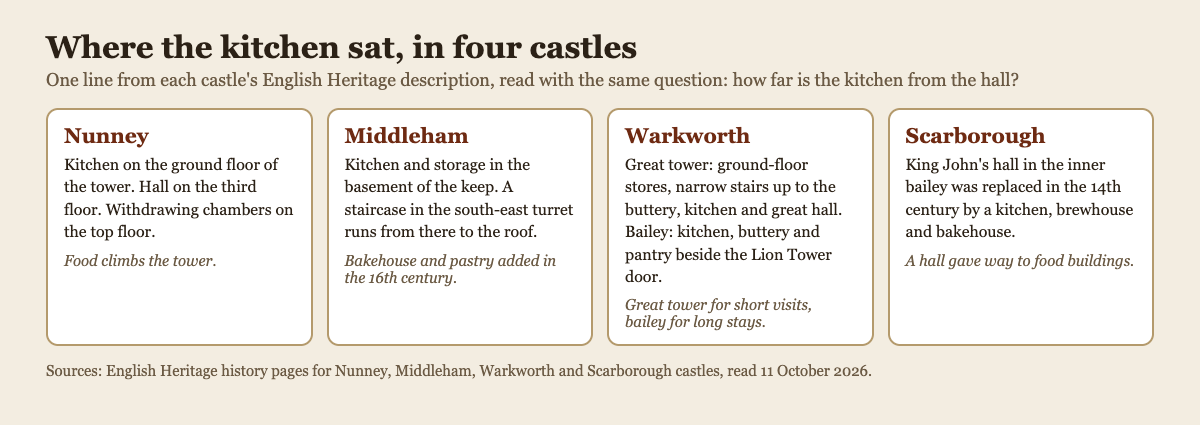
At Nunney in Somerset, built by John de la Mare under a royal licence of 1373, everything sat inside one tall tower. English Heritage says the tower held "a kitchen at ground floor level, a hall on the third floor and withdrawing chambers on the top floor." The food had to climb.
At Middleham in Yorkshire, the kitchen and storage areas were in the basement of the keep. A staircase in the south-east turret ran from there all the way to the roof.
At Warkworth in Northumberland, the great tower has "a warren of vaulted service and storage chambers" on the ground floor, joined by narrow stairs to the first floor, where the buttery, the main kitchen and the great hall sat. A second kitchen, buttery and pantry lay beside the Lion Tower entrance in the bailey.
At Scarborough, a hall built by King John in the inner bailey was replaced in the 14th century by a kitchen, a brewhouse and a bakehouse. Their remains can still be seen.
The rooms around the kitchen
A castle kitchen was never one room working alone. The sources name the rooms that sat around it.
- The buttery. Warkworth's page explains it in brackets: a room "for storing and serving beer".
- The pantry. At Warkworth it sits with the kitchen and buttery by the Lion Tower door.
- The servery. At Middleham, "behind the screen were a pantry and servery from which food and drink were dispatched" into the hall.
- The bakehouse and brewhouse. Scarborough had both beside its kitchen. Middleham gained a bakehouse in its south range and a pastry in its west range in the 16th century.
- The stores. Middleham's basement and Warkworth's vaulted ground floor held them, close to the kitchen.
Read together, the pattern is plain. Food was stored low, cooked near the stores, and carried up or across to the hall through a service end. The great hall post follows Middleham's hall from that service end to the dais.
Keeping the kitchen apart from the family
Some castles kept the kitchen out of the family's way. At Goodrich in Herefordshire, English Heritage's teachers' guide says the family could move between their rooms and the chapel "without encountering the working areas of the courtyard or kitchens." The same guide says Goodrich's small keep could only have worked alongside other buildings, now gone, "such as a hall, kitchen and chapel."
Warkworth shows a second reason for more than one kitchen. English Heritage thinks the earls probably used the great tower for shorter visits and the bailey buildings for longer stays with their larger household. The bailey had its own kitchen, buttery and pantry, and the tower kept its own.
How castle kitchens changed over time
Kitchens changed as castles changed. The sources show three kinds of change.
- A hall became a kitchen. At Scarborough, King John's hall gave way to a kitchen, brewhouse and bakehouse in the 14th century.
- A great rebuild included the kitchens. At Kenilworth, John of Gaunt's works lasted two decades and covered the great hall, remodelled apartments, "services and kitchens."
- New comforts came late. At Goodrich, Gilbert, son of the sixth Earl of Shrewsbury, almost certainly installed a piped water supply. Traces of it can still be seen in the kitchen. At Middleham, the bakehouse and pastry came in the 16th century.
So when you stand in a castle kitchen, ask which century you are looking at. It is often not the century of the walls.
Worked example: read a castle kitchen in four questions
Next time you visit a castle, or read its history page, ask these four questions. Here they are run on Middleham, using only its English Heritage description.
- Which floor is the kitchen on, and which floor is the hall? Kitchen and storage in the basement of the keep; the hall above, over a cellar. Food went up.
- How did the food get there? By the staircase in the south-east turret, which runs from the basement to the roof, and through the pantry and servery behind the hall's screen.
- Where were the stores? In the same basement as the kitchen. Cooks did not have far to fetch.
- What was added later? A bakehouse in the south range and a pastry in the west range, in the 16th century.
Now run the same four questions on Nunney. Kitchen on the ground floor, hall on the third floor, so the food climbed further. Nothing in the page says what was added later, so you leave the fourth answer blank. That is the honest result: a short source gives a short answer.
Castle kitchens in a siege
In peacetime a kitchen fed a household. In a siege it fed a garrison that could not leave. English Heritage's page on medieval siege warfare says "large supplies of food and water could be stockpiled", with beer and wine "if there was a possibility that the water supply could be poisoned", and that "most castles had wells and cisterns for rainwater." The castle wells post covers the water side.
The same page explains why the stores beside the kitchen mattered so much. A blockade aimed "to prevent anyone and anything arriving or leaving, so that the defenders' resources dwindled." At Kenilworth in 1266, a siege of almost six months ended in an honourable surrender "when the defenders' food supplies were exhausted." The walls held. The kitchen ran out. The starving a castle post follows that kind of ending step by step.
From the kitchen to the gate in Two Towers
Two Towers is a free medieval tower defense game that plays in your browser, with no ads. It puts you on the other side of those walls. Its title screen calls it "A castle siege without end" and sets the task in one line: "Two towers. One gate. Hold it as long as you can."
You do not cook in Two Towers. You keep the gate standing, so that everything behind it, kitchen and stores included, stays safe. Between attacks the gate's sheet says "Repair what the attackers broke, or reinforce it." You pick the two towers that guard it, such as the Archer Tower ("Fast arrows") or the Trebuchet ("Stones on a crowd"), and spend the gold you win on upgrades. The castle you defend can be the Old Keep, "Grey stone and slate, as it always stood." Gold in the game is in-game gold, never money.
It is a game, not a history course. Use it next to the sources above, not instead of them.
Frequently asked questions
Where were castle kitchens usually located?
There was no single rule. Nunney's was on the ground floor of its tower, Middleham's in the basement of the keep, and Warkworth's on the first floor of the great tower, with a second one in the bailey.
What was a buttery in a castle?
A room for storing and serving beer, as English Heritage's Warkworth page puts it. It usually sat beside the kitchen and the pantry.
Can you still see medieval castle kitchens today?
Yes, as remains. English Heritage says the remains of Scarborough's 14th-century kitchen, brewhouse and bakehouse can still be seen, and traces of Goodrich's piped water supply survive in its kitchen.
Why did food matter so much in a siege?
Because a blockade aimed to make the defenders' supplies run out. Kenilworth's garrison surrendered in 1266 when its food was exhausted, not because its walls fell.
Get started
Read one castle's English Heritage page with the four questions above, then hold the gate yourself. Play Two Towers free in your browser, pick your two towers, and see how long your castle lasts.
Comments
No comments yet.
Sign in or make an account to comment.