Castle prisons: who was locked up in a castle?
Castle prisons held some of the most famous people in English history. A castle was built to keep enemies out, which also made it good at keeping people in. English Heritage's history pages name a king, a queen, border raiders, a young princess and the founder of the Quakers among those held in castles. This guide looks at who they were, how they were kept, and how one king tried twice to get out.
What castle prisons were used for
In the cases English Heritage describes here, a castle prison was not a dungeon. The prisoner was held in the castle itself: in a tower, in the hall range, or in rooms chosen because they were hard to leave. The walls, gate and garrison that kept attackers out also kept a prisoner in.
The people held fall into a few kinds. Some were royal or political prisoners. Some were border raiders. And one was held for his beliefs. The sections below take each in turn.
A king in a castle: Charles I at Carisbrooke
English Heritage's page on Charles I as a prisoner at Carisbrooke tells the fullest story. In November 1647, fearing that radical soldiers controlled Parliament, Charles slipped away from what proved to be lax custody at Hampton Court. His companions brought the governor of the Isle of Wight, Colonel Robert Hammond, to him, and the king went to the island believing Carisbrooke Castle would be a refuge. It turned out to be a prison.
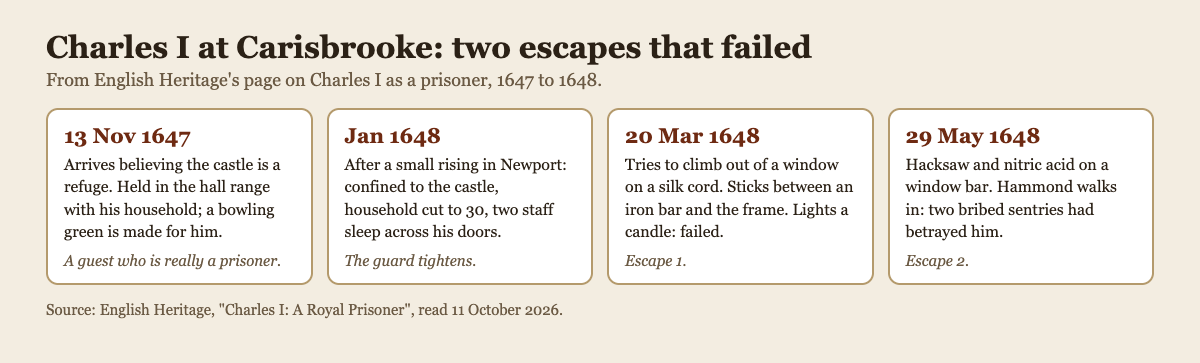
From 13 November 1647, for just over a year, the king was held on the Isle of Wight, mainly at Carisbrooke. Hammond was courteous but wrote at once to Parliament to report his royal guest. Charles was housed with some ceremony in the hall range, attended by his own household, and a bowling green was laid out for him.
After a small uprising for the king in Newport in January 1648, his freedom was cut back. He was confined to the castle, allowed no private audience, his household was reduced to 30 and his chaplains were dismissed. Two of his own staff slept across his bedchamber doors at night.
Two escape attempts, step by step
Royalist supporters planned his escape all the time, passing coded letters in and out through servants. English Heritage says some of the people in that network were almost certainly double agents, so Parliament knew something of most plans.
The first attempt, 20 March 1648. The king tried to climb out of a window and lower himself about 3 metres on a silk cord into the unguarded courtyard, then leave by an outer bastion where Henry Firebrace waited. He became stuck between an iron bar and the window frame. He could only retreat to his room and light a candle, the signal to Firebrace that the attempt had failed.
The second attempt, 29 May 1648. This one took longer to plan. A hacksaw and nitric acid were smuggled in to loosen a window bar. Jane Whorwood chartered a ship, Firebrace arranged a boat off the island, and horses were found. But Parliament's committee knew of the plot by 15 April, Hammond moved the king to rooms against the north wall that were harder to leave, and one of the planners was arrested on 19 May. The king tried anyway. He was working at the bar when Hammond walked in, offering "to take leave of your Majesty, for I hear you are going away". Two bribed sentries had betrayed him.
In September Charles was taken to Newport for talks with Parliament, and then by stages to London, where he was executed on 30 January 1649.
A queen and the border reivers at Carlisle
English Heritage's history of Carlisle Castle has a section titled "Famous Prisoners at Carlisle". When Mary, Queen of Scots, fled from her rebellious subjects to England, she was housed for some weeks in what was then called the Warden's Tower, in the south-east corner of the inner ward. Supporting her small court there cost Elizabeth I an average of £56 a week in food and wine.
The same castle held a very different kind of prisoner: the border reivers, armed bands from family groups on both sides of the border who robbed their neighbours. One of them, William Armstrong of Kinmont, known as Kinmont Willie, was freed on 13 April 1596 when a large armed group of his friends broke into the castle with ladders. How that kind of ladder attack worked is explained in what was escalade?
Royalists, a princess and a Quaker
After the Civil War, castles held the losing side. English Heritage's history of Carisbrooke Castle says its main use from 1642 until 1660 was as a prison for important Royalists. After the king, it held his youngest son and his daughter, Princess Elizabeth, who died there in 1650 at the age of 14.
The history of Scarborough Castle says that from the 1650s it also served as a prison, and that among those held there was George Fox, the founder of the Society of Friends, the Quakers. A castle that had stood two sieges in the 1640s became a place to hold someone for what he taught.
A worked example: three questions for any castle prisoner
When you meet a prisoner on a castle's history page, ask three questions:
- Who held them, and why?
- How were they kept? A tower, a household, a guard at the door?
- How did it end? Release, escape, rescue, removal or death?
Run them on the five cases above:
- Charles I, Carisbrooke: held by Parliament's governor while talks went on; kept in the hall range with a shrinking household and guards at his door; two failed escapes, then removal to Newport and London.
- Mary, Queen of Scots, Carlisle: held after fleeing her own subjects; kept in a tower with a small court paid for by Elizabeth I; the page says she stayed some weeks.
- Kinmont Willie, Carlisle: held as a reiver; ended by a rescue over the wall on ladders.
- Princess Elizabeth, Carisbrooke: held as the king's child; ended with her death at 14.
- George Fox, Scarborough: held for his beliefs; the page does not say how he was kept or released.
The last answer matters as much as the others. A history page that says nothing about how someone was kept is telling you where its sources stop. Note the gap rather than filling it with a dungeon you have imagined.
The other job in Two Towers: keeping people out
A castle prison turned the castle's defences inward. In Two Towers, a free medieval tower defense game that plays in your browser, the defences point the usual way. "Two towers. One gate. Hold it as long as you can." You choose the tower for each side of the gate from four kinds (Archer Tower, Trebuchet, Ballista or Fire Tower), upgrade them with the gold you win, and buy two more towers for the hills.
The title screen lets you pick the castle you defend from, starting with the Old Keep, "Grey stone and slate, as it always stood". Every stage comes stronger, faster or in greater numbers than the last, and there is no final stage. Gold in the game is in-game gold, never money.
Frequently asked questions
Were castles used as prisons?
Yes. English Heritage's pages show Carisbrooke holding Charles I and important Royalists, Carlisle holding border reivers and, for some weeks, Mary, Queen of Scots, and Scarborough serving as a prison from the 1650s.
How was Charles I kept at Carisbrooke Castle?
At first with some ceremony in the hall range, with his own household and a bowling green. After January 1648 he was confined to the castle, his household was cut to 30, and two of his staff slept across his bedchamber doors.
Did anyone escape from a castle prison?
Charles I tried twice at Carisbrooke in 1648 and failed both times. At Carlisle in 1596, Kinmont Willie was freed when his friends broke in with ladders.
Who was held at Scarborough Castle?
English Heritage says Scarborough served as a prison from the 1650s, and that George Fox, founder of the Quakers, was among those held there.
Get started
Look up a castle near you on English Heritage and run the three questions on anyone it says was held there. Then switch to defending one: Play Two Towers, pick your two towers, and keep the gate shut as long as you can.
Comments
No comments yet.
Sign in or make an account to comment.