Castle stores: how a garrison stocked up for a siege
When a castle's walls held, its castle stores decided how long the siege lasted. A garrison that knew an attack was coming had time to lay things in, and what it laid in set how long it could hold. Food comes to mind first, but English Heritage's own list of a garrison's preparations is mostly about other things: arrows, stones, oil, tar, timber and earth. This guide sorts that list into four kinds of store, gives you a checklist to run on any siege, and shows what two real sieges tell you and what they leave out.
What castle stores held before a siege
English Heritage's page on medieval siege warfare starts the defenders' side with one idea: good defence relied on knowing in advance, so that careful preparations could be made. Everything after that is a store of some kind.
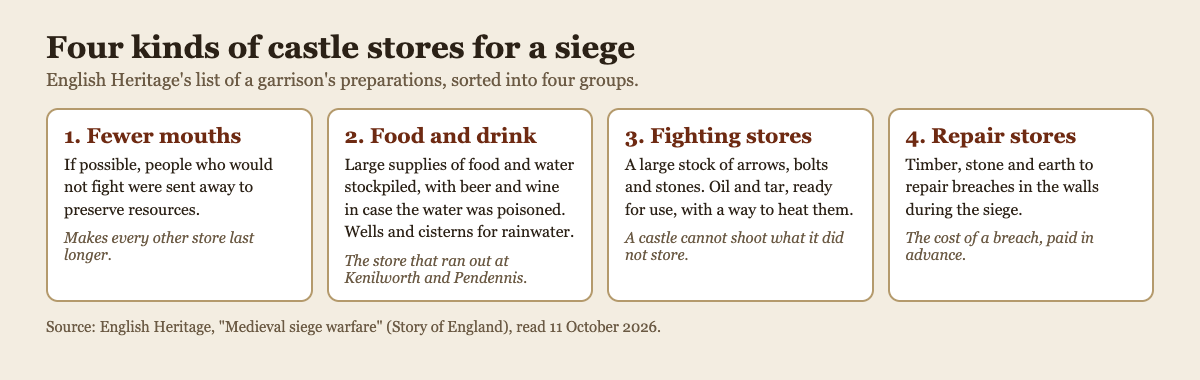
Read the page's list slowly and it falls into four groups:
- Fewer mouths. If possible, people who would not fight were sent away to preserve resources.
- Food and drink. Large supplies of food and water could be stockpiled, with beer and wine in case the water supply was poisoned.
- Fighting stores. A large stock of missiles (arrows, bolts and stones), and supplies of oil and tar ready for use, with a way to heat them.
- Repair stores. Supplies of timber, stone and earth to mend breaches in the walls during the siege.
The same page adds tools that had to be ready in place: siege engines mounted on towers and walls, timber galleries (hoards) built out over the walls, long poles for pushing ladders away, and cranes with chains and hooks for catching battering rams. Those are fittings rather than stores, but each one had to be built and stocked before the enemy arrived.
Food and drink: the store that ran out
Food is the store these sources mention most, because it is the one that ended the sieges they describe. English Heritage's 10 things about sieges says plainly that hunger was used as a weapon: if a castle had good defences, attackers often waited and tried to starve the defenders out. As supplies ran low, people inside sometimes ate their horses, or even their dogs and cats.
Water was the other half. The siege warfare page notes that most castles had wells and cisterns for rainwater, and that beer and wine were laid in because the water could be poisoned or tainted. The page treats drink as a store in its own right, not only as something the well supplied. How castles kept their water is a story of its own, told in castle wells: how a castle kept its water in a siege.
Sending people away belongs here too. Every person who left was a share of the food that the fighters could keep. The page puts that step first, before the stockpiling, which tells you how the problem was thought about: cut the number eating, then fill the stores.
The fighting stores: arrows, stones, oil and tar
A garrison could not shoot what it had not stored. The siege warfare page lists "a large stock of missiles: arrows, bolts and stones" as the first of its military measures. Stones could be dropped from the timber galleries on the walls or thrown by the siege engines the defenders mounted on their own towers.
Next on the list is oil and tar, stored ready for use with the means to heat them. The page ties these to the timber galleries built out over the walls, from which missiles, stones and hot liquids could be dropped on attackers below. Whether boiling oil itself was common is a fair question, taken up in did castles use boiling oil?; the point for stores is that anything poured had to be gathered, kept dry and heated long before the first ladder went up.
These stores do not keep anyone alive, so they are easy to forget. But a castle with plenty of bread and no arrows can only watch the enemy work.
The repair stores: timber, stone and earth
The fourth group is the quietest: "supplies of timber, stone and earth to repair breaches in the walls during the siege." A siege was not one blow. Attackers battered, mined and threw stones, and every crack had to be closed before the next attack came through it.
That means a garrison planned to lose some of its wall. The repair stores were the cost of that loss paid in advance. Without them, the first breach stayed open, and a storming party could fight its way in.
A worked example: a stores checklist for any siege
You can turn the four groups into a checklist and run it on any siege you read about. Ask five questions:
- Did the defenders know the attack was coming, and how long did they have?
- How many people were inside, and were any sent away?
- What does the source say about food and drink?
- What does it say about missiles, oil, tar or repairs?
- Which store ran out first, and how did the siege end?
Run it on Pendennis Castle in 1646, using English Heritage's history of Pendennis Castle. It was one of the last Royalist strongholds holding out against the Parliamentary army. Question 2: about 1,000 soldiers and their dependents were inside, so the people who did not fight had stayed. Question 5: they endured a five-month siege and agreed an honourable surrender in August, when their food ran out. Questions 3 and 4: the page says nothing about what was stocked, only that the food came to an end. The 10 things page adds that the garrison marched out with full honours of war and remained free men.
Run it on Kenilworth in 1266, using the 10 things page. Question 1: around 1,200 rebels built up supplies and arms at Kenilworth, which had very strong defences, so they had time and used it. Question 4: "arms" is the only word on fighting stores. Question 5: the siege began on 25 June and lasted 172 days, and when the castle surrendered the defenders had enough food for only two more days. English Heritage's history of Kenilworth gives the surrender in December 1266.
Put the two answers side by side and a pattern shows. In both, the sources record when the food ran out and say little about the other stores. That is not proof the other stores lasted; it tells you what was written down. When you read any siege, mark the questions your source cannot answer. Those gaps are as useful as the answers.
The attackers needed stores too
A siege tested both sides' supplies. The 10 things page says that keeping an army large enough to besiege a major castle fed and armed was a hugely expensive challenge. Royal armies often gave farmers no choice but to sell their goods to the army at low prices.
At Kenilworth in 1266 at least 20 counties had to supply food to King Henry III's army, and the Sheriff of London even sent a whale to help feed it. The same page notes that sieges were expensive to keep going, so attackers were often keen to offer good terms of surrender rather than wait. The siege warfare page calls blockade and starvation a last resort that was not desirable for either side, because it could be long and costly. For how that waiting game worked from the outside, see starving a castle: how sieges ended without a breach.
Castle stores in Two Towers: the gold between stages
In Two Towers, a free medieval tower defense game that plays in your browser, there are no barrels or arrow chests to count. Your store is gold. The intro puts it in one line: "Two towers hold the gate. Upgrade them as gold comes in."
The four kinds of store still show up in how you spend it:
- Fighting stores are upgrades to your two towers: damage, fire rate, range or each tower's special.
- Repair stores are the gate. Its sheet says "Repair what the attackers broke, or reinforce it." Repair gives +25%, and when nothing is broken the game says "The gate is whole. Reinforce it to raise its strength."
- More defences are the hill towers, 150 gold for the first and 300 for the second, and barricades: "Raise barricades to slow them down."
Every stage comes stronger, faster or in greater numbers than the last, and there is no final stage. So the garrison's question is yours too: spend everything on fighting now, or keep some back for the gate you know will be hit. That gold is in-game gold, never money.
Frequently asked questions
What did a castle store before a siege?
English Heritage lists food and water, beer and wine, a large stock of arrows, bolts and stones, oil and tar with a way to heat them, and timber, stone and earth for repairs. Garrisons also sent away people who would not fight, to make the food last.
Why did castles store beer and wine?
Because attackers sometimes poisoned or tainted the water supply. Most castles also had wells and cisterns for rainwater.
Which store usually ran out first?
In the sieges English Heritage describes, it is food: Pendennis in 1646 surrendered when its food ran out, and Kenilworth in 1266 had only two days of food left. The sources say much less about the other stores.
Did the attackers have supply problems too?
Yes. At Kenilworth in 1266 at least 20 counties had to send food to the king's army, and a long siege was costly for both sides.
Get started
Pick one siege from a castle you know and run the five-question checklist on its English Heritage page. Then hold a gate of your own: Play Two Towers, choose your two towers, and decide how much gold to keep back for the gate.
Comments
No comments yet.
Sign in or make an account to comment.