Castle toilets: how a medieval garderobe worked
Castle toilets are one of the first things people ask about on a castle visit, and the answer is built into the walls. A medieval castle toilet, often called a garderobe, was a small room with a seat over a chute that carried waste out of the building. This post follows one real example, the rare shared garderobe tower at Goodrich Castle, from the seat to the ditch. Then it shows where latrines turn up in other castles, using English Heritage's own descriptions, so you can spot one yourself.
Castle toilets: what a garderobe was
English Heritage's glossary for Goodrich Castle defines the key part plainly. A latrine chute is a sloping channel built into a wall to let waste from the toilet escape into the moat or a stream. The teachers' guide for the same castle uses "garderobe" and "toilets" for the same thing, and calls the small rooms that held the seats latrine chambers.
So a garderobe was not a separate building in the yard. It was part of the castle's stone, usually in the thickness of a wall or in a tower that stood out from it. The design had one job: get waste out of the building and away from the people living in it, using nothing but gravity.
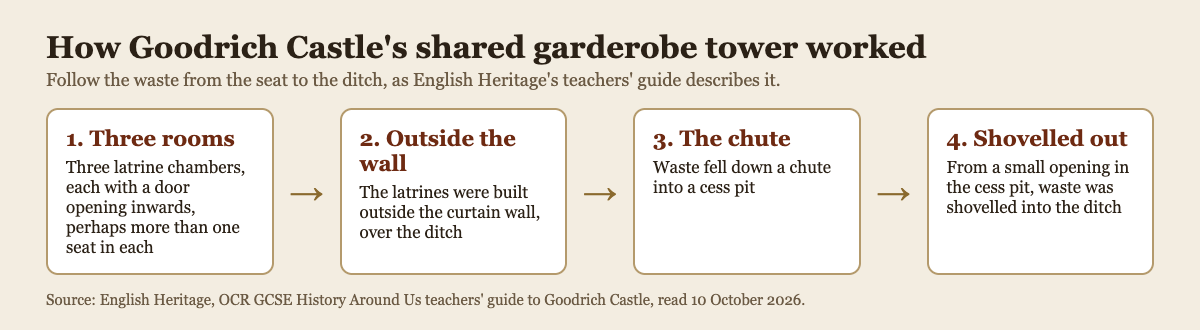
Worked example: Goodrich's shared garderobe tower, seat to ditch
Goodrich Castle has what English Heritage's teachers' guide calls a large communal garderobe tower, an extremely rare survival of its type in England and Wales. Follow it in four steps.
- The rooms. Several people could use it at the same time. There were three latrine chambers, each with a door opening inwards, and there may have been more than one seat in each.
- The position. The latrines were built outside the curtain wall, over the ditch below. That placing is the whole trick: the seats hang beyond the main wall, so nothing falls inside the castle.
- The chute. Waste fell down a chute into a cess pit, a pit that collected it at the bottom.
- The cleaning. The cess pit had a small opening, and from it the waste was shovelled into the ditch.
Read that way, a garderobe tower is a little machine with no moving parts except the person with the shovel. For more on what a ditch was for in the first place, see what a castle moat was for.
Latrines for the guards
Garderobes were not only for the lord. At Goodrich, the gatehouse has a guard passage built into the walls, with a guardroom that has its own fireplace and a small latrine at the other end of the passage. Guards on duty did not have to leave their post to find one.
The teachers' guide draws the wider point. Rooms, towers and latrines designed for armed guards and sentries show that the castle needed permanent, 24-hour security. A latrine beside a guardroom is a small sign of a big fact: someone was always watching the gate. There is more on that part of the castle in why the gatehouse was a castle's strongest part.
Latrines for the lord and guests
The best rooms had their own. In the late 12th-century keep at Conisbrough, English Heritage describes the great chamber on the first floor and the bedchamber above it. Each has a fireplace, a washbasin set into the wall, and a latrine in a mural chamber, a small room inside the thickness of the wall. You can read the rest of that tower floor by floor in what a castle keep was for.
At Acton Burnell, the private chambers west of the hall rose over three storeys, with access to a latrine block. Its central projecting part even has a pyramid roof. At Goodrich, many rooms around the courtyard and in the towers have fireplaces, window seats, washbasins and latrines. The teachers' guide reads these as evidence that the castle was built to house guests as well as the family.
Middleham: counting latrines to read a castle
Latrines can date a building's purpose. At Middleham, English Heritage's history says work that probably began in 1397 focused on better accommodation, and that this is clear from the number of extra latrines. More latrines meant more people expected to live there in comfort.
The latrines were one part of a bigger rebuild. In the same work, the page says, the curtain wall was raised to make first-floor ranges on at least three sides, the towers were heightened, and the tower at the north-east corner became the castle's main gatehouse. Every new range of rooms needed its own latrines, so counting them is a quick way to see how many people the castle was now built to hold.
Middleham's latrine towers also have a later story. By 1889 the lower few feet of stone of the keep's latrine towers had been taken away for buildings in the town, leaving them hanging in the air. Conservation began in 1897, and datestones from 1906 with the letter M, marking that repair work, can still be seen in the latrine towers.
How to spot castle toilets on a visit
Use what these four castles show as a checklist when you walk round a ruin.
- Look for a tower or bay that sticks out over a ditch. At Goodrich the latrines were built outside the curtain wall, over the ditch.
- Look off the best rooms. At Conisbrough each main chamber has a small room in the wall's thickness beside its fireplace and washbasin.
- Look at the end of guard passages. Goodrich's gatehouse passage ends at a small latrine.
- Look for an opening at the foot of the wall. A chute had to come out somewhere, and Goodrich's cess pit had a small opening for clearing it.
Frequently asked questions
What is a garderobe in a castle?
It is a castle toilet: a small chamber with a seat over a chute built into the wall, so waste fell out of the building into a pit, a ditch, a moat or a stream.
Where did the waste go?
Down a chute. At Goodrich it fell into a cess pit, which was then emptied by shovel into the ditch; English Heritage's glossary says chutes let waste escape into the moat or a stream.
Did castle toilets have more than one seat?
Some did. Goodrich's shared garderobe tower had three latrine chambers, and there may have been more than one seat in each.
Did guards have their own latrines?
Yes, at least at Goodrich, where the gatehouse guard passage ends in a small latrine beside a guardroom with its own fireplace.
Get started
Two Towers is a free medieval tower defense game, an original game rather than a history course. Like Goodrich's guards, your job never stops: you hold the city gate, every stage comes stronger, faster or in greater numbers, and there is no final stage. The title screen offers "sixteen castles to hold them from", and between stages you repair or reinforce the gate.
Play Two Towers: it is free and plays in your browser on a computer or a phone.
Comments
No comments yet.
Sign in or make an account to comment.