Castle wells: how a castle kept its water in a siege
A castle could hold grain for months, but a garrison with nothing to drink could not hold out for long. That is why castle wells mattered so much in a siege. This post looks at four real castle wells described on English Heritage's own pages, from a well on a rock to a well in the basement of a keep. It then reads one well, at Goodrich, from the top down, because when it was emptied it turned out to hold the story of its own siege.
Why castle wells mattered in a siege
A siege was a contest of supply. English Heritage's page on medieval siege warfare sets out how a castle got ready when it knew an attack was coming. Large supplies of food and water could be stockpiled. Beer and wine were laid in too, in case the water supply was poisoned. And, the page says plainly, most castles had wells and cisterns for rainwater.
The same page says non-combatants were sent away if possible, to make the stores last. Every mouth inside the walls drew on the same water. A well inside the defences was the one supply the enemy could not simply block on the road, which is why builders went to such lengths to dig one.
Food was the other half of the problem. If you want that side of the story, read starving a castle: how sieges ended without a breach.
Beeston: a well as old as the castle
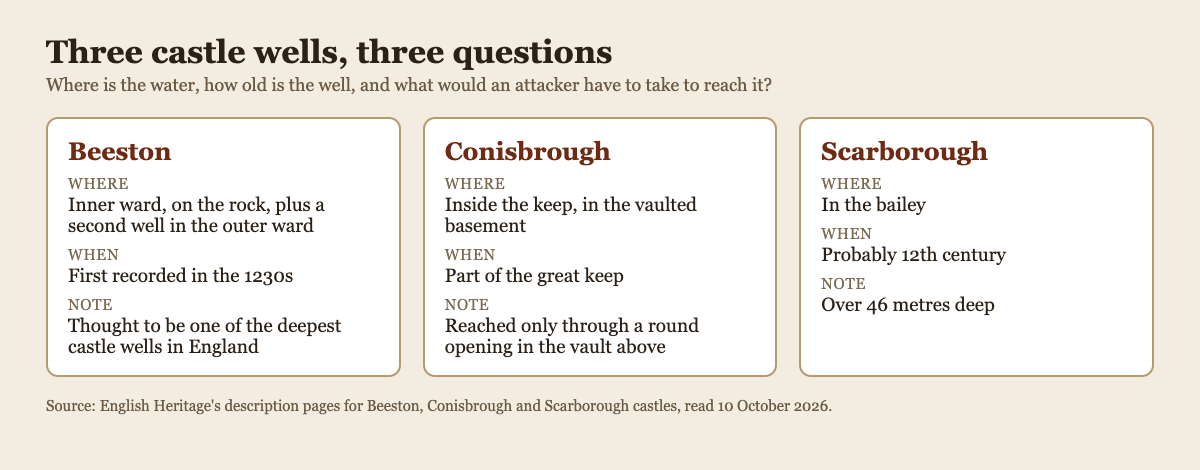
Beeston Castle stands on a rock. English Heritage describes the well in its inner ward as probably one of the deepest wells of any castle in England. It was first recorded in the 1230s, which the page reads as a sign that it is as old as the earliest building on the site.
That detail is worth a pause. The inner ward at Beeston is rocky and uneven, and the page suggests the castle was never finished. Even so, the well was there from the start. A castle on a rock is hard to attack, but the rock that keeps attackers out also puts the water a long way down.
Beeston also had more than one. The page notes another of the castle's wells in a hollow in the outer ward, diagonally opposite the tall square tower beside the outer gatehouse. Two wells in two wards meant that losing the outer ward did not mean losing all the water.
Conisbrough: the well inside the keep
At Conisbrough the water sat inside the strongest building of all. The great cylindrical keep was built in the late 12th century. Its vaulted basement room contains a well, and English Heritage notes that the room can only be reached through a circular opening in the vault above.
Think about what that means in a siege. If attackers took the bailey, the garrison could still draw water inside the keep, through a hole in a floor that only they controlled. The keep was the last line of defence, and its water came with it. There is more on that last line in what a castle keep was for.
Scarborough: a deep well in the bailey
At Scarborough, English Heritage describes a well in the bailey, probably 12th century and over 46 metres deep. Unlike Conisbrough's, this well was in the open courtyard, behind the curtain wall rather than inside a tower.
Put the three side by side and you see three answers to one question: where do you keep the water safe? Beeston split it between two wards. Conisbrough locked it inside the keep. Scarborough sank it deep into the headland and guarded it with the wall.
Worked example: read Goodrich's well from the top down
Goodrich Castle gives the best worked example, because English Heritage's page on life under siege there describes what was found inside the well. You can follow it in four steps, the way the workers who emptied it did.
- The top: a well that had vanished. In the 1920s, workers clearing rubble from the courtyard found the castle's well. It had been filled in and buried. The page says the well head took a direct hit during the Civil War siege, probably from a shell fired by the mortar Roaring Meg.
- The upper fill: the siege itself. Above the bottom lay tools and household things mixed in with cannonballs, under a great depth of rubble from the bomb-damaged buildings. Fragments of the shell were found too.
- The surroundings: daily life. The kitchen and bread oven stood near the well in the courtyard. A baker's peel and a laundry paddle came out of it, kept from rotting by the waterlogged conditions.
- The bottom: 166 feet down. At the base, about 50 metres below the courtyard, lay the bucket with its windlass and chain. The page draws the lesson: all the water in the castle was drawn by hand and carried to where it was needed.
Read that way, the well tells you three things about a siege. The water came up one bucket at a time. The well stood in the busiest part of the castle, by the kitchen. And it was a target: a shell on the well head was a shell on the garrison's water.
English Heritage's own pages disagree on why Goodrich surrendered. One puts it down to hunger, while the Goodrich history page points to the threat of mining and Roaring Meg. The well cannot settle that, but it shows how close the mortar came to the water.
Water as a wall: Kenilworth's mere
Water could defend a castle as well as supply it. Kenilworth was laid out with a castle, park and mere, a large lake, from about 1120. In 1266 the castle held out against the king through a six-month siege, one of the longest in English medieval history, before the garrison surrendered on 13 December. The Water Tower later overlooked the lower pool of the mere, which was drained after the Civil War. For water as a ditch rather than a lake, see what a castle moat was for.
Frequently asked questions
How deep were castle wells?
It depended on the ground. English Heritage gives Scarborough's well as over 46 metres deep and Goodrich's as 166 feet, and calls Beeston's probably one of the deepest of any castle in England.
Where in a castle was the well?
It varied. Conisbrough's was in the basement of the keep, Scarborough's was in the bailey, and Beeston had wells in both its inner and outer wards.
What if the well water was poisoned?
English Heritage says castles preparing for a siege laid in beer and wine in case the water supply was poisoned, and most castles also had cisterns for rainwater.
How was water raised from a castle well?
By hand. At Goodrich the bucket was found at the bottom with its windlass and chain, and every drop was carried from there to where it was needed.
Get started
Two Towers is a free medieval tower defense game, an original game rather than a history course. Its title screen offers "sixteen castles to hold them from", starting with the Old Keep: "Grey stone and slate, as it always stood". Your supply to guard is the gate. Between stages you "Repair what the attackers broke, or reinforce it", and every stage comes harder than the last. Plan it like a garrison: keep something in reserve before the next attack.
Play Two Towers: it is free and plays in your browser on a computer or a phone.
Comments
No comments yet.
Sign in or make an account to comment.