Cause and consequence in history: a student's guide
Cause and consequence in history is the question "why did this happen, and what did it lead to?" Every history essay asks it in some form. This guide explains what historians mean by a cause, using the Stanford Encyclopedia of Philosophy entry on philosophy of history, then shows you how to trace a real chain of causes and consequences step by step.
Why "why" is the hard part
Dates and names tell you what happened. Explaining why is harder. The Stanford entry says historians "conceptualize, describe, contextualize, explain, and interpret" the past, and that their task is to shed light on "the what, why, and how of the past", from the evidence we have now.
Explaining "why" means making a claim about causes. The entry's own example is the sentence "The American Civil War was caused by economic conflict between the North and the South". What would you need to show to make a sentence like that stand up?
Four ways to think about a cause
Section 3.3 of the entry sets out several ideas philosophers have used. Each gives you a question to ask of your own essay.
- Regularities. Does a cause need a general rule behind it, such as "periods of rapid inflation cause political instability"? The entry argues this approach is "fatally flawed in the social sciences", because such universal rules are not available for human societies.
- Necessary and sufficient conditions. Was the factor needed for the event? Was it enough on its own? Or did it make the event more or less likely?
- Reasons as causes. Many historical causes are deliberate human actions, so the reason someone acted is part of the cause of what followed.
- Chains of mechanisms. A historical account is often a series of events, each one a condition or a trigger for the next. The entry calls tracing such chains "crucial" for current understanding.
Necessary, sufficient, and the "what if" test
The most useful tool for a student is the counterfactual, the "what if" question. The entry puts it carefully: to say that C was necessary for E, you need evidence that E would not have happened if C had not been there.
That is a high bar, and it is a fair one. If you claim a cause was essential, say what would have been different without it, and point to the evidence.
The entry adds a warning. Sometimes no single factor is necessary, because an outcome is "overdetermined": several independent factors could each have brought it about. In an essay, that means you rank causes rather than crown one.
The entry also lets you be concrete. It is often justifiable, it says, to name one concrete action as the cause of a particular event, meaning the action was enough in the circumstances of the time, as long as you can give a convincing account of the reasons that led the person to act. So in your essay, name the action, then explain the reasons behind it.
Consequences: following the chain forward
A consequence is the same link seen from the other end. Once you have traced why an event happened, ask what it made possible next. In a chain, each consequence can become the condition for the next event.
Two habits help. Separate short-term consequences from long-term ones. And watch for the trap of inevitability: the entry asks whether the fall of the Roman Empire was "inevitable" given the circumstances, and treats that as an open question, not a fact.
Where historians disagree
Not every historian puts causes at the centre. The Stanford entry describes a shift from the 1970s, beginning with Hayden White's Metahistory (1973). This "new" philosophy of history "emphasizes historical narrative rather than historical causation", and pays more attention to how historians tell the story and to the mindset of people in the past.
The other side keeps causal explanation central, and the entry reports later research that supports explanations built from chains of causal mechanisms. You do not need to pick a side to write a good essay. You need to know which kind of question you are answering. Our guide to historiography covers how historians' approaches change.
A worked example: cause and consequence in history, traced
Take the hegira, the migration of the Prophet Muhammad from Mecca to Medina in 622 CE. The facts below come from the World History Encyclopedia article on Prophet Muhammad, which our post on Prophet Muhammad's life follows in order.
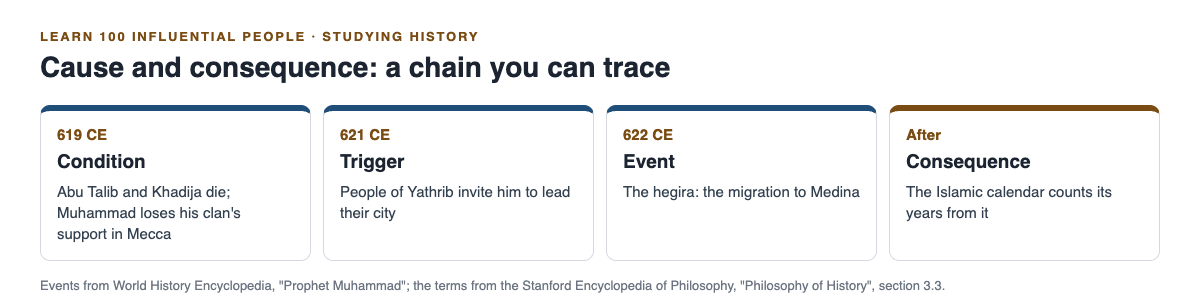
A condition, a trigger, an event and a consequence.
- Find the condition. In 619 CE his uncle Abu Talib and his wife Khadija died. The article says that, lacking any support from his clan, he was "completely vulnerable" in Mecca.
- Find the trigger. In 621 CE people from Yathrib invited him to their city, wanting him to act as their ruler.
- Name the event. He entered Medina in 622 CE: the hegira.
- Follow a consequence. The Islamic lunar calendar counts its years from the hegira.
- Run the "what if" test. Was the invitation necessary? Some Muslims had already left for Abyssinia in 615 CE, so some followers found a way out of Mecca without it. Write two sentences on what the invitation added: a city to lead, not only a refuge.
That last step turns a list of dates into an argument. Our guide on how to build a history argument from evidence shows how to write it up.
Frequently asked questions
What is cause and consequence in history?
It is the study of why events happened and what they led to. A cause explains an event; a consequence is what the event made possible next.
What is the difference between a condition and a trigger?
A condition is a circumstance that makes an event possible; a trigger is the event that sets it off. In a chain, each event can be a condition or a trigger for later ones.
How do I know if a cause was necessary?
Ask whether the event would have happened without it, and find evidence for your answer. If several factors could each have produced the event, rank them instead.
Do all historians focus on causes?
No. Since the 1970s some philosophers of history have put narrative ahead of causation, while others still treat causal explanation as central.
Get started
Causes and consequences are easier to see when you know the people involved. Learn 100 Influential People teaches the 100 people who most shaped human history, from Moses to the web, in 46 short lessons of about 9 minutes. Its 272 questions include putting things in order, matching and sorting, 38 cards set out where researchers disagree, and every lesson lists its sources. Sign in with your email and an emailed code, and read what the site is for.
Comments
No comments yet.
Sign in or make an account to comment.