Centre for the Study of Existential Risk (CSER) explained
The Centre for the Study of Existential Risk, or CSER, is a research centre at the University of Cambridge. It studies threats from present or future technology that could be big enough to wipe out humanity. Advanced AI is one of its four areas, next to biological risks, the environment and extreme technological risks in general. This post explains who started it, what it works on and what it has actually done. The claims come from Wikipedia's Centre for the Study of Existential Risk article.
What the Centre for the Study of Existential Risk is
CSER is part of the University of Cambridge. Its purpose is to study possible extinction-level threats that come from technology, both the technology we have today and the technology we may build next.
It has three co-founders:
- Huw Price: the Bertrand Russell Professor of Philosophy at Cambridge.
- Martin Rees: the Astronomer Royal and a former President of the Royal Society.
- A third co-founder from the technology industry.
From the start it joined philosophy, science and technology, and its workshops bring academics, policy-makers and industry into the same room.
Why it says these risks need their own centre
According to CSER, managing extreme technological risks is an urgent task. It is also a hard one, and one that universities have comparatively neglected. The centre exists to fill that gap.
Some of its general work on the subject:
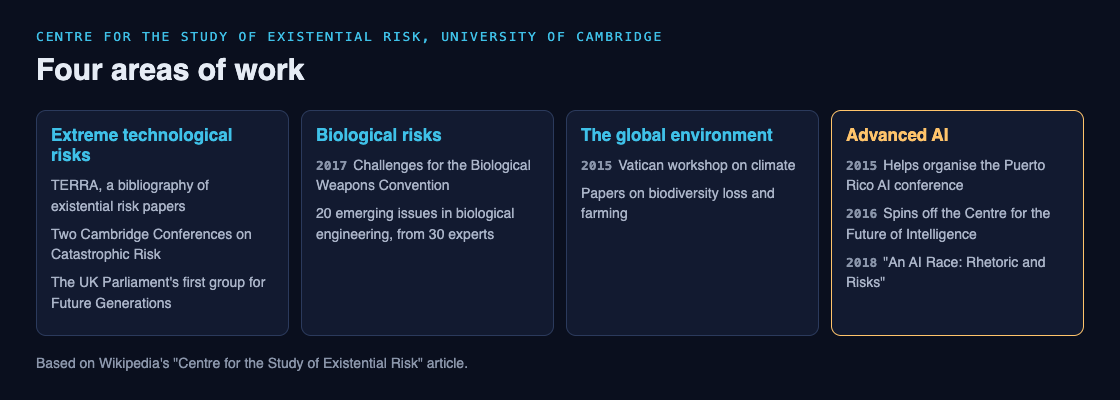
- TERRA: a tool its researchers built to produce a bibliography of research on existential risks.
- Conferences: two international Cambridge Conferences on Catastrophic Risk.
- Helping others start: it advised on new global risk projects at the Australian National University, the University of California, Los Angeles and the University of Warwick.
- Parliament: it helped set up the first All-Party Parliamentary Group for Future Generations in the UK Parliament, to bring long-term thinking to political leaders.
- Workshops: more than thirty, on subjects such as cybersecurity, nuclear security, climate change and gene drives.
Its public lectures have been viewed more than 500,000 times online. If you want the wider picture of which risks count as global and catastrophic, see our post on global catastrophic risk.
Risks from advanced AI
This is the part of CSER's work closest to the ideas behind Contain ASI.
- 2015: CSER helped organise a conference in Puerto Rico on the future of AI. It led to an Open Letter on Artificial Intelligence, signed by research leaders around the world, calling for research on making AI systems safe and good for society. The Future of Life Institute post covers that conference from the organiser's side.
- 2016: CSER launched its first spin-off, the Leverhulme Centre for the Future of Intelligence, led by Professor Price. It studies the opportunities and challenges that AI brings.
- From 2017: a series of academic conferences bringing together decision theory and AI safety.
- 2018: with partners from technology companies and security think-tanks, CSER published The Malicious Use of Artificial Intelligence, on what AI means for physical security and cybersecurity.
An AI race paper
Also in 2018, CSER published "An AI Race: Rhetoric and Risks". It won the first Best Paper prize at the 2018 AAAI/ACM conference on AI, Ethics and Society. If the idea of a race between AI developers is new to you, our post on the AI race explains why it worries researchers.
Biological risks
In 2017, CSER brought policy-makers and academics together to find problems facing the Biological Weapons Convention (BWC). A key problem they found: science and technology now move so fast that bodies like the convention find it very hard to keep pace.
CSER researchers also ran a horizon-scanning exercise. It drew on 30 experts from Europe and the US and named 20 emerging issues in biological engineering. They presented it at the 2017 meeting of the convention's member states, and in 2018 to the Science Advisory Board of the Organisation for the Prohibition of Chemical Weapons.
The global environment
Martin Rees and Partha Dasgupta, a senior advisor, co-organised a series of workshops with the Vatican. The article says the 2015 workshop influenced the Pope's encyclical on climate change, which in turn influenced the Paris Agreement.
CSER researchers have also published on biodiversity loss in the journal Nature, on the environmental cost of high-yield farming and on geoengineering. One report asked business school rankings to include sustainability. Four days later, the Financial Times announced a "complete review of our methodology".
A worked example: place an AI-risk headline in three questions
CSER's work gives you a simple way to read any news story about a big technology risk. Ask three questions, then try them on the 2018 AI race paper.
- Which area is it? Extreme technological risk in general, biology, the environment, or AI. The AI race paper is AI.
- Who has to act? CSER's workshops bring academia, policy and industry together. A race between AI developers involves all three.
- Where could it be decided? A treaty meeting, a parliament, a research conference, or a ranking that changes its method. For AI, CSER has used conferences, a spin-off centre and published reports.
Try the same three questions on the next AI headline you read. If no one can say who has to act, you have found the kind of risk CSER says academia has comparatively neglected. For the bigger debate about whether AI could be an existential risk at all, see our post on existential risk from AI.
Exploring the idea in Contain ASI
Contain ASI is a story strategy game for 1 to 4 players that runs in your browser and needs WebGL 2. Chapter 1, Before ASI, starts in January 2024 with four fictional AI labs in one race. As a researcher, research manager, CEO or government, you try for three years to keep every lab from crossing into recursive self-improvement before 2027.
It is a game, not a forecast: the page says all its labs, people and events are fictional, and it does not mention CSER. But its roles match the people CSER tries to bring together: researchers, managers, industry leaders and government.
Frequently asked questions
What does the Centre for the Study of Existential Risk do?
It studies threats from present or future technology that could cause human extinction, across four areas: extreme technological risks, biological risks, the global environment and advanced AI.
Who founded CSER?
Its co-founders are the Cambridge philosopher Huw Price, the Astronomer Royal Martin Rees, and a third co-founder from the technology industry.
Does CSER work on AI safety?
Yes. It helped organise the 2015 Puerto Rico AI conference, spun off the Leverhulme Centre for the Future of Intelligence in 2016, and has run conferences joining decision theory and AI safety since 2017.
Is CSER the same as MIRI or the Future of Humanity Institute?
No. CSER is at Cambridge. Wikipedia lists the Future of Humanity Institute and the Machine Intelligence Research Institute as related but separate groups.
Get started
Want to see why one race is so hard to manage? Open Contain ASI in your browser and start a campaign as a researcher, research manager, CEO or government.
Comments
No comments yet.
Sign in or make an account to comment.