Christopher Columbus's voyages: what changed after 1492
Christopher Columbus's voyages, four of them between 1492 and 1504, set off one of the biggest changes in world history: lasting contact between Europe and the Americas. They are also among the most argued-over events you will study. This guide follows World History Encyclopedia's account of each voyage, what changed after 1492, and why people still disagree about how to remember him.
Christopher Columbus's voyages at a glance
Columbus was born in Genoa in 1451, a city that only became part of Italy in 1861. According to World History Encyclopedia's article on Columbus, he made four voyages to the Caribbean and the coasts beyond it:
- First voyage, 1492 to 1493: the crossing and first landing.
- Second voyage, 1493 to 1496: a fleet of colonists and the first Spanish settlements.
- Third voyage, 1498 to 1500: the coasts of Central and South America, and his arrest.
- Fourth voyage, 1502 to 1504: the islands off Honduras and the coast of Costa Rica, and a shipwreck on Jamaica.
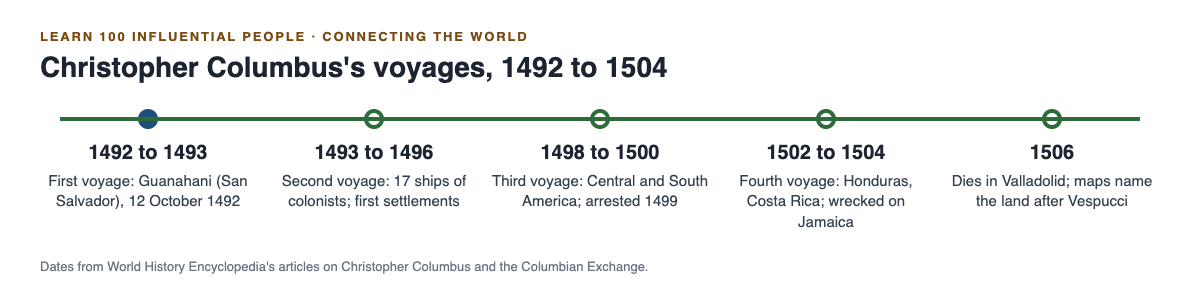
Four voyages in twelve years, with the dates World History Encyclopedia gives.
Why he sailed west
Columbus was not looking for a new world. He wanted a sea route west to Cathay, as Europeans called China. The article explains that after the Byzantine Empire fell to the Ottoman Turks in 1453, the Ottomans closed the overland routes to the East, and European merchants turned to the sea.
In 1474 the Florentine mathematician Toscanelli sent Columbus a map suggesting the westward route. Columbus estimated the distance from the Canary Islands to Cathay at about 2,300 miles. King John II of Portugal turned him down because the estimate was too low, and the article notes it was: the real distance is about 12,200 miles. Genoa and Venice also said no. Ferdinand and Isabella of Spain kept him on retainer until Granada, the last Moorish stronghold in Spain, fell in 1492, and then gave him three ships.
The first voyage: 1492 to 1493
Columbus left port on 3 August 1492 with the Nina, the Pinta and the Santa Maria. His contract promised the crown 90% of the profits and made him governor of any lands he claimed.
On 12 October 1492 he landed on an island the local people called Guanahani. He renamed it San Salvador, still its name in the Bahamas, and claimed it for Spain. He called the people indios, which is how the word "Indian" came to be used for the peoples of the Americas. He sailed on, left 39 men at a settlement called La Navidad on Haiti, and returned to Spain, the article says, "taking a number of kidnapped natives with him".
The later voyages and their cost
The second voyage came back with 17 ships of colonists and dogs used to subdue the local people. It set up the encomienda system, in which Spanish settlers held land worked by native labour. The article reports a figure from the later works of Las Casas that the native population fell by 50,000 by 1495; it says many modern scholars think that figure too high, while its author thinks it most likely too low. Disease, forced labour and people shipped to Europe as slaves all added to the losses.
On the third voyage Columbus reached the coasts of Central and South America, still sure he was near Asia. In 1499 he and his brother were arrested on charges of tyranny and corruption and sent back to Spain. The article says the charges followed his punishment of colonists who were abusing and selling native people, and that Ferdinand and Isabella acquitted him.
On the fourth voyage he was shipwrecked on Jamaica. Refused help, he predicted the lunar eclipse of 29 February 1504 to frighten the islanders into helping him. He returned to Spain in poor health and died in Valladolid in May 1506.
What changed after 1492: the Columbian Exchange
The lasting result was what the historian Alfred Crosby named in 1972 the "Columbian exchange". World History Encyclopedia's article on the Columbian Exchange defines it as the transfer of plants, animals and diseases between the Old World and the New.
- Animals: on the second voyage, horses, cattle, pigs and chickens were brought to the Americas.
- Crops and plantations: the Spanish brought wheat, olives and grapevines, and sugar, rice, tobacco and cotton plantations became a new base for wealth and trade.
- Disease: diseases carried by Europeans spread to the native peoples and, the article says, resulted "in the catastrophic deaths of upwards of 90% of all native peoples".
How Columbus is remembered, and the debate
Much of the popular story comes later. The Columbus article says he never claimed to have "discovered America", and that the continents are named after Amerigo Vespucci, whose published letters led mapmakers from 1506 to credit him. The "discovery" story was set by Washington Irving's 1828 book on Columbus, which the article calls "largely fictional", and it helped make Columbus Day a United States holiday in 1906.
Since the 1970s, a reassessment has called for honouring the native peoples harmed by the voyages and the colonisation that followed, rather than celebrating Columbus. The article says plainly: "This debate continues in the present." Its author warns against judging the past by present-day standards, which the author calls presentism. Others put the suffering of native peoples at the centre of how the voyages should be remembered. Learn both positions and the evidence each uses.
A worked example: sort the myths from the record
Here are four common statements. Sort each one using the two articles before you read the answer.
- "Columbus proved the earth was round." Myth: the article says it was well known in 1492 that the earth was round.
- "Columbus said he discovered America." Myth: he never claimed it, and he believed the lands were near Asia.
- "Columbus landed on 12 October 1492 at Guanahani." Record: both articles give this.
- "Contact after 1492 brought deadly disease to the Americas." Record: the Columbian Exchange article describes it.
For a method you can use on any source about Columbus, read primary vs secondary sources in history.
Frequently asked questions
How many voyages did Columbus make?
Four: 1492 to 1493, 1493 to 1496, 1498 to 1500, and 1502 to 1504.
Where did Columbus land in 1492?
On 12 October 1492 he landed on an island in the Bahamas that its people called Guanahani, which he renamed San Salvador.
Why is America not named after Columbus?
Because Amerigo Vespucci's published letters about his own voyages led mapmakers from 1506 onward to credit the discovery to him.
Why is Columbus controversial?
His voyages opened lasting contact between two worlds, but they also began colonisation that brought forced labour, slavery and disease to native peoples. Since the 1970s people have argued over whether and how he should be honoured.
Get started
Columbus is in Connecting the World, an Advanced course on Learn 100 Influential People, with Zheng He, Ada Lovelace, Alan Turing and Tim Berners-Lee. Advanced courses cover "modern power, modern physics and the debates still running today", and 38 cards set out where researchers disagree. Every lesson lists its sources, as the about page says, "so you can read the original work". You sign in with your email and an emailed sign-in code.
Comments
No comments yet.
Sign in or make an account to comment.