Civil War castle sieges: what happened to the castles
Civil War castle sieges did not all end the same way, and the castles did not all end up the same either. Some were starved, some were battered until walls fell, and one barely saw a fight. Then the winners decided what to do with the building, and that choice shaped the ruins you can walk around today. This guide takes seven castles that English Heritage looks after and asks two questions of each: how did the fight end, and what was done to the walls afterwards?
It is a guide to the afterwards. The fights themselves are told in other posts, on starving a castle, slighting a castle and how many soldiers held a castle.
How Civil War castle sieges ended
English Heritage's pages show three kinds of ending in these seven castles, and it helps to name them before the details.
- Hunger. The garrison ran out of food. Carlisle and Pendennis ended this way, and Scarborough's Sir Hugh Cholmley ran out of gunpowder and money first and food last.
- Threat or bombardment. Guns, a mortar or a mine made the castle impossible to hold. At Goodrich the Royalists surrendered under threats of undermining and a deadly Parliamentarian mortar. At Scarborough the bombardment sheared the great tower's walls.
- Politics, not a fight. Tynemouth was surrendered to Parliament in July 1644 after the Battle of Marston Moor, when the Royalist cause in the North collapsed. Kenilworth was taken in August 1642 with no substantial action at all.
Two questions to ask of any castle
Here are the questions this guide runs on every castle. You can run them on any castle with a history page.
- How did the fight end? Hunger, bombardment, a threat, or a surrender with no fight.
- What was done to the castle afterwards? It could be slighted (made indefensible on purpose), made untenable (impossible to hold), kept as a garrison, or put to a new use.
The second question is the one that explains the ruin. A castle that was kept and used looks very different from one that was ordered broken.
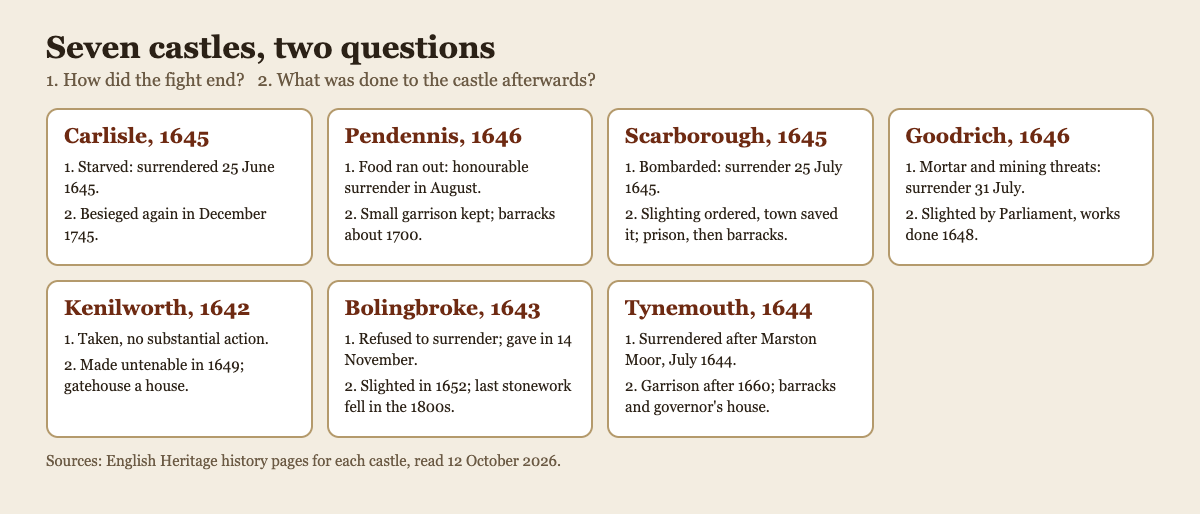
Castles that were starved or shot down
Carlisle. English Heritage's history of Carlisle Castle says the Royalists garrisoned it in 1642, and it was one of the few places in the north to hold out for the king after Marston Moor in July 1644. In October 1644 a Parliamentarian army surrounded it with guns and earthworks and settled down to starve it out. The horses were eaten, then the dogs and rats. After the Royalist defeat at Naseby in June 1645 there seemed no more hope of relief, and on 25 June the city surrendered. Afterwards? English Heritage's page on Carlisle's last siege puts it in December 1745, when the Duke of Cumberland's army besieged the city and castle, and many Jacobite soldiers were then imprisoned in the castle.
Pendennis. English Heritage's history of Pendennis says it was one of the last Royalist strongholds to hold out in 1646. About 1,000 soldiers and their dependents endured a five-month siege and agreed an honourable surrender in August, when their food ran out. Afterwards? There were no major events after 1646, but wars with the Dutch and the French meant a small garrison was kept on and off, and a new guard barracks and gateway were built in about 1700.
Scarborough. On the history page for Scarborough, Sir Hugh Cholmley held the castle for five months in 1645 in what English Heritage calls one of the bloodiest sieges of the Civil War. The great tower's massive walls sheared and half the building collapsed. He ran out of gunpowder, then money and finally food, and surrendered on 25 July 1645. In 1648 the Parliamentary garrison of 100 men under Colonel Boynton declared for the imprisoned king after Parliament had failed to pay them, and the castle was besieged again until December. Afterwards? Instructions were given that the castle should be slighted, but opposition from the town preserved it. From the 1650s it served as a prison, and George Fox, founder of the Quakers, was held there. A barracks block went up in response to the Jacobite Rebellion of 1745 to 1746.
Castles that were broken on purpose
Goodrich. English Heritage's history of Goodrich Castle says a Royalist garrison under Henry Lingen held it from late 1643 or early 1644. On the night of 9 to 10 March 1646 Colonel John Birch raided the stables and burned them. About three months later he came back to force a surrender, and a ferocious siege ended on 31 July 1646 with the Royalists giving up under threats of undermining and a mortar called Roaring Meg. Afterwards? The siege itself reduced the castle to ruin, but enough survived for the attorney Richard Tyler to move back in. For that reason Parliament ordered it slighted, probably by removing the battlements and damaging the main defences, and the works were finished in 1648. The castle was sold to Admiral Thomas Griffin in 1755, and from the 18th century visitors who loved the Picturesque came to see it.
Kenilworth. The history of Kenilworth Castle says the Parliamentarian army took it in August 1642 and it saw no substantial action. In 1649 the new regime was anxious to avoid the cost of maintaining a garrison, so it ordered the castle made "untenable". The north wall of the keep was destroyed and the outer curtain wall breached. Afterwards? Colonel Joseph Hawkesworth bought the castle for a group of Parliamentary soldiers, and its interiors were stripped out and sold. Only Leicester's Gatehouse stayed in use, converted to a house. By the 1660s, Mr Fortescue wrote, the castle was "utterly demolished" apart from some ruins.
Bolingbroke. English Heritage's history of Bolingbroke Castle says it was a defensible base for a Royalist garrison. In early October 1643 a Parliamentarian officer representing the Earl of Manchester ordered it to surrender. The garrison refused, was surrounded and held out until 14 November. Afterwards? The castle was slighted in 1652, nine years after the surrender, and in the early 19th century the last remaining part of the stonework fell down.
A castle that went on working
Tynemouth. The history of Tynemouth Priory and Castle says Newcastle and Tynemouth were among the few important ports the Royalists controlled, and they were crucial in denying coal to Parliament. Tynemouth Castle and the Spanish Battery were heavily fortified, and their guns controlled the river until July 1644, when both places were surrendered after Marston Moor. Afterwards? After the Restoration of Charles II, Tynemouth continued as a military garrison, with new barracks and a house for the governor, Colonel Edward Villiers, built from stone and lead taken from demolished priory buildings.
What the seven castles show
Put the two answers side by side and the pattern is plain. The ending of the fight did not decide the ruin.
- Two castles that fell to hunger had different afterwards: Carlisle was besieged again in 1745 and Pendennis kept a small garrison.
- Two castles that surrendered after a siege were slighted, Goodrich in 1648 and Bolingbroke in 1652.
- A castle with no real fight, Kenilworth, was still made untenable.
- A slighting order could fail: Scarborough's town saved it, and a prison and a barracks followed.
- Soldiers' needs outlasted the war: Tynemouth and Pendennis kept garrisons, and Scarborough became a prison and then a barracks.
Pick any castle and its English Heritage history page, and look for the Civil War paragraph. Then ask: was it besieged, who held it, and when did it surrender? Next look for the verbs of the afterwards: "slighted", "untenable", "garrison", "sold". If a castle has none of those words, it may have been ruined in another way, as the post on slighting a castle explains. If the page names an owner and a date, you can usually tell whether the walls you are looking at were broken by a siege or by an order that came later.
The contrast in Two Towers: a gate that comes back
In Two Towers, a free medieval tower defense game that plays in your browser, nobody slights your castle after a loss. The title screen sets the rule: "Two towers. One gate. Hold it as long as you can." Every stage comes stronger, faster or in greater numbers than the last, and there is no final stage. If the gate falls the game is over, and the game tells you what did it: "The gate fell mostly to" the attacker that did most of the damage. Then you choose "Start again from stage 1".
A real garrison could not do that. Where Goodrich lost its battlements for good, your defences go the other way: every five stages your towers are rebuilt stronger, through ages from Timber to Legendary, and between attacks you can repair or reinforce the gate with gold. Gold in the game is in-game gold, never money.
Frequently asked questions
Were all castles slighted after the Civil War?
No. Goodrich and Bolingbroke were slighted, and Kenilworth was made untenable, but Scarborough's slighting order was stopped by the town, and Tynemouth went on as a military garrison.
Which siege on this list lasted longest?
By English Heritage's dates, Carlisle was surrounded from October 1644 until it surrendered on 25 June 1645. Scarborough in 1645 and Pendennis in 1646 each held out for five months.
Why was Scarborough Castle saved?
English Heritage says instructions were given that the castle should be slighted, but opposition from the town preserved it from destruction.
Get started
Pick a castle near you and run the two questions on its history page. Then try holding a gate that is rebuilt after every loss: Play Two Towers, choose your two towers, and see how many stages you last.
Comments
No comments yet.
Sign in or make an account to comment.