Combo Meter in Games: How Chains and Multipliers Work
You land a kill, then another, then another, and a number in the corner of the screen climbs. That number is a combo meter. A combo meter in games tracks how many actions you chain together without a break, and it often turns that streak into extra points. This guide explains what a combo is, how a chain grows and breaks, how a meter shows it, and how the chain works in Tank City Zero Day, with a worked example in real numbers.
What is a combo meter in games?
Start with the word combo. According to Wikipedia's page on combos), a combo is a set of actions you perform in sequence, usually with strict timing limits, that gives you a real benefit. The word is short for combination.
A combo meter is the part of the screen that counts that sequence for you. Each action that counts adds to it. If you wait too long, the count stops and starts again from zero.
So a combo meter answers two questions at a glance. How long is your streak right now? And how much longer do you have to keep it going?
Where the idea of a combo comes from
The same Wikipedia page says the term comes from fighting games. There, a combo is a timed run of moves that hit one after another.
The idea did not stay there. It has since been used in many kinds of games, including puzzle games, shoot 'em ups and sports games. A shoot 'em up is a game where you shoot large numbers of enemies, often while dodging their shots.
The page also notes that a combo can do different jobs. It can be a core part of how you play. It can raise your score or your attack power. Or it can simply be a way to show off a flashy style.
How a chain grows and breaks
A combo meter can run on three simple rules, and Zero Day's follows all three.
- Each action counts. A hit, a kill or a well-timed press adds one to the chain.
- A timer runs between actions. After each action, a short window opens. If your next action lands inside it, the chain grows.
- Some events end the chain. If the window closes, or something else the game picks happens, the chain drops back to zero.
The timer is what makes a combo tense. You are not only trying to win. You are trying to keep moving while you do it.
That changes how you play. You stop waiting for enemies to come to you. You go to them, because a pause costs you the chain.
Counters and multipliers
A combo meter can reward a streak in two plain ways.
A counter
The simplest meter is just a number: 5, 10, 20. It shows how long your streak ran. It may not change your score at all.
A multiplier
A multiplier turns the streak into points. It starts at x1 and climbs as the chain grows. Each kill is worth its normal points times the current value.
With a multiplier, a fast clear can be worth far more than a slow, careful one, even if you destroy the same enemies. The points come from how you play, not only from what you hit.
How the meter shows on screen
A good combo display tells you two things without making you stop and read.
- How big your chain is. Usually a number or a multiplier such as x4.
- How much time you have left. Often a bar that drains between actions and fills again when you score.
Watch the bar, not only the number. The number tells you what you have. The bar tells you when you need to act to keep it.
The combo chain in Tank City Zero Day
Tank City Reboot is a site with two original tank games that play in your browser. They are inspired by the 8-bit tank classics of the Family Computer. The first game, Tank City Reboot, has no chain. The second game, Tank City Zero Day, is where the combo meter lives.
These rules come from the game's code.
- Each enemy you destroy adds 1 to the chain and resets a 2.5 second window.
- If the window runs out, the chain goes back to 0.
- If you lose your tank, the chain resets too.
- The multiplier is 1, plus one for every 3 kills in the chain, up to 8.
- Each kill scores its points times the multiplier.
In plain steps: kills 1 and 2 score at x1. Kills 3 to 5 score at x2. Kills 6 to 8 score at x3. From the 21st kill on, every kill scores at x8, which is the cap.
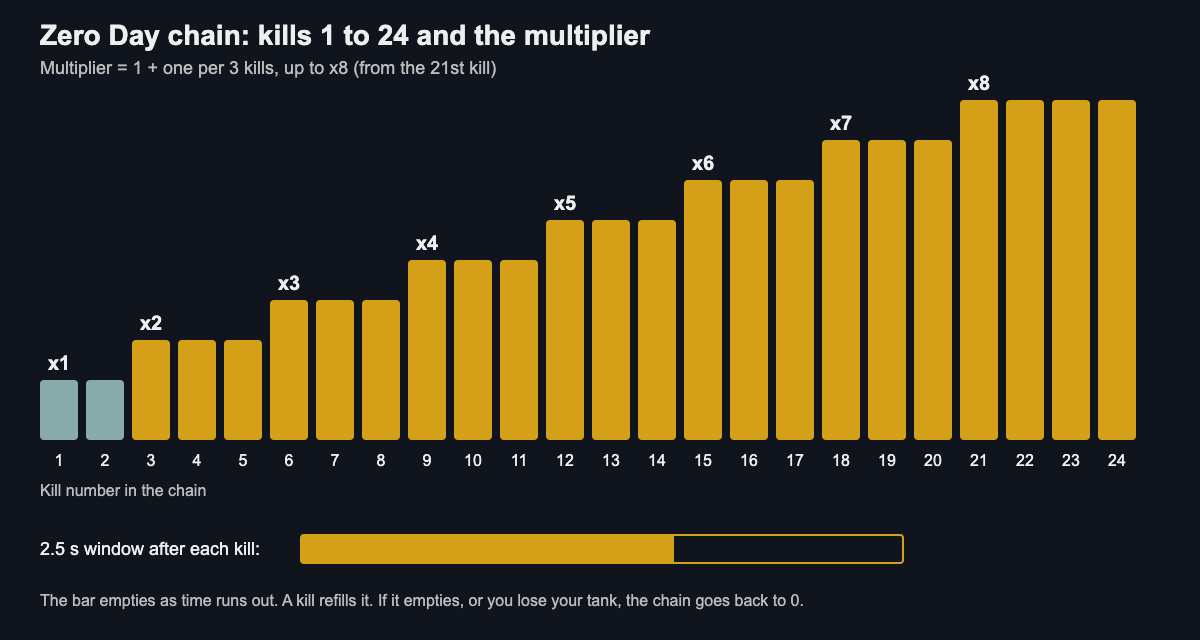
When you score, the number that pops up shows both the points and the multiplier, for example "200 X2". The side panel shows the multiplier from X1 to X8. It turns gold when it is above 1, and a bar under it empties as the window runs out.
A worked example in real numbers
Here are the points each enemy is worth in Zero Day: a botnet drone 50, a worm 100, each worm half 50, ransomware 200, a cryptominer 250 and the boss 2500.
Say you chain six kills, each within 2.5 seconds of the last one.
- A drone, kill 1, at x1: 50 points.
- A drone, kill 2, at x1: 50 points.
- A worm, kill 3, at x2: 200 points.
- A worm half, kill 4, at x2: 100 points.
- A worm half, kill 5, at x2: 100 points.
- Ransomware, kill 6, at x3: 600 points.
That chain scores 1,100 points. The same six kills with no chain would score 500. The streak more than doubled your score.
Now picture the cap. A cryptominer killed at x8 scores 2,000 instead of 250. The boss at x8 would score 20,000 instead of 2500.
The lesson is simple. Small, quick kills build the multiplier. Then the big targets pay out at the higher value. For more on how points add up, read Tank game scoring: points, chains and multipliers.
Frequently asked questions
What does a combo meter do?
It counts how many actions you chain together without a break. It can also raise the points each kill is worth while the chain lasts.
Why does my combo reset?
A chain can end when you wait too long between actions. In Tank City Zero Day, the chain goes back to 0 when the 2.5 second window runs out or when you lose your tank.
What is the highest multiplier in Zero Day?
The highest is x8. You reach it on the 21st kill in a chain, and it stays there while you keep the chain going.
Does the first Tank City game have a combo meter?
No. The first game, Tank City Reboot, has no chain. The combo meter is in Tank City Zero Day.
Get started
The fastest way to understand a combo meter is to chase one. Open Zero Day, take a few quick kills, and watch the multiplier turn gold. Then try to keep the bar from running out.
Comments
No comments yet.
Sign in or make an account to comment.