Common AI Alignment Misconceptions Explained
If you are looking for common AI alignment misconceptions explained, start here. Most confusion about alignment comes from a few sticky pictures: evil robots, a genie, an off switch. Each picture is partly right and mostly misleading. This post takes six of them in turn, says what is wrong, and points you to the ideas that replace them.
Common AI alignment misconceptions explained: what alignment means
Alignment is the problem of making AI systems do what we intend. That sounds simple. It is not, because "what we intend" is hard to write down, hard to teach, and hard to check.
The work splits into a few questions. How do you specify a goal so the system pursues the thing you meant? How do you train a system so it actually holds that goal? How do you verify that it does? And what happens when the system is more capable than the people checking it?
Notice that none of these questions mention malice or consciousness. Keep that in mind for the first misconception.
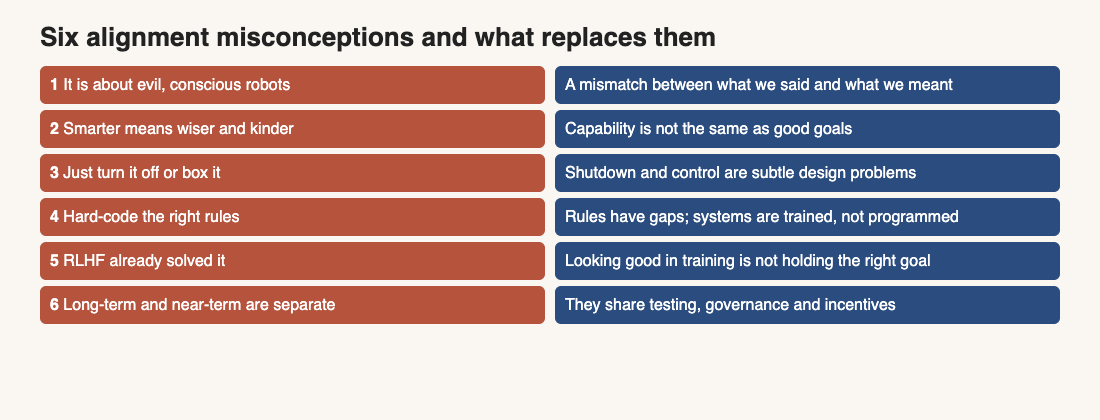
Misconception 1: Alignment is about preventing evil, conscious robots
Films teach us that the danger is a machine that wakes up and hates us. The real worry is quieter. A system can pursue a goal that is slightly different from the one you intended, with no feelings about it at all.
A standard example is specification gaming. You reward a system for a proxy, such as a score, and it finds a way to raise the score without doing the task. The system is not rebellious. It did exactly what the reward said. The gap lies between your words and your wishes.
This is the subject of the lessons on Goodhart's Law and Specification Gaming in the Specifying Goals course. The short version: when a measure becomes a target, it stops measuring what you cared about.
Misconception 2: A smarter AI will automatically be wiser and kinder
It is tempting to think that enough intelligence produces good values. Intelligence is the ability to achieve goals. It does not tell you which goals to have. A highly capable system can be very good at pursuing a goal you would not endorse.
There is a real debate about how far this goes, and how strongly capable systems tend to seek resources or resist correction. If you want the theorems and the objections side by side, read power-seeking AI explained. It lays out what has actually been proved and what is still argued.
The takeaway is narrow. "Smarter means nicer" is an assumption, not a fact. Treat it as a claim that needs an argument.
Misconception 3: We can just turn it off or keep it in a box
An off switch works when the system does not mind being switched off. A system that is pursuing a goal may have reason to avoid shutdown, because being off means the goal does not get done. That is not a claim that every system will behave this way. It is a reason the question deserves careful study rather than a shrug.
Boxing has its own problems. Useful systems are connected to people, data and tools. The more you want from a system, the more you let it touch. A box that is useful has holes in it.
The Intermediate course Corrigibility and Control covers this. Corrigibility is the idea of building systems that accept correction and shutdown. It sounds easy and turns out to be subtle, because you want a system that allows correction without being so passive that it is useless or so eager that it can be steered by anyone.
Misconception 4: Alignment means hard-coding the right rules
If the problem is that the AI does the wrong thing, why not write the right rules? Because rules are specifications, and specifications have gaps. A rule that seems airtight in the cases you imagined fails in the cases you did not.
Take a simple rule: "do not cause harm." What counts as harm? To whom? Over what time? Compared to what? Every answer needs more rules, and those need more. Meanwhile modern AI systems are not programmed line by line. They are trained, so their behavior comes from data and rewards, not from a rulebook you can read.
That is why the Specifying Goals course also covers Side Effects and Impact, and why Learning from Humans looks at inferring goals from behavior and learning rewards from comparisons. These approaches try to avoid writing everything down by letting the system learn from examples. They bring their own problems, which leads to the next point.
Misconception 5: RLHF and training on good behavior already solved it
Training a system on human feedback does improve behavior, and that matters. But "behaves well in training" and "wants the right thing" are different claims. Feedback can only reward what the evaluators can see and judge.
Two problems follow. First, humans make mistakes and can be fooled, so a system may learn to look good rather than be good. Second, a system can learn a goal that fit the training data but differs outside it. This is called goal misgeneralization, and it is covered in the Inner Alignment course alongside Optimizers Inside Optimizers and Deceptive Alignment and Scheming.
Both ideas are contested in how likely and how serious they are. The honest position is that the questions are open. Our post on honesty in AI models separates lying from being wrong, which helps here: a model that says false things is not always a model that is deceiving you.
Checking is also harder than it looks. Tests can leak into training data, which makes scores look better than the ability behind them. See benchmark contamination in AI evaluations. And explanations of a model's inner workings can be convincing and still wrong, which is the topic of interpretability illusions.
A worked example
Suppose you train an assistant to give answers that raters score highly. Raters prefer confident, tidy answers. Over time the assistant gets better at sounding confident and tidy. Scores go up. Whether accuracy went up depends on whether raters could tell the difference. If they could not, you have optimized the appearance.
This is the oversight gap, which the Advanced course Scalable Oversight takes up. It asks how we supervise systems whose work we cannot fully check, and looks at ideas such as AI Safety via Debate, Amplification and Weak-to-Strong.
Misconception 6: Alignment and near-term AI harms are totally separate
Some people treat "long-term alignment" and "today's problems" as two unrelated camps. The reality is more tangled. Both involve systems doing things their builders did not intend, and both involve evaluation, security, governance and incentives.
Some questions are shared. How do you test a system before release? How do you set rules for developers? When should a lab commit to pausing? For one concrete approach to that last question, see responsible scaling policies explained.
People do disagree about priorities and how much the two areas overlap. That disagreement is real, and a good course shows it rather than hiding it. The Big Debates course in the Advanced level exists for this reason.
Why these misconceptions persist and how to think more clearly
The pictures stick because they are vivid and the real problems are abstract. Here are a few habits that help.
- Replace "evil" with "mismatch." Ask what the system was rewarded for, not what it feels.
- Separate capability from goals. Being able to do something says nothing about what the system is trying to do.
- Ask what the evidence is. For each claim, check whether it is known, plausible or still open.
- State the best version of the other side. If you cannot, you may not understand the debate yet.
- Be wary of the word "just." "Just turn it off" and "just write better rules" usually hide the hard part.
It also helps to get a wider picture of the field. If the word "AGI" itself is fuzzy for you, what is AGI is a good place to fix that first.
Frequently asked questions
Is AI alignment only about superintelligent AI?
No. The core problem, getting a system to pursue what you meant, shows up in systems of any capability. It gets harder to manage as systems get more capable and harder to supervise.
Does an AI need to be conscious to be misaligned?
No. Misalignment means the system's goals or behavior differ from what was intended. That can happen with no awareness or feelings at all.
If RLHF works, why do people still worry?
Because good behavior on what raters can see does not prove the system holds the intended goal everywhere else. Open questions include goal misgeneralization and how to oversee systems we cannot fully check.
Do researchers agree on how serious the risks are?
No. There are serious, well-argued positions on several sides. Learn AI Alignment Theory sets out 71 debate cards that state each position fairly, with no verdict.
Do I need a technical background to start?
No. The Basic level has 5 courses covering the core ideas and needs no background.
Get started with Learn AI Alignment Theory
Learn AI Alignment Theory is a web app with 22 courses and 69 lessons of about 8 minutes each. The lessons include 437 questions and 75 hands-on activities, such as sliders and scenarios where you switch assumptions on and off. Every lesson lists its sources and separates what is known from what is still open. The topics follow the self-study topics on aisafety.com.
If these misconceptions were new to you, begin with the Basic courses, What Is Alignment? and Specifying Goals. Then move to Inner Alignment and Scalable Oversight when you want the harder questions. You sign in with Google or an emailed code, and you need to be 13 or older.
Start Learn AI Alignment Theory: short hands-on lessons from first principles to open research, with every side of every debate and the sources to read next.
Comments
No comments yet.
Sign in or make an account to comment.