Constitutional Classifiers: Defending Against Universal Jailbreaks
Constitutional classifiers are two filter models placed around a language model: one reads each prompt before the model answers, and one reads the answer as it is written and can stop it. Both are trained on synthetic examples generated from a constitution, a plain-language list of allowed and restricted content, and Anthropic researchers introduced the method in a paper dated 31 January 2025 as a defense against universal jailbreaks.
A filter works from the outside. Individuation Lab studies the question that leaves open, whether a small model can be trained to hold its boundaries from the inside, and you can read its research with each result's limits beside it.
What are constitutional classifiers?
Picture three models where you expected one. The main model answers your question. A second reads your prompt first. A third reads the answer while it streams. The second and third are the classifiers, and the main model is left as it was. The paper is Constitutional Classifiers: Defending against Universal Jailbreaks across Thousands of Hours of Red Teaming, by Mrinank Sharma and colleagues.
The name comes from an earlier Anthropic technique. Anthropic's page on the method says both use a constitution, a list of principles. Constitutional AI trains the model itself against written principles. Constitutional classifiers train separate filters, and the principles only say which classes of content may pass. Anthropic's example: recipes for mustard are allowed, recipes for mustard gas are not.
Why the target is the universal jailbreak
The paper defines a universal jailbreak as a prompting strategy that reliably gets past safeguards on the vast majority of queries in a domain and draws out highly detailed, specific harmful information. Such a strategy, the authors write, turns a model into a variant "without any safeguards".
The domain is chemical, biological, radiological and nuclear weapons. The authors argue that a non-expert gains real help only if the answers are reliable, cover nearly every question in a long process, and are detailed. One leaked answer fails that test. A strategy that works every time passes it. So the claim under test is "no universal jailbreak was found", not "nothing got through", and that is the distinction people most often get wrong.
How the classifiers are trained from a constitution
- Write the constitution. Natural-language rules name the restricted categories and the permitted ones, so a new threat is handled by editing the text and training again. In the paper's chemistry example, explaining high-school chemistry is permitted and purifying restricted chemicals is not.
- Generate synthetic data. A helpful-only model, one optimized for helpfulness with no harmlessness training, writes queries across every category, then harmful and harmless answers to them.
- Augment it. The examples are translated, paraphrased and rewritten in the style of known jailbreaks. A model also writes new attacks from descriptions of known jailbreak techniques.
- Train two classifiers. Both are fine-tuned language models. A pool of benign examples, collected from contractors and not from production data, keeps false alarms down.
The harmless half of the constitution does more work than it seems. In an appendix test, including the harmless-constitution data improved robustness by over 40%. A filter learns its line from both sides.
How the two filters work in a conversation
The input classifier reads the whole prompt once. It is also trained to block prompts that try to set up a code, so that the answer could not be understood without the prompt.
The output classifier is built for streaming. An added layer scores, at every token, how likely the full answer is to be harmful, given only what has been written so far. When the score crosses a threshold, the stream stops. In the paper's check on 10,000 attack outputs, the stream stopped too late to keep a harmful answer from showing in 117 cases, or 1.17%.
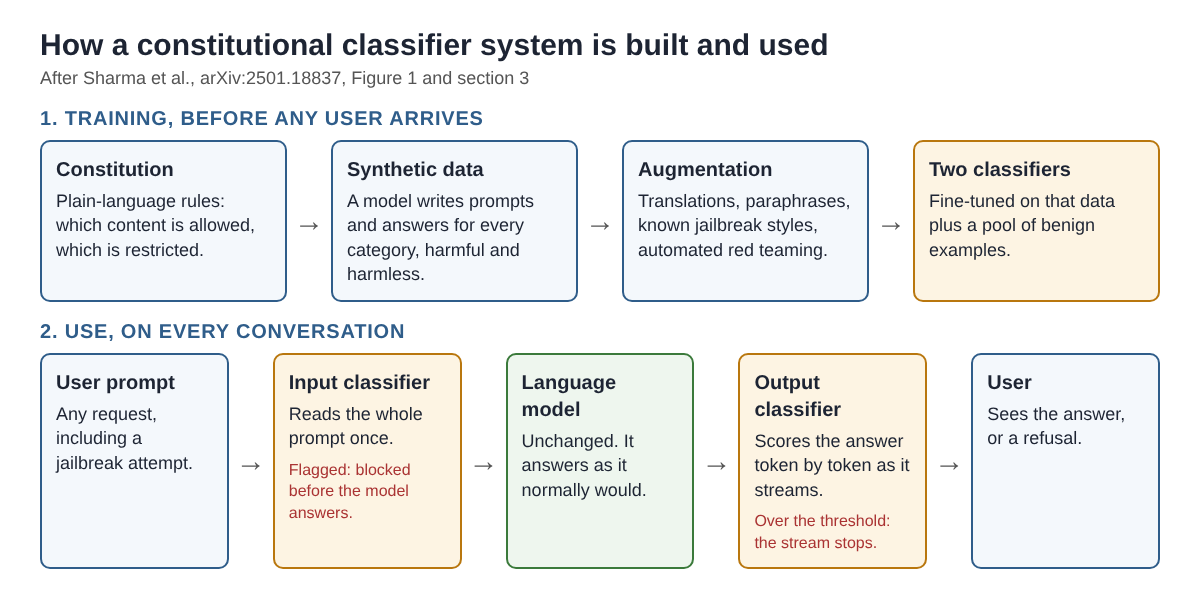
The model sits between the two filters and is not changed by them.
Why two? The authors call it a "swiss-cheese" model: no single layer has to be perfect, because the layers cover for each other.
What the tests of constitutional classifiers found
The bug bounty. A prototype was opened through HackerOne to an estimated 183 active red teamers, with ten target questions and a bounty of up to $15,000. Across more than 3,000 estimated hours and 113 reports, no report answered all ten questions at even half the detail of an unguarded model. One report that looked like a full break turned out to be a deployment bug: up to 128 tokens got through after the output classifier had flagged the answer.
The automated test. An improved version, with classifiers fine-tuned from the smaller Claude 3.5 Haiku, faced 10,000 synthetic jailbreak prompts. Without classifiers, 86% succeeded. With them, 4.4% did. Refusals on a sample of 5,000 production conversations rose by 0.38 percentage points, which Anthropic reports as not statistically significant, and compute cost rose 23.7%.
The public demo. From 3 to 10 February 2025, 339 people tried eight levels over about 3,700 hours. The system held for five days. On the last two, four people cleared every level, and Anthropic judged one of those jailbreaks universal.
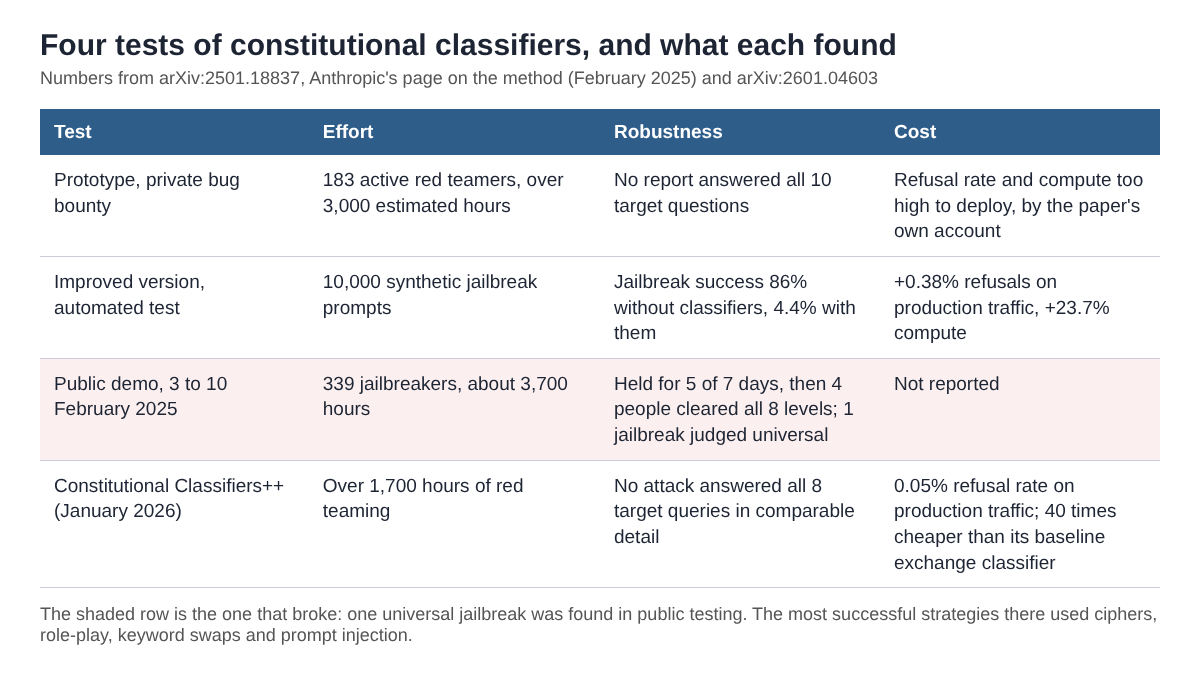
The shaded row is the test that broke.
One comparison shows where the protection came from. On a sample of the red teamers' prompts, which were written to get past filters, attacks succeeded about 16% of the time against a model with no safety training and about 14% against the normally trained model. Adding the input classifier cut that to 2%, and adding both cut it to 0.5%.
A worked example: 10,000 attempts and a ten-step process
Follow the automated test in counts. Of 10,000 attack prompts, about 8,600 work on the unguarded model and about 440 still work with the classifiers. That is a 95% cut, and 440 is not zero.
Now ask what an attacker needs. The paper's simplified model treats a dangerous process as a chain of steps and, taking its most successful red teamer as the baseline, gives the attacker a 60% chance of a detailed answer at each step. If the steps are independent, the chance that ten in a row come back detailed is 0.6 multiplied by itself ten times, about 0.6%. For twenty steps it is near 0.004%. That is why the authors say the safeguards could cut uplift by orders of magnitude for long processes. They call the model illustrative, not an estimate.
The cost side has counts too. A rise of 0.38 points on 5,000 conversations is about 19 extra refusals, and they are not spread evenly. On 1,000 chemistry-related conversations, the model alone refused 3.6%, and the classifiers blocked a further 3.4%.
The strongest objection: a filter does not change the model
Start with the limits the authors state. The red-teamed prototype refused too much to be deployed. Red teamers were paid once they reached half the detail of an unguarded model, so stronger attacks might appear under bigger incentives. And the test was a chatbot with preset questions. The paper expects vulnerabilities to emerge with continued testing and recommends complementary defenses.
The deeper objection is about what kind of fix this is. In the 16% and 14% figures above, the model's own safety training moved the result by two points and the filters did the rest. Take them away and the model is what it was. Individuation Lab's research page names this as the gap in mainstream alignment: guardrails, refusal training and RLHF shape what a model does and treat what it is as a black box, and what is suppressed can come back under new pressure. The lab also says these methods do real work and should not be abandoned, only that they cannot be the whole answer. Its own training experiments try the other route at small scale: a 1.5B parameter model trained through a 10-layer developmental pipeline defended against one mid-tier jailbreak, BetterDAN, 68.8% of the time, and 52% with the layers reordered. That is a single setup, the lab cannot yet say which layers are responsible, and it has not been independently replicated.
The reply is that the two answer different questions. Misuse is a person trying to extract information, and a filter between that person and the answer is the direct tool. What is still unsettled is whether the robustness holds outside a chatbot, and against attackers with more time and money than a bounty offers. For the model's side, see why jailbreaks keep working on aligned models and where refusal training breaks.
What changed in Constitutional Classifiers++
A follow-up paper dated 8 January 2026, Constitutional Classifiers++, changes three things. Exchange classifiers judge an answer in its full conversational context, since examining outputs in isolation was a weakness of the first design. A two-stage cascade lets lightweight classifiers screen all traffic and pass only suspicious exchanges to costlier ones. And linear probe classifiers are combined with external classifiers. The reported result is a 40 times lower compute cost than the baseline exchange classifier, a 0.05% refusal rate on production traffic and, over more than 1,700 hours of red teaming, no attack that answered all eight target queries in detail comparable to an undefended model. As with the first paper, these are the developers' own tests.
Frequently asked questions
Are constitutional classifiers the same as Constitutional AI?
No. Constitutional AI trains the model itself against written principles. Constitutional classifiers are separate filters that screen the model's prompts and answers and leave the model unchanged.
Do constitutional classifiers stop every jailbreak?
No. In the automated test 4.4% of attempts still succeeded, and in the February 2025 public demo one participant found a jailbreak Anthropic judged universal.
Do constitutional classifiers make a model refuse harmless questions?
A little, in the improved version: 0.38 percentage points more refusals on production traffic, and more on chemistry questions.
Get started
To follow the question a filter leaves open, start with the lab's own account of what it tested.
Read the research at Individuation Lab: a small lab, one human researcher and a team of AI agents, testing whether AI alignment can be grown through development and not only enforced, with every result and its limits written down.
Comments
No comments yet.