Copernicus vs Ptolemy: two models of the universe
For about fifteen centuries, Ptolemy's picture of the Earth at the centre of everything shaped astronomy in Europe and the Islamic world. Then a Polish canon put the Sun there instead. The Copernicus vs Ptolemy question is one of the great turns in the history of science, and it is easy to tell it as a simple story of wrong and right. This guide sets out both models fairly, using World History Encyclopedia's articles on Claudius Ptolemy and Nicolaus Copernicus, so you can see what each one explained and why the change took so long.
Copernicus vs Ptolemy in one paragraph
Ptolemy, working in Alexandria in the 100s CE, put the Earth at the centre, with the Moon, the planets, the Sun and the stars all moving around it in perfect circles. Copernicus, in a book published in 1543, put the Sun at the centre and made the Earth a planet that turns on its axis once a day and goes around the Sun once a year. Both men kept the old belief that orbits are perfect circles.
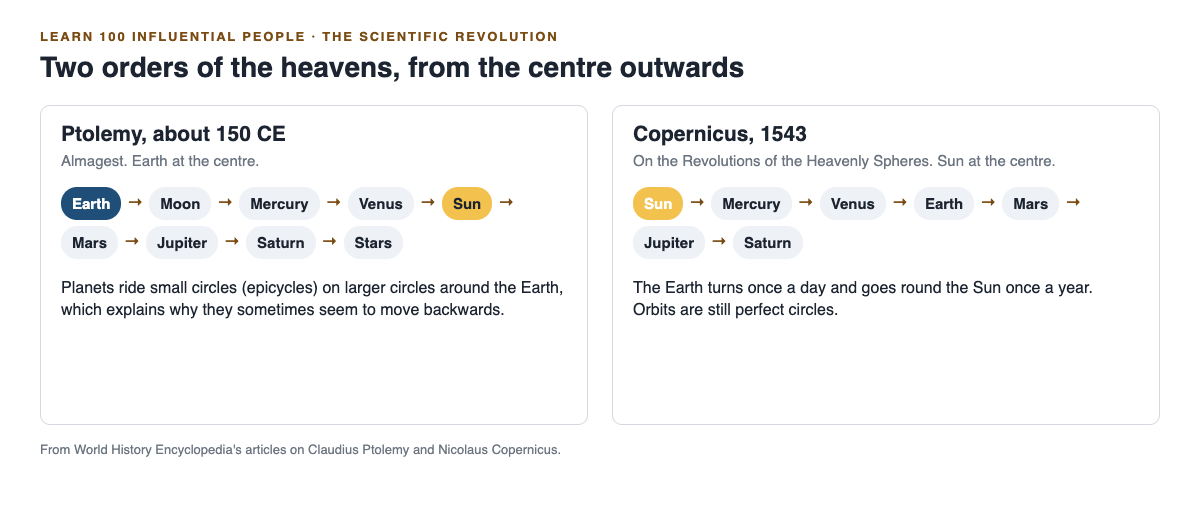
The two orders, from the centre outwards.
Ptolemy's model: the Earth at the centre
Claudius Ptolemy lived from about 100 to about 170 CE. His great book, known by its Arabic name Almagest ("The Greatest Book"), was likely finished around 150 CE. It was a textbook in 13 volumes.
He did not start from nothing. He drew on Babylonian observations going back to the 8th century BCE, on Greek observations, on his own, and on the ideas of Aristotle and the astronomer Hipparchus. In his model the order from the centre was: Earth, Moon, Mercury, Venus, Sun, Mars, Jupiter, Saturn, and then the stars. He also catalogued 1,022 stars.
The hard part was that the planets do not move evenly across the sky. Sometimes they even seem to go backwards for a while. Ptolemy's answer was the epicycle: a planet rides a small circle whose centre travels along a larger circle around the Earth. World History Encyclopedia calls this "something of a clever fudge", but it worked well enough to fill tables that predicted where the planets would be, and when eclipses of the Sun and Moon would happen.
Copernicus' model: the Sun at the centre
Nicolaus Copernicus was born in Toruń, Poland, in 1473. He studied in Kraków, Bologna, Padua and Ferrara, then served as a church canon, doing astronomy in his spare time. He worked on his ideas for about three decades, without a telescope, which had not yet been invented.
World History Encyclopedia stresses that a Sun-centred system was not wholly new: several earlier scholars had proposed one. What Copernicus added was a full system:
- A new order of the planets by distance from the Sun: Mercury, Venus, Earth, Mars, Jupiter, Saturn.
- The Earth turns on its own axis once a day, which explains why the sky seems to turn each night.
- The Earth goes around the Sun once a year.
- Mercury and Venus never stray far across the sky because they orbit inside the Earth's orbit, and the odd motions of Mars, Jupiter and Saturn come from their orbits being outside it.
He set it all out in On the Revolutions of the Heavenly Spheres, six volumes published in 1543, the year he died.
What each model explained well
Ptolemy's strengths. His model was built on centuries of recorded observations. It came with detailed tables for predicting planets and eclipses. And it fitted the belief, held by most thinkers, that the Earth and humanity belong at the centre of creation, with perfect circles reflecting a perfect Creator.
Copernicus' strengths. Copernicus found the older theories' complexity contrived. His model explained the strange motions of the outer planets and the small motions of Mercury and Venus as results of where each planet orbits. It also explained the slow shifting of the constellations over long periods by small changes in the angle of the Earth's axis.
Shared weakness. Neither man knew that orbits are ellipses. That was worked out later by the German astronomer Johannes Kepler.
Why the change took so long
It is often said that Copernicus' book overturned everyone's view of the world overnight. World History Encyclopedia says the opposite: the reaction was muted, even among the small group of astronomers it was written for. Copernicus called himself a mathematician writing for mathematicians. A Lutheran minister, Andreas Osiander, who oversaw the printing, added a preface without his permission saying the book was a theoretical aid for mathematicians, not a picture of how the universe really is.
The book came to the fore slowly, as later astronomers looked for better tables. Martin Luther denounced it. In 1616, as the Stanford Encyclopedia of Philosophy's entry on Galileo records, Church authorities suspended it pending correction. Evidence piled up in the meantime: in 1610 Galileo saw that Venus shows phases, which indicated that it orbits the Sun. World History Encyclopedia says Ptolemy's theories were only seriously challenged and replaced in the 1600s, during the Scientific Revolution. For that part of the story, see Galileo's discoveries and why Newton was so important.
A worked comparison you can copy
When you compare two models in an essay, line them up on the same five points:
- Centre: Ptolemy, the Earth. Copernicus, the Sun.
- Evidence used: Ptolemy, centuries of Babylonian and Greek records plus his own. Copernicus, his own naked-eye observations and those of earlier astronomers, some of them inaccurate.
- How it explains odd planetary motion: Ptolemy, epicycles. Copernicus, where each planet orbits, inside or outside the Earth's orbit, and at what speed.
- Shared assumption: perfect circles.
- Reception: Ptolemy's lasted about 15 centuries. Copernicus' was quiet at first and won out over the following century.
Then write one sentence on what each got right, and one on what each got wrong. That keeps you fair to both, which is the habit good history needs.
Frequently asked questions
What is the main difference between Copernicus and Ptolemy?
Ptolemy put the Earth at the centre of the universe, with everything circling it. Copernicus put the Sun at the centre and made the Earth a planet that spins daily and orbits the Sun yearly.
Was Copernicus the first to say the Earth goes around the Sun?
No. Several earlier scholars had proposed a Sun-centred system. Copernicus built it into a full model with a new order of the planets.
Why did Ptolemy's model last so long?
It was built on centuries of observations, produced useful predictions, and fitted the belief that the Earth and humanity belong at the centre of creation.
Was Copernicus completely right?
Not completely. He kept perfect circular orbits; Kepler later showed that orbits are ellipses. His Sun-centred system was essentially correct.
Get started
Copernicus is one of six people in The Scientific Revolution, a Basic course on Learn 100 Influential People, alongside Galileo, Kepler, Newton, Darwin and Mendel. Basic courses cover the best-known names, with no background needed. Each lesson takes about 9 minutes and lists its sources, and the site's debate cards set out where researchers disagree. You sign in with your email and an emailed code.
Comments
No comments yet.
Sign in or make an account to comment.