Countermeasure meaning: what it is and how to pick one
Countermeasure meaning in plain words
Here is the countermeasure meaning in short: a countermeasure is an action you choose to deal with the cause of a specific problem, so the problem stops, shrinks or does not come back. It is aimed at a cause, not at a feeling about the problem.
The idea comes from lean problem solving, but it fits everyday life too. A late invoice, a slow laptop, a bad run of nights: each can have a countermeasure. The key is that you pick the action because of what you know, or guess, about the cause. You do not pick it because it sounds sensible.
The Lean Enterprise Institute's page on problem solving puts it this way: a plan is a theory of both what will address the problem's cause and what it will take to implement a countermeasure to that cause. That is a useful way to think. A countermeasure is a theory you test, not a promise.
It also makes a countermeasure different from a vague plan like "do better". A countermeasure is concrete. It says who does what, and what should change as a result.
Countermeasure vs solution vs corrective action
These words overlap, and people use them loosely. Here is a plain way to tell them apart. It is a working tool, not a formal standard.
- Solution is the broad word. Any idea that might fix a problem is a solution, including ones you have not tried.
- Countermeasure is a solution you have matched to a cause and chosen to try.
- Corrective action is what you have done once the cause has been dealt with.
The Lean Enterprise Institute's A3 report page lists "countermeasures tried" and "corrective actions taken" as separate parts of the report, next to the facts gathered, the hypotheses considered and the experiment results. So the words are kept apart there too.
The practical difference is the word "chosen". A pile of ideas is not a set of countermeasures. A countermeasure is what is left after you ask what is causing the problem and which idea fits that cause.
Why you need the cause first
A countermeasure that ignores the cause is a guess. Sometimes the guess works. But when it does not, you learn little, because you never said why you expected it to work.
Take a simple case: your household keeps running out of milk. You could buy two cartons every time. But if the real cause is that nobody checks what is low, the extra carton does not touch it. The countermeasure has to match the cause.
A quick way to find the cause is to ask "why" until the answer is something you can act on. Stop when you reach a cause you can change.
- Why did we run out of milk? Nobody noticed it was low.
- Why did nobody notice? Nobody looks at what is left before shopping.
- Why not? There is no list of what to check.
Now you have something to work with. You can stop at the third answer because it is within your control. The 5 whys example walks through the same chain on a personal problem.
Three jobs a countermeasure can do
Not every countermeasure does the same job. Here is one simple way to sort them: contain, correct and prevent.
Contain
A containment countermeasure limits the damage right now. It does not fix the cause. A bucket under a leaking roof is containment. So is calling a client to warn them a delivery is late.
Correct
A corrective countermeasure removes the cause you found. Repairing the roof is correction. Changing the step in your process that produced the late delivery is correction.
Prevent
A preventive countermeasure stops the same kind of problem from appearing elsewhere. If one roof leaked because of a bad seal, you check the seals on the other roofs. The post on yokoten is about this step.
Most real problems need more than one kind. Contain first so things stop getting worse. Then correct the cause. Then prevent the repeat.
How to pick a countermeasure: a step-by-step method
Use this method when you have a problem and several possible fixes.
- Write the problem in one line. Be specific. "Invoices go out late" is better than "money stress".
- Name the likely cause. Use the "why" chain above. If you are unsure, write down your best guess and mark it as a guess.
- List several candidate actions. Do not stop at the first idea. Aim for at least three.
- Check each against the cause. Ask: if this action works perfectly, does it remove the cause or only hide it?
- Check cost and effort. Prefer the smallest action that addresses the cause. You can always try a bigger one next.
- Look for what others tried. Someone may already have faced a similar problem, and their failures can tell you what to skip.
- Pick one and define the test. Decide in advance what result would count as success.
Step six is where a shared record helps. In Problem Graph, you can see similar problems other people have shared, in any lane, and which of their solutions worked. You can borrow one into your own graph with one tap, and it keeps a link back to where it came from. You can also ask for suggestions: the AI proposes new solutions grounded in what worked for others on problems like yours. Treat these as proposals to test, not as answers that are already right.
A worked example: late invoices
This example is invented, to show the method. Problem: invoices go out nine days after the job ends. Guessed cause: you only invoice when you remember. Three candidate countermeasures: send the invoice from your phone on site, ask a colleague to remind you, or set a weekly invoicing hour.
All three are worth trying. The method says to try them one at a time, so the result tells you which one helped. In this invented example, the phone on site was tried first and worked on days with signal, so it is partly. The colleague's reminder came second and failed, because you still did not invoice when reminded. The weekly hour on Friday came third and worked: the next three invoices went out within two days.
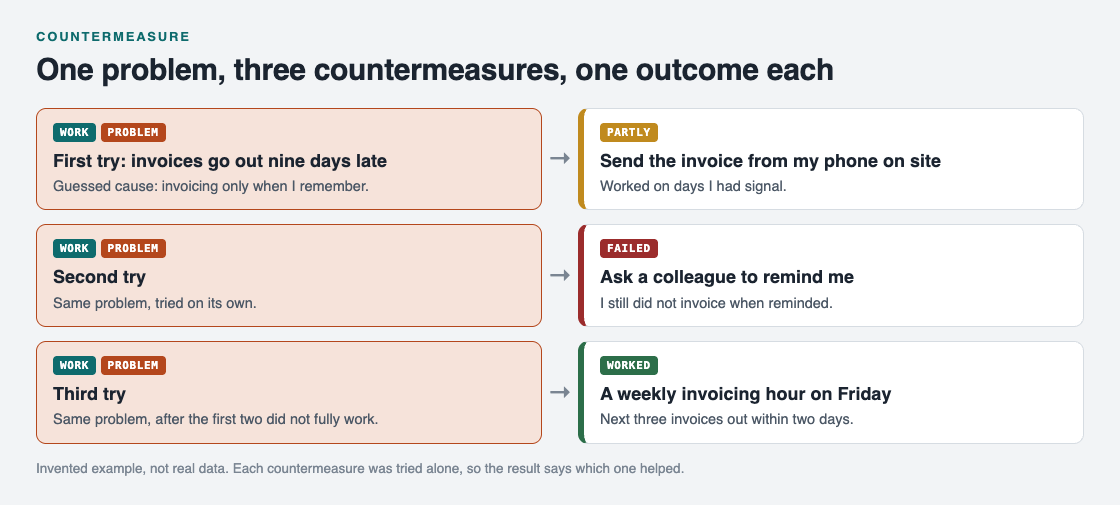
The weekly hour matches the guessed cause best, since it replaces memory with a fixed slot. In the three-job sort above, it is a corrective countermeasure. A phone call to the client about the invoice that is already late is containment. Both belong on the list.
The failed reminder is as useful as the one that worked. It tells you that the cause is not simply forgetting that invoices exist, and it saves you from trying the same thing again in six months.
Two shorter examples
Tired mornings. Problem: you wake up tired. A guess at the cause, to test: screens late at night. Candidate actions: a phone charger outside the bedroom, a screen cutoff time, or a later wake time. The charger outside the room removes the temptation, so it fits the guess. This is a journal example, not medical advice. If poor sleep persists, ask a doctor.
A language exchange. Problem: you and your exchange partner keep forgetting what to practise next. Guessed cause: there is no single list. The countermeasure is one list that one of you keeps and shares, while the other reads it. The post on language exchange problems covers this in more detail.
How to test a countermeasure and know it worked
A countermeasure is only useful if you can tell whether it worked. Decide three things before you start.
- The measure. What will you look at? Days to send an invoice, hours slept, cartons of milk left on shopping day.
- The window. How long will you try it? Pick it up front, such as two weeks.
- The verdict. Will you call it worked, partly worked, or failed?
Change one thing at a time. If you add a charger, a cutoff time and a new mattress together, you will not know which one helped. The post on one change at a time shows how.
Record failures, too. Problem Graph uses three outcomes for a solution you try: worked, partly, or failed. It keeps a failed solution on the map as a failed solution, which is useful to the next person who looks at that problem.
A failure also invites a second look at your cause. If three reasonable countermeasures fail, your guessed cause may be wrong. Go back to the "why" chain.
Frequently asked questions
What is the meaning of countermeasure?
A countermeasure is an action chosen to stop, reduce or prevent a specific problem. It is chosen because of the cause you found or guessed, not just because it seems like a good idea.
Is a countermeasure the same as a solution?
Not exactly. A solution is any idea that might fix a problem. A countermeasure is a solution you have matched to a cause and picked to test.
What are the types of countermeasures?
One simple sort has three jobs. Containment limits the damage now. Correction removes the cause. Prevention stops the same kind of problem from appearing elsewhere.
How do I know if a countermeasure worked?
Set a measure and a time window before you start, then compare the result. Mark it as worked, partly or failed, and keep the record either way.
Get started
Problem Graph is a journal that draws itself as a map. You write a problem in one line, put it in a lane (personal, work, expert or scientific), and attach the solutions you try. Then you record what happened: worked, partly or failed. You can link related problems, even across lanes, so patterns show up that a plain list would hide.
Your problems are private by default. If you want input, you can mark a main node and share it into a private network, or put it out for everyone. It works in your phone's browser, it is free, and you can look around the public network without an account. Write one problem down in a line and attach the first countermeasure you will try.
Comments
No comments yet.
Sign in or make an account to comment.